
Not long ago, the phrase 'digital transformation' belonged almost exclusively to the vocabulary of CTOs and IT architects. Today, it sits at the top of nearly every board agenda — and the professionals leading those conversations aren't always the ones who wrote the first line of code.
If you've spent years in marketing, finance, operations, HR, or consulting — and you're watching technology reshape every industry around you — the question isn't whether digital transformation is relevant to your career. It's whether you're building the credentials to lead it rather than just react to it.
This guide maps out a practical certification roadmap designed specifically for non-IT professionals who want to pivot toward digital transformation consulting, strategy, or leadership roles. We'll cover the right sequence of courses, the skills that actually matter, and how to position yourself credibly — without pretending you need to become a software engineer.
Table of Contents
- Why Non-IT Professionals Are Increasingly Leading Digital Transformation
- Key Insight
- The 4-Stage Certification Roadmap
- Stage 1 — Build Your Digital Foundations
- Stage 2 — Digital Transformation & AI Strategy
- Stage 3 — Earning a Credible Digital Transformation Certificate
- Stage 4 — Executive Leadership Programme
- Core Skills the Roadmap Develops
- How to Choose the Right Digital Transformation Course Online
- Building Your Consulting Positioning: Beyond the Certificate
- Common Mistakes Non-IT Professionals Make on This Journey
- Ready to Start Your Roadmap?
- Frequently Asked Questions
Why Non-IT Professionals Are Increasingly Leading Digital Transformation
Here's a counterintuitive truth the consulting world has quietly accepted: the biggest obstacles to digital transformation are rarely technical. They're organizational. They're about culture, change resistance, misaligned incentives, and the gap between what technology can do and what a business actually needs.
That's where professionals with domain expertise — people who understand business processes, customer behaviour, and organizational dynamics — have a structural advantage. They don't need to build the technology. They need to frame the problem, align stakeholders, select the right solutions, and manage the transition.
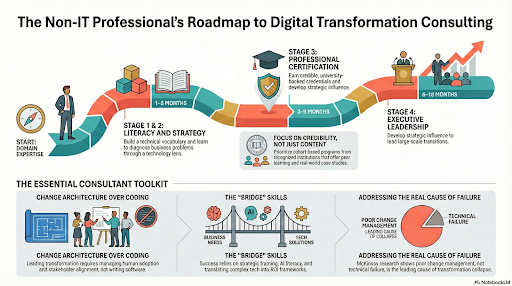
McKinsey research consistently shows that the leading causes of failed transformation programmes are poor change management and lack of leadership alignment — not technical failure. Which means the skills most in-demand aren't coding skills. They're judgment, communication, and structured thinking applied to a technology-driven context.
💡 Key Insight
Digital transformation & AI literacy is now a leadership competency, not just a technical one. Boards, investors, and clients expect business leaders to speak fluently about technology strategy — even if they never write a line of code.
The 4-Stage Certification Roadmap
Think of this roadmap as a career progression rather than a checklist. Each stage builds on the last, and the goal isn't to collect certificates — it's to develop genuine capability that shows up in how you think, communicate, and lead.
| Stage | Focus Area | Target Outcome | Typical Duration |
|---|---|---|---|
| Stage 1 | Digital Foundations | Shared language with technical teams | 4–8 weeks |
| Stage 2 | Digital Transformation & AI Strategy | Apply frameworks to real business problems | 8–16 weeks |
| Stage 3 | Digital Transformation Certificate | Demonstrated, assessable competency | 3–6 months |
| Stage 4 | Executive Leadership Programme | Strategic influence & consulting positioning | 6–12 months |
Stage 1 — Build Your Digital Foundations (Weeks 1–8)
Before you invest in a formal digital transformation certificate, you need a working vocabulary. This isn't about becoming technical — it's about being literate enough that you can have meaningful conversations with technologists, evaluate vendor claims critically, and spot where AI is a genuine solution versus a sales pitch.
At this stage, focus on understanding core concepts: cloud computing, data infrastructure, APIs, machine learning basics, and the economics of platforms. You don't need deep expertise — you need enough clarity to ask the right questions.
Recommended learning at this stage includes introductory programmes from Google (Google Digital Garage), MIT OpenCourseWare's business technology modules, or platforms like Coursera and edX that offer structured foundations in business technology and AI literacy.
Stage 2 — Digital Transformation & AI Strategy (Months 2–5)
This is where most professionals should invest the most time. Digital transformation and AI, when studied together, give you an integrated view of how modern organizations are being restructured — not just digitized.
What you're learning here isn't a set of tools. It's a way of diagnosing business problems through a technology lens: understanding where automation creates leverage, where AI creates new decision-making capabilities, and how to build a transformation roadmap that a CFO will fund and an operations team will actually follow.
Look for programmes that include real case studies, industry-specific applications, and exposure to change management frameworks alongside the technology content. The best digital transformation courses online at this level blend business strategy with hands-on application — not just theory.
- Key topics to cover: AI strategy and governance, platform business models, data-driven decision making
- Key topics to cover: Customer journey redesign, agile methodology for non-developers
- Key topics to cover: Digital operating model design, ROI frameworks for technology investment
- Key topics to cover: Organizational change management during technology transitions
Stage 3 — Earning a Credible Digital Transformation Certificate (Months 4–9)
A certificate matters most when it signals to a client, employer, or board that your knowledge has been assessed against a standard. Not every programme delivers this — many online courses issue completion certificates that carry limited professional weight.
When evaluating a digital transformation certificate programme, look for three things: institutional credibility (is this from a recognized university, business school, or professional body?), curriculum relevance (does it address real transformation challenges rather than just product demos?), and peer learning (cohort-based programmes where you work through real case studies with peers consistently outperform self-paced video libraries for professional development).
Programmes worth considering include offerings from MIT Sloan, INSEAD, London Business School, and IIM campuses, as well as professional certifications from bodies like APMG International, Prosci (for change management), and IIBA (for business analysis in digital contexts).
📌 What to Look For in a Certificate Programme
Avoid programmes that are primarily vendor certifications (e.g., Salesforce admin, AWS solutions architect) unless you're specifically building a technical niche. For consulting and strategy roles, look for programmes that develop your ability to diagnose organizational problems and design transformation strategies — these are harder to commoditize and far more valuable at a senior level.
Stage 4 — Executive Leadership Programme (Months 8–18)
If you're aiming for a senior consulting role, a head of digital transformation position, or you're building your own advisory practice, an executive leadership programme is where the investment pays off most.
These programmes — typically run as intensive residential modules, online cohorts, or hybrid formats — aren't primarily about learning new content. They're about developing your strategic thinking, expanding your professional network, and learning to navigate the political and organizational dynamics that determine whether a transformation actually succeeds.
The best executive leadership programmes in digital transformation tend to focus on leading through ambiguity, influencing without authority, building business cases for technology investment, and developing the judgment to know when a technology solution is the right answer and when the problem needs something else entirely.
Core Skills the Roadmap Develops
Credentials open doors, but skills determine whether you can walk through them with confidence. The following capabilities are what clients and employers actually assess when they're deciding whether to trust you with a transformation programme.
- Strategic framing: Translating business problems into transformation opportunities, and vice versa
- AI literacy: Understanding what machine learning, generative AI, and automation can and cannot do for a specific business context
- Stakeholder management: Aligning leadership teams, functional heads, and frontline staff around a shared transformation vision
- Data fluency: Reading dashboards, asking good questions about data quality, and understanding what metrics actually indicate progress
- Change architecture: Designing programmes that manage the human side of technology adoption
- Commercial judgment: Building financial models and ROI frameworks that resonate with finance and procurement
How to Choose the Right Digital Transformation Course Online
The market for digital transformation education has grown dramatically in the last five years, which means both the quality and relevance of programmes vary enormously. Here's how to evaluate them honestly.
-
Check the faculty, not just the institution
A prestigious university name on a certificate means less than you might hope if the course was designed by an instructional design team with minimal input from practitioners. Look for programmes where the faculty includes working consultants, transformation leaders with verifiable track records, or academics who publish applied research rather than purely theoretical work.
-
Look for real transformation case studies
The best digital transformation courses online use case studies from organizations that have actually gone through the process — including the failures. If a programme only showcases success stories from technology companies, it's probably not preparing you for the messy reality of leading transformation inside a traditional organization.
-
Cohort learning matters more than content volume
One of the most consistent findings in professional development research is that peer learning — working through real problems with people from different industries and functional backgrounds — accelerates the development of judgment far more than watching video lectures. Prioritize programmes with structured cohort interaction, even if the content library is smaller.
-
Ask about outcome data
Reputable programmes track what happens to their participants. Ask directly: what percentage of graduates are in digital transformation or consulting roles within 12 months? What's the average salary change post-programme? If the admissions team can't answer these questions, treat that as a signal.
Building Your Consulting Positioning: Beyond the Certificate
The certificate gives you credibility. What creates clients — or gets you promoted into a transformation leadership role — is your ability to demonstrate applied expertise. Here's how to build that while you're still learning.
- Document your current work through a transformation lens. Every project you're working on today has a digital dimension. Start writing internal case notes — what problem did you solve, what technology was involved, what was the outcome? This becomes your portfolio.
- Volunteer for internal digital initiatives. Most organizations have a backlog of digital projects that are under-resourced. Volunteering to support these — even in an advisory or coordination capacity — builds real experience and visible credibility.
- Develop a point of view on your industry. Clients and employers pay a premium for consultants who understand their specific sector. Pick two or three industries where you have genuine experience and build a perspective on how digital transformation is playing out there.
- Build in public. Write about what you're learning. Share case studies (anonymized where needed). Comment intelligently on industry developments. Consultants who are visible are consultants who get hired.
- Network inside the transformation community. Find the communities where transformation practitioners gather — professional associations, LinkedIn groups, alumni networks from the programmes you complete. Referrals and introductions are how most consulting work moves.
Common Mistakes Non-IT Professionals Make on This Journey
Having mapped out what to do, it's worth being direct about what often goes wrong — because these mistakes are avoidable if you know to watch for them.
- Chasing the wrong credentials: Collecting vendor certifications or short online courses without a strategic view of how they fit together. More certificates don't substitute for depth.
- Skipping the business fundamentals: Some professionals swing too far in the other direction and try to become quasi-technical. The value you add is business judgment, not technical execution. Stay in your lane.
- Underestimating change management: Nearly every failed transformation comes back to people, not technology. If your certification roadmap doesn't include substantive change management training, you're missing the core of the discipline.
- Treating the certificate as the destination: The certification is a signpost, not the goal. The goal is the ability to walk into a complex organization and help them navigate from where they are to where they need to be.
- Ignoring the AI component: Digital transformation and AI are now inseparable. Any programme or practitioner positioning that doesn't address machine learning, automation, and generative AI as central themes is already behind the curve.
📢 Ready to Start Your Roadmap?
Whether you're building toward a digital transformation certificate, exploring an executive leadership programme, or simply trying to make sense of where digital transformation & AI fits in your career — the time to start is now, not when conditions are perfect.
→ Explore our recommended digital transformation courses online and take the first step toward a future-ready consulting career.