
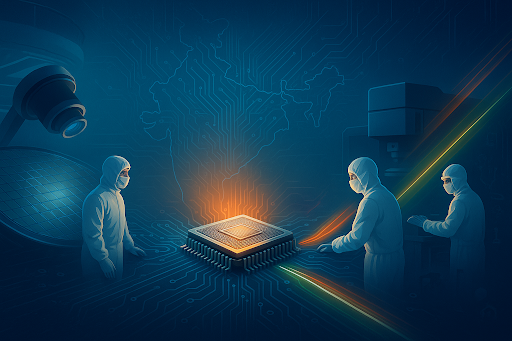
Semiconductors power every aspect of modern civilisation—from smartphones and electric vehicles to defence systems and artificial intelligence. India has launched one of the most ambitious semiconductor missions in the world, backed by ₹76,000 crore of incentives and a target of becoming a global hub by 2030. A dedicated Semiconductor Manufacturing Certification Course transforms engineers and science graduates into the exact talent that fab units, design houses, and equipment suppliers now hunt aggressively.
The country’s first commercial fab is already under construction, multiple OSAT and ATMP facilities are approved, and global giants like Micron, Tata-PSMC, and CG Power are building multi-billion-dollar plants. Each facility requires thousands of specialised professionals who understand wafer fabrication, packaging, testing, and supply-chain integration. This creates an unprecedented window of opportunity for young professionals to enter a sector that will define India’s technological sovereignty.
Table of Contents
- Core Technical Domains Covered in the Programme
- High-Impact Career Roles After Completion
- Essential Skills Mastered During the Programme
- The Strategic Importance of Learning Semiconductor Manufacturing
- Why an Executive Programme in Semiconductor Accelerates Leadership Careers
- India’s Semiconductor Mission and the Talent Imperative
- Seizing the Once-in-a-Generation Opportunity
Core Technical Domains Covered in the Programme
The curriculum delivers an end-to-end understanding of the semiconductor value chain:
- Wafer Fabrication Processes – Photolithography, etching, deposition, ion implantation, and CMP techniques used in 3 nm to 28 nm nodes.
- Clean-Room Operations and Contamination Control – Ultra-pure environments, particle monitoring, ESD protection, and yield management protocols.
- Materials Science for Semiconductors – Silicon, SiC, GaN, photoresists, and advanced packaging materials.
- Device Physics and Process Integration – MOSFET scaling, FinFET, GAA transistors, and memory technologies, including DRAM and NAND.
- Advanced Packaging and Testing – Fan-out, 2.5D/3D integration, chiplets, and high-bandwidth memory assembly.
- Equipment Engineering and Maintenance – Operation and upkeep of multi-million-dollar tools from ASML, Applied Materials, Lam Research, and KLA.
- Fabs Sustainability and Safety – Ultra-pure water recycling, chemical safety, and energy-efficient manufacturing practices.
Every module includes virtual fab tours, simulation-based training, and real process data analysis.
High-Impact Career Roles After Completion
Graduates secure positions that offer starting packages rarely seen in traditional engineering fields:
- Process Engineer – Optimises individual steps such as lithography or etching to maximise yield and performance.
- Equipment Engineer – Maintains and troubleshoots billion-rupee fabrication tools to keep production lines running 24×7.
- Integration Engineer – Ensures all process modules work together to deliver functional chips at target specifications.
- Yield Enhancement Engineer – Analyses defect data and implements solutions that directly impact fab profitability.
- Product Engineer – Bridges design and manufacturing teams to bring new chip designs into volume production.
- Test Engineer – Develops test programmes for wafer-sort and final-test stages using Advantest and Teradyne platforms.
- Packaging Engineer – Designs advanced packaging solutions for AI accelerators, 5G chips, and automotive semiconductors.
Fresh graduates from reputed programmes routinely start at ₹15–30 lakhs per annum, with top performers crossing ₹50 lakhs within three years.
Essential Skills Mastered During the Programme
Participants gain capabilities that global and Indian fabs demand immediately:
- Proficiency in statistical process control (SPC) and design of experiments (DoE)
- Expertise in failure analysis techniques, including SEM, TEM, and FIB
- Hands-on experience with industry-standard simulation tools such as Synopsys TCAD and Silvaco
- Knowledge of ISO 9001, IATF 16949, and semiconductor-specific quality standards
- Understanding of India’s SPECS scheme, PLI incentives, and fab economics
- Ability to interpret inline metrology data from tools like KLA and Hitachi
- Familiarity with safety protocols for handling toxic gases, lasers, and high-voltage equipment
These skills remain in demand across Gujarat, Assam, Uttar Pradesh, and emerging semiconductor clusters.
The Strategic Importance of Learning Semiconductor Manufacturing
The online delivery follows the identical syllabus, faculty expertise, simulation labs, and evaluation standards used in full-time programmes. Participants access cloud-based TCAD and EDA tools, record clean-room demonstrations, and live sessions with fab veterans.
Weekly assignments replicate real fab scenarios, while capstone projects often involve solving actual yield or integration challenges shared by industry partners. Placement cells and industry consortia ensure that Semiconductor Courses Online produce graduates who join fabs within weeks of completion.
Why an Executive Programme in Semiconductor Accelerates Leadership Careers
Mid-career professionals from electronics, electrical, chemical, or mechanical backgrounds transition into senior roles through this focused executive route. The curriculum emphasises fab management, supply-chain strategy, technology road-mapping, and policy frameworks.
Participants move into positions such as Fab Operations Head, Site Director, Supply Chain Director, or Government Relations Lead for semiconductor projects. Many alumni now lead India’s approved fab and OSAT initiatives.
India’s Semiconductor Mission and the Talent Imperative
The government targets $100 billion in semiconductor production and 500,000 direct jobs by 2030. Approved projects already exceed ₹1.5 lakh crore in investment. Global equipment suppliers, material providers, and design companies are establishing Indian subsidiaries at a record pace.
Yet the biggest bottleneck remains skilled manpower. Each 300 mm fab requires 3,000–5,000 specialised engineers and technicians. Industry estimates show India needs over 250,000 trained professionals in the next five years alone.
Seizing the Once-in-a-Generation Opportunity
Very few sectors offer the combination of national priority, global relevance, and lifetime career security that semiconductor manufacturing now provides in India. Professionals who enter this ecosystem today will design the chips that power India’s electric vehicles, defence systems, 6G networks, and quantum computers tomorrow.
A Semiconductor Manufacturing Certification Course is not just education—it is direct entry into the most strategic industry India has ever built. The fabs are rising. The tools are arriving. The future is being fabricated right now.
Those who master semiconductor manufacturing will power India’s rise as a technology superpower.