
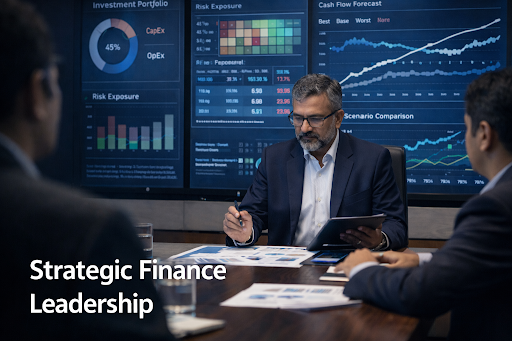
The role of the Chief Financial Officer has quietly but fundamentally changed. Once defined by control, compliance, and reporting accuracy, the CFO today operates at the centre of enterprise strategy. Capital allocation, risk exposure, digital investment, and long-term value creation now sit alongside traditional financial responsibilities. In volatile markets and policy-sensitive economies, financial leadership has become inseparable from organisational direction.
Table of Contents
- The CFO as a Strategic Partner to the CEO
- The Indian Context: Regulation, Growth, and Accountability
- Differentiating CFO-Focused Learning from Finance Degrees
- Emerging Roles Shaped by the CFO’s Expanded Mandate
- Key Takeaways for Senior Finance Professionals
- Conclusion: The CFO as a Shaper of Organisational Futures
The CFO as a Strategic Partner to the CEO
Modern organisations increasingly rely on CFOs to translate economic signals into strategic action. Inflation cycles, interest rate shifts, and regulatory changes demand leaders who can interpret financial data not as static reports, but as narratives about future risk and opportunity. This evolution explains the growing relevance of structured leadership pathways such as the Chief Financial Officer Programme, which are designed around enterprise-level judgement rather than functional finance alone.
As businesses scale, the cost of poor financial judgement multiplies. CFOs are expected to anticipate downside risk, ensure capital resilience, and guide boards through uncertainty with clarity and credibility. This expanded mandate has led to the emergence of the CFO Executive Program as a strategic intervention—one that strengthens decision intelligence, governance thinking, and cross-functional influence rather than technical accounting expertise.
The Indian Context: Regulation, Growth, and Accountability
India’s economic landscape presents a distinct set of challenges for financial leaders. Rapid growth coexists with regulatory complexity, capital market scrutiny, and evolving governance norms. CFOs operating in this environment must balance ambition with compliance, and innovation with prudence. It is within this national context that a CFO Course in India increasingly focuses on policy awareness, risk governance, and long-term financial architecture rather than transactional finance skills.
The CFO’s influence now extends beyond finance teams into strategy, operations, technology, and talent decisions. Financial leaders are expected to frame trade-offs, challenge assumptions, and ensure that growth is both scalable and sustainable. This broader responsibility aligns closely with the intent of a financial leadership course, where the emphasis shifts from mastering numbers to mastering judgement under complexity.
Differentiating CFO-Focused Learning from Finance Degrees
As professionals evaluate advanced finance education, an important distinction emerges between leadership-oriented CFO development and traditional finance specialisation. While both paths are valuable, they serve fundamentally different career trajectories. This distinction becomes especially clear when examining CFO vs MBA Finance through a strategic lens.
| Dimension | CFO-Oriented Programmes | MBA Finance |
|---|---|---|
| Primary focus | Enterprise leadership & governance | Functional finance expertise |
| Decision scope | Organisation-wide, board-level | Departmental or role-specific |
| Skill emphasis | Capital strategy, risk judgement, stakeholder leadership | Financial analysis, valuation, modelling |
| Career trajectory | CFO, executive leadership, board roles | Finance manager, analyst, specialist roles |
| Strategic exposure | High—macro, policy, enterprise risk | Moderate—functionally driven |
This contrast highlights why CFO-aligned programmes are positioned as leadership accelerators rather than finance credentials.
Emerging Roles Shaped by the CFO’s Expanded Mandate
As the CFO role broadens, new leadership and hybrid roles are emerging across organisations:
- Chief Value Officer
Focuses on long-term value creation by aligning capital strategy, sustainability, and stakeholder expectations. - Enterprise Risk Leader
Integrates financial, operational, and regulatory risk into unified decision frameworks. - Finance Transformation Lead
Oversees digitisation of finance functions, analytics integration, and decision automation. - Strategic Capital Advisor
Supports boards and leadership teams on funding strategy, acquisitions, and long-horizon investments. - Governance and Compliance Strategist
Ensures regulatory alignment while enabling growth and innovation.
Key Takeaways for Senior Finance Professionals
- The CFO role is now inherently strategic, not transactional
- Financial judgement is as critical as financial accuracy
- Policy, risk, and capital strategy define modern CFO credibility
- Leadership influence matters more than technical depth alone
- CFO development pathways differ fundamentally from finance degrees
Conclusion: The CFO as a Shaper of Organisational Futures
The modern CFO is no longer confined to safeguarding the past through controls and compliance. Instead, the role is increasingly about shaping the future—allocating capital wisely, interpreting uncertainty responsibly, and guiding organisations through economic and regulatory complexity. As enterprises face longer planning horizons and higher accountability, the CFO’s mandate continues to expand from financial stewardship to institutional leadership.
For institutions and educators, this shift carries a clear responsibility: to prepare financial leaders not just to manage numbers, but to exercise judgement, influence strategy, and contribute meaningfully to long-term organisational resilience.