
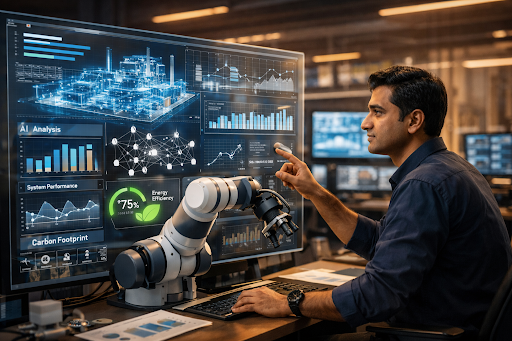
Industry 4.0 digitised manufacturing, embedded sensors into machines, and connected data flows across supply chains. Industry 5.0 moves beyond automation into augmentation. It emphasises human–machine collaboration, sustainability, resilience, and ethical intelligence. The shift is subtle but significant: productivity is no longer the sole objective; adaptability, creativity, and responsible innovation now shape industrial strategy.
This transition redefines the role of engineers. Computer science engineers are no longer expected merely to build systems; they are increasingly required to design systems that collaborate with humans, respond to uncertainty, and operate responsibly within complex ecosystems.
Table of Contents
- From Automation to Augmentation
- The Convergence of Engineering and Human-Centred Design
- Why Postgraduate Engineering Education Is Evolving
- Working Professionals and Continuous Engineering Evolution
- Digital Delivery and the Expanding Talent Ecosystem
- Expanding Career Pathways in the Industry 5.0 Era
- The Recalibration of Skill Architecture
- Industry–System–Skill Mapping in Industry 5.0
- The Strategic Position of Computer Science Engineers
- Key Takeaways
- Conclusion: Engineering the Human–Machine Future
- FAQs
From Automation to Augmentation
Industry 5.0 repositions technology as a collaborative partner rather than a replacement. Artificial intelligence, edge computing, digital twins, and cyber-physical systems are now expected to enhance human decision-making rather than eliminate it.
This changes the scope of computer science engineering in three important ways:
- Systems must be interpretable and transparent, not just efficient
- Algorithms must integrate ethical and sustainability considerations
- Software architectures must adapt dynamically to environmental and human inputs
The engineer’s responsibility, therefore, expands from code optimisation to systems orchestration.
The Convergence of Engineering and Human-Centred Design
Unlike previous industrial revolutions, Industry 5.0 explicitly foregrounds human well-being. Engineers must now design for safety, usability, explainability, and trust. Cybersecurity is no longer just a compliance matter; it is a societal necessity. AI systems must align with regulatory frameworks and public accountability.
This convergence demands engineers who understand both technical depth and system-level thinking. It is within this evolving context that advanced pathways such as M.Tech in Computer Science and Engineering are being re-evaluated—not merely as academic credentials but as platforms for deeper technological and ethical competence.
Why Postgraduate Engineering Education Is Evolving
Industry 5.0 environments operate at scale and speed. Autonomous systems, AI-driven decision engines, and distributed computing networks require professionals capable of designing resilient and adaptive infrastructures.
Traditional undergraduate education often provides foundational coding and algorithmic skills. However, Industry 5.0 requires expanded capabilities:
- AI system architecture and optimisation
- Advanced distributed systems
- Real-time data engineering
- Responsible AI and governance
- Sustainable computing models
These demands explain why structured postgraduate learning formats such as Computer Science M.Tech Courses are increasingly aligned with industry transformation rather than purely academic research trajectories.
Working Professionals and Continuous Engineering Evolution
Industry 5.0 does not pause while engineers return to classrooms. Technology cycles shorten, and frameworks evolve rapidly. Working professionals must therefore upgrade capabilities without disconnecting from live industrial contexts.
Programmes such as M.Tech in Computer Science for Working Professionals reflect this reality. They allow engineers to integrate advanced AI, machine learning, and systems architecture knowledge directly into ongoing projects—creating immediate organisational value while strengthening long-term career positioning.
The significance lies not in convenience but in synchronisation: learning evolves alongside industry application.
Digital Delivery and the Expanding Talent Ecosystem
Industry 5.0’s distributed nature—remote collaboration, global supply chains, and cloud-based innovation—has influenced how advanced engineering education is delivered. The shift toward digitally enabled formats mirrors the decentralised structure of modern engineering work.
Within this ecosystem, the Online M.Tech in Computer Science represents an institutional response to industrial decentralisation. It enables access to advanced curriculum without geographic constraints, supporting professionals who operate across regions, sectors, and time zones.
The expansion of delivery modes is therefore not a dilution of rigour; it reflects the distributed architecture of modern industry itself.
Expanding Career Pathways in the Industry 5.0 Era
Industry 5.0 expands not only technological capabilities but also professional roles. Computer science engineers now occupy positions that blend analytics, ethics, automation, and sustainability.
Emerging and expanding roles include:
- AI Systems Architect: Designs scalable, interpretable AI infrastructures aligned with enterprise strategy and regulatory frameworks.
- Human–Machine Interaction Engineer: Builds collaborative systems that integrate human cognition with algorithmic intelligence.
- Cyber-Physical Systems Specialist: Develops integrated software–hardware environments for smart manufacturing and infrastructure.
- Sustainable Computing Engineer: Optimises computational models to minimise environmental impact while maintaining performance.
- AI Governance and Compliance Lead: Ensures that AI systems operate transparently, ethically, and within policy boundaries.
These roles reflect a broader mandate: computer science engineers are increasingly system architects rather than coders alone.
The Recalibration of Skill Architecture
The expansion of scope is not simply quantitative; it is qualitative. Engineers must now demonstrate:
- Systems thinking across hardware, software, and human layers
- Advanced data interpretation under uncertainty
- Ethical reasoning in algorithm design
- Cross-functional collaboration with business and policy teams
This shift places renewed emphasis on postgraduate depth and interdisciplinary integration.
Industry–System–Skill Mapping in Industry 5.0
| Industry 5.0 Reality | System Response | Skill Evolution | Human Outcome |
|---|---|---|---|
| Human–machine collaboration | Advanced interdisciplinary education | AI interpretability & design thinking | Higher innovation accountability |
| Sustainability mandates | Energy-aware computing frameworks | Green AI & optimisation | Responsible technological growth |
| Supply chain resilience | Distributed systems architecture | Edge computing & real-time analytics | Operational adaptability |
| Regulatory oversight | Governance-integrated curriculum | AI ethics & compliance engineering | Trust-centric innovation |
This mapping highlights that Industry 5.0 is reshaping not only tools but professional identity.
The Strategic Position of Computer Science Engineers
In Industry 5.0 ecosystems, computer science engineers become central to enterprise transformation. Their work intersects with operations, strategy, and policy. Engineering decisions influence productivity, sustainability, and public trust.
As organisations adopt intelligent automation, the demand is not for more code but for more judgement—technical decisions that consider societal and organisational impact.
This repositioning elevates computer science engineering from functional support to a strategic enabler.
Key Takeaways
- Industry 5.0 shifts engineering focus from automation to augmentation
- Computer science engineers now design collaborative, ethical systems
- Postgraduate education aligns with expanded technical and strategic responsibilities
- Working professionals must evolve capabilities alongside industry change
- Career pathways now integrate AI, sustainability, governance, and systems architecture
Conclusion: Engineering the Human–Machine Future
Industry 5.0 does not diminish the relevance of computer science engineers; it expands it. The engineer of tomorrow must navigate complexity, interpret AI responsibly, and design systems that strengthen rather than displace human capability.
This evolution requires deeper technical mastery combined with system-level awareness. As industries prioritise resilience, sustainability, and ethical innovation, computer science engineers stand at the centre of this transformation—shaping not just technological futures but industrial responsibility itself.
The scope is no longer confined to software development. It extends to architecture, governance, sustainability, and strategic design. Industry 5.0, therefore, is not narrowing engineering pathways; it is redefining them.