
“When Machines Begin to Learn, Humans Must Learn Deeper.â€
The global automotive industry stands at a defining moment. The age of combustion is giving way to the age of computation — and at its core lies one of the most transformative specialisations in modern engineering: Advanced Electric Vehicle Systems.
From battery management and control algorithms to embedded intelligence and sustainable power design, the EV ecosystem is now the epicentre of innovation. For engineers seeking to stay relevant, mastering these systems is not just an option; it’s a necessity.
After two decades of working with research teams and guiding learners across IITs, I’ve seen how engineering has evolved from designing mechanical efficiency to programming intelligent motion. The modern engineer must think in volts, code in algorithms, and design for sustainability — all of which converge in the field of MTech in Advanced Electric Vehicle Systems.
Table of Contents
- From Circuits to Control: The Changing Face of Engineering
- Why Advanced Systems Decide the Future of Electric Mobility
- Inside an Electric Vehicle Technology Programme
- Careers in Electric Vehicle Manufacturing and Research
- The Ethical and Environmental Imperative of EV Systems
- FAQs
From Circuits to Control: The Changing Face of Engineering
Traditional automotive engineering dealt primarily with mechanical strength and design precision. In contrast, today’s electric vehicles demand integration — combining electrical, electronic, and computational systems into one synchronised framework.
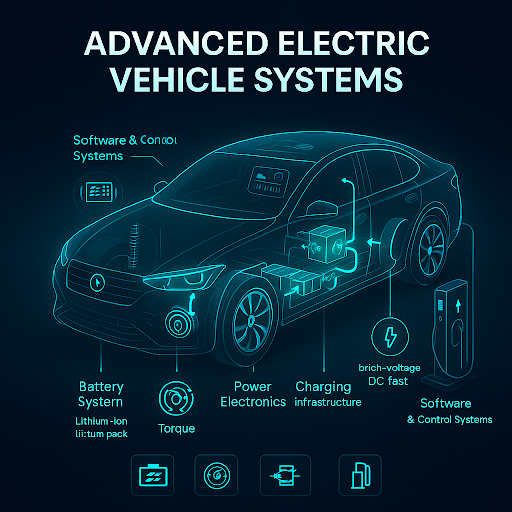
Each EV is a living system of sensors, controllers, and software. Motor drives, power converters, and regenerative braking units constantly exchange information to optimise performance. Engineers must now understand how circuits interact with control logic and how data supports decision-making within embedded platforms.
This marks a new paradigm: engineers who can visualise both the hardware and its behavioural logic are shaping the industry’s direction.
Why Advanced Systems Decide the Future of Electric Mobility
Pursuing an MTech in Advanced Electric Vehicle Systems equips learners with the expertise to design, simulate, and implement the very systems that define modern mobility. The programme integrates advanced concepts in electrical drives, control systems, embedded technologies, and vehicle dynamics — all aimed at building smarter, safer, and more efficient vehicles.
What distinguishes these systems is their ability to adapt. Modern EVs perform self-diagnostics, adjust torque output based on terrain, and optimise charging patterns in real time. Engineers trained in system-level design are capable of integrating sensors, algorithms, and electronics into a cohesive, intelligent powertrain.
💡 Insight: The engineer of tomorrow is not just an operator of machines but a designer of interconnected ecosystems.
Inside an Electric Vehicle Technology Programme
An electric vehicle technology programme immerses learners in multidisciplinary engineering — blending power systems, mechatronics, and computational modelling. Students gain exposure to both theoretical depth and practical simulation tools.
Key areas typically include:
- Power Electronics and Drives — Understanding inverter topologies and motor control algorithms.
- Battery Management and Energy Storage — Learning how to balance charge cycles and enhance longevity.
- Embedded Systems and Vehicle Intelligence — Programming microcontrollers and sensors for adaptive performance.
- Thermal and Control Systems — Designing temperature regulation mechanisms for safety and efficiency.
By the end of the programme, graduates understand how each subsystem — electrical, electronic, and digital — interacts within the EV ecosystem. This systems-oriented thinking prepares them to design the next generation of electric mobility solutions.
Careers in Electric Vehicle Manufacturing and Research
India’s EV market is expanding at a remarkable pace, driven by innovation and government initiatives toward clean mobility. Engineers entering electric vehicle manufacturing careers are finding opportunities in both established automotive giants and new-age startups.
R&D divisions are hiring specialists in powertrain systems, battery analytics, and control software. Manufacturing units seek experts in energy management and embedded automation. Beyond technical roles, opportunities are emerging in product design, testing, and AI-driven diagnostics — where system knowledge meets analytical insight.
âš™ï¸ Industry Insight: In northern industrial zones like Gurugram, Noida, and Faridabad, engineers with strong EV systems expertise are among the most sought-after professionals in the green-tech sector.
The Ethical and Environmental Imperative of EV Systems
Advanced Electric Vehicle Systems are not just technical innovations — they are instruments of sustainability. Designing efficient powertrains and smart energy systems helps minimise emissions and conserve resources.
Engineers must now balance technological advancement with environmental responsibility. Understanding system efficiency, material optimisation, and energy reuse is fundamental to ensuring that progress remains ethical, not just electrical.
✅ Summary Insight: Electric mobility is not just a shift in energy — it’s a shift in engineering philosophy. As systems grow more intelligent, engineers who master advanced EV technologies will define how the world moves, thinks, and sustains itself.