
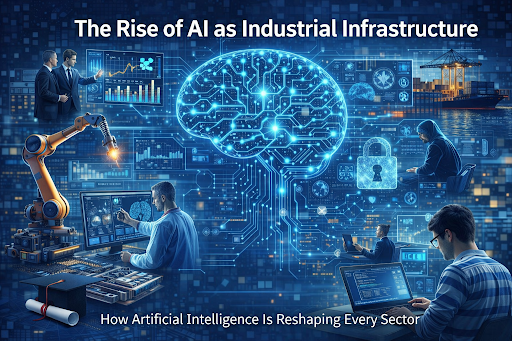
Over the course of my academic and research journey—working deeply in AI-enabled IT infrastructure and engaging with learners across IITs and IIITs—I have seen artificial intelligence transition from a specialised research domain into a foundational layer across industries. What was once considered an advanced capability is now a baseline expectation.
Today, AI does not sit at the edge of systems. It is embedded within them—shaping how software is written, how hardware is optimised, how decisions are automated, and how organisations scale intelligence across operations. From cloud platforms and cybersecurity frameworks to manufacturing automation and healthcare diagnostics, AI has become the invisible engine driving modern systems.
This shift has profound implications, especially for students choosing their academic pathways after school. The question is no longer whether to learn AI, but how early and how deeply one should engage with it.
Table of Contents
- AI as Infrastructure, Not Just Application
- Why Every Industry Is Becoming AI-Driven
- The Shift Toward Early, Structured AI Education
- Digital Learning Models and the Expansion of AI Access
- Choosing AI as a Starting Point After School
- A Researcher’s Perspective on Building Future-Ready Talent
- Key Takeaways
- FAQs
AI as Infrastructure, Not Just Application
One of the most important misconceptions I address in my sessions is the idea that AI is merely an application-layer technology—something added on top of existing systems. In reality, AI is increasingly infrastructural.
Modern IT environments rely on AI for:
- Intelligent resource allocation in cloud and data centres
- Predictive maintenance of hardware systems
- Automated threat detection in cybersecurity
- Performance optimisation across distributed networks
AI now influences system behaviour continuously, not intermittently. This is why foundational understanding—rather than surface-level exposure—has become essential for future technologists. Students who wish to build this depth from the outset often consider a BSc AI degree to develop strong foundations in algorithms, data structures, and intelligent system design.
Why Every Industry Is Becoming AI-Driven
Across sectors, AI has moved from experimentation to necessity. In manufacturing, it enables precision and efficiency. In finance, it drives risk assessment and fraud detection. In healthcare, it supports diagnostics and personalised treatment. In logistics, it powers real-time optimisation.
What connects these applications is not the industry, but the underlying intelligence layer. AI systems learn, adapt, and improve continuously, making them central to competitive advantage. In my interactions with industry leaders, a clear pattern emerges: organisations that fail to integrate AI at a foundational level struggle to scale, adapt, or innovate effectively.
To prepare learners for this reality, many institutions now design an undergraduate artificial intelligence course that blends computer science fundamentals with applied AI models and real-world problem solving.
The Shift Toward Early, Structured AI Education
A decade ago, AI education was typically reserved for postgraduate study. Today, that timeline has moved forward. Students are being introduced to AI concepts—machine learning, neural networks, data modelling—much earlier in their academic journeys.
This early exposure matters because AI thinking is not just technical; it is conceptual. It changes how students approach problems, reason about uncertainty, and design systems.
From my experience mentoring young learners, those who engage with AI early develop:
- Strong analytical reasoning
- Comfort with abstraction and modelling
- Systems-level thinking
- Adaptability across domains
This has increased interest in structured formats such as an online bachelor's degree program, which allows learners to access AI education while benefiting from flexible, technology-enabled delivery.
Digital Learning Models and the Expansion of AI Access
The rise of digital education has significantly broadened access to AI learning. Virtual labs, cloud-based development environments, and simulation platforms now allow students to work with real datasets and tools from anywhere.
Well-designed online programmes replicate much of the rigor of on-campus learning by focusing on:
- Project-based assessment
- Continuous evaluation
- Faculty-led conceptual grounding
- Industry-aligned tool exposure
When implemented thoughtfully, digital learning can democratise access to high-quality AI education. This is why many learners now explore an online undergraduate degree in AI as a way to combine foundational depth with flexibility and practical exposure.
Choosing AI as a Starting Point After School
For students completing school education, AI represents more than a career option—it represents a way of thinking that will remain relevant across decades of technological change.
AI intersects with:
- Computer science and software engineering
- Electronics and hardware systems
- Data science and analytics
- Robotics and automation
- Cybersecurity and infrastructure
Rather than narrowing options, AI expands them. Students evaluating Science courses after 12th with AI are often motivated by the opportunity to build future-ready skills while keeping pathways open across multiple industries.
A Researcher’s Perspective on Building Future-Ready Talent
From my work in AI-enabled infrastructure and academic mentorship, I am convinced that the future belongs to those who understand intelligence as a system property, not a feature.
AI literacy will soon be as fundamental as computer literacy once was. Students who build strong foundations early—grounded in theory, ethics, and application—will be best positioned to lead, innovate, and adapt.
Education, therefore, must not chase trends. It must prepare learners for a world where intelligence is embedded everywhere.
Key Takeaways
- Artificial intelligence has evolved into foundational infrastructure across industries.
- AI now influences system design, performance, and decision-making continuously.
- Early, structured exposure to AI builds strong analytical and systems-thinking skills.
- Digital learning models have expanded access to high-quality AI education.
- Choosing AI early keeps career pathways broad and future-ready.