
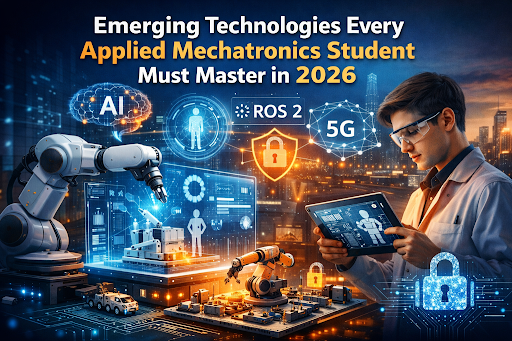
Applied mechatronics is no longer “mechanical + electronics + a bit of coding.” In 2026, high-impact roles demand engineers who can design systems where sensors, actuators, controls, connectivity, AI, and safety standards work together in real environments. That shift is accelerating because modern automation is moving from isolated machines to intelligent, connected, human-centric production ecosystems (often described as Industry 5.0).
In practical terms, applied mechatronics in 2026 is about engineering cyber-physical systems that can sense, interpret, decide, act, communicate, and fail safely as one integrated system. Industry 5.0 strengthens this approach by placing human-centricity, sustainability, and resilience alongside productivity and automation.
If you’re building your career in Applied Mechatronics and Robotics, the winning strategy
is simple: master the technologies that
(1) show up repeatedly in real projects and
(2) make you “deployment-ready,” not just “lab-ready.”
Below are the emerging technologies you should prioritise and what “mastery” looks like for each.
The 2026 Reality: Robots Are Becoming “Physical AI”
The most visible change is that robotics is being reshaped by “physical AI” AI models and workflows designed to operate in the real world with sensors, constraints, and safety requirements. At CES 2026, major announcements underscored how fast this is moving: Arm launched a “Physical AI” unit to expand in robotics, while Hyundai showcased production-ready humanoid capabilities and outlined plans for large-scale deployment in manufacturing over the next few years.
Physical AI can be understood as intelligence embodied in machines: systems that perceive their physical environment, process that information, make decisions, and translate those decisions into controlled physical actions. For mechatronics engineers, this brings perception, AI, motion planning, controls, actuation, and safety into the same engineering problem.
For students, this means your differentiator won’t be “I know robotics.” It will be:
“I can integrate perception + control + safety + communication + deployment.”
Edge AI, TinyML, and On-Device Intelligence
Robotic systems increasingly need decisions at the edge near the sensor because latency, bandwidth, reliability, and privacy matter in factories, warehouses, and field robotics.
Edge AI and TinyML solve related but different problems. Edge AI moves AI inference closer to the machine or sensor, while TinyML enables machine-learning models to run on highly resource-constrained microcontrollers. In mechatronics, both can reduce dependence on continuous cloud connectivity for time-sensitive decisions.
What to master
Edge inference workflows: optimise models, run inference on edge GPUs/NPUs, handle
real-time constraints
TinyML: deploying ML on microcontrollers for always-on sensing (vibration, current
signatures, acoustic anomalies)
Signal-to-decision pipelines: data acquisition → feature extraction →
classification/regression → action
Why it’s emerging in 2026
Robotics platforms and partners are pushing stronger “physical AI” pipelines:
simulation-to-real, perception, and edge deployment.
Practical project idea: Build a TinyML-based fault detector on a motor (vibration + current sensing) that triggers a control-mode change (e.g., derate torque, alert, log).
Digital Twins + Simulation-Driven Engineering
Digital twins are now a core engineering method, not a buzzword. They reduce commissioning time, enable predictive maintenance, and improve control tuning by testing scenarios before hardware is at risk.
For applied mechatronics, a useful digital twin is more than a 3D simulation. It is a digital representation connected to physical-system data that can support monitoring, experimentation, prediction, and engineering decisions. NIST identifies predictive maintenance, performance monitoring, and system optimisation among important digital-twin applications in manufacturing.
What to master
Plant models: motor-drive dynamics, gearbox backlash, flexible link effects
Co-simulation: mechanical + electrical + control + perception
Validation workflows: simulation-based verification before deployment
Why it matters now
As production becomes more complex and human-centric, reducing downtime and improving
resilience is a major driver. Industry 5.0 thinking reinforces this direction.
Practical project idea: Create a digital twin of a 2-DOF manipulator, validate PID vs. model-based control in simulation, then port the same logic to hardware and compare tracking error.
ROS 2 as the Industry Baseline (Not ROS 1)
In industrial robotics, ROS 2 is increasingly the default for new architectures because it was built with distributed systems, real-time considerations, and security alignment in mind.
A major advantage of ROS 2 is its configurable communication layer. Its Quality of Service (QoS) mechanisms allow engineers to tune how robotic data is exchanged based on factors such as reliability, durability, history, and network conditions important when camera streams, control commands, and status messages have different communication requirements.
What to master
ROS 2 core concepts: nodes, topics, services, actions, lifecycle nodes
DDS fundamentals: QoS settings (reliability, durability, latency budgets)
Bridging to industrial systems: thinking in “robot + cell + line,” not just “robot +
laptop”
Research and industry work continue to push deterministic networking and real-time control approaches in distributed robotics stacks.
Practical project idea: Implement a ROS 2-based mobile robot stack with QoS tuning for sensor streams, then measure message loss/latency under network load.
Time-Sensitive Networking (TSN) + Industrial Interoperability (OPC UA)
Modern mechatronics systems don’t live alone. They must integrate with PLCs, MES/SCADA, and IIoT stacks reliably and deterministically.
OPC UA addresses secure, reliable, vendor-independent industrial data exchange, while TSN technologies are designed to improve predictable communication over Ethernet for time-sensitive industrial traffic. Together, they help connect machines, control systems, robotics platforms, and higher-level industrial software without treating each system as an isolated technology stack.
What to master
OPC UA concepts: information modelling, secure client/server communication
TSN basics: deterministic Ethernet behaviour for time-critical applications
Gateway thinking: bridging robotics middleware (DDS/ROS 2) with industrial protocols
(OPC UA)
There’s active work on DDS-TSN deterministic communication and on bridging DDS with OPC UA, exactly the kind of “systems glue” that makes you valuable on real deployments.
Practical project idea: Simulate a robot cell where ROS 2 publishes telemetry and an OPC UA server exposes key KPIs to a dashboard.
Collaborative Robotics + Safety Engineering as a Technical Skill
Cobots and shared workcells aren’t just about “safe speeds.” They require structured safety design, risk assessment, and compliance with recognised standards.
An important distinction for students is that robot safety and robot-cell safety are not identical. ISO 10218-1:2025 addresses industrial robot requirements, while ISO 10218-2:2025 addresses industrial robot applications and robot cells. ISO/TS 15066:2016 supplements these standards with guidance for collaborative robot systems and shared workspaces.
Standards and what they imply
ISO 10218-1:2025 covers safety requirements for industrial robots (robot-level
requirements).
ISO/TS 15066 provides guidance for collaborative robot operation and shared workspaces.
What to master
Risk assessment mindset (hazards, severity, probability, mitigation)
Safety-rated monitored stop, hand guiding, speed/separation monitoring, and force-limited
operation (know when each applies)
Designing for safe recovery: what happens after E-stop, after fault states, after sensor
failure
Practical project idea: Design a mock cobot workstation layout: define hazards, propose controls, and write a simple “safety state machine” for safe-stop and restart logic.
OT Cybersecurity for Robotics and Automation (IEC 62443)
In 2026, cybersecurity is part of mechatronics competence because robots are networked industrial assets. The most credible baseline is the ISA/IEC 62443 series for industrial automation and control systems security.
For a mechatronics engineer, OT cybersecurity is not simply about adding passwords to connected machines. The ISA/IEC 62443 framework treats industrial security as a system-level discipline, including risk assessment, defence-in-depth, network segmentation, and the use of “zones and conduits” to control communication between different parts of an industrial system.
What to master
Secure device onboarding, authentication, network segmentation
Threat modelling for sensors/actuators/controllers
Logging, patching, and update strategy without breaking uptime requirements
Practical project idea: Build a threat model for a robot cell (camera + PLC + robot controller + edge PC). Propose zones/conduits and security controls aligned with IEC 62443 concepts.
Advanced Sensing + Sensor Fusion (The “Perception Stack”)
Robots are only as good as their perception. The emerging requirement is combining multiple sensors robustly.
Sensor fusion is especially important because individual sensors have limitations. Cameras can be affected by lighting, IMUs can drift, encoders provide limited environmental information, and LiDAR can introduce its own measurement constraints. Combining complementary sensing inputs can produce a more reliable estimate of a robot’s state and surroundings than depending on one sensor alone.
What to master
Machine vision: calibration, lighting control, feature extraction, defect detection
3D sensing: depth cameras, LiDAR, point cloud processing
Sensor fusion: IMU + encoders + vision for state estimation
Data quality discipline: drift, bias, noise, and failure modes
Practical project idea: Implement visual servoing for a pick-and-place task using camera calibration + pose estimation, and add encoder feedback to stabilise motion.
A 2026 Skill Map (What to Learn vs. What to Build)
A deployment-ready mechatronics engineer should be able to connect the complete technology chain: sensing → perception → state estimation → decision-making → control → actuation → communication → safety and cybersecurity. The ability to demonstrate how these layers interact is increasingly more valuable than knowing each technology only in isolation.
| Capability | Learn (Concepts) | Build (Proof Project) |
|---|---|---|
| Edge AI + TinyML | Model optimisation, on-device inference | Microcontroller anomaly detection + action trigger |
| Digital Twin | Modelling, co-simulation, validation | Simulation-to-hardware controller comparison |
| ROS 2 + DDS | QoS, distributed systems | Latency/loss tests under network stress |
| OPC UA + TSN | Interoperability, deterministic comms | Telemetry gateway + dashboard integration |
| Cobot Safety | ISO 10218 + TS 15066 basics | Risk assessment + safety state machine |
| OT Security | IEC 62443 approach | Zones/conduits plan + hardening checklist |
Where an Executive MTech Fits in This Landscape
A well-structured Executive MTech in Applied Mechatronics is most valuable when it forces you to connect the dots: you don’t just study control theory or robotics independently; you learn how to design deployable systems with safety, interoperability, and edge intelligence baked in.
For working engineers, the real value of advanced mechatronics education lies in moving from component-level knowledge to system-level engineering understanding not only how a controller, robot, sensor, or AI model works, but how the complete system performs under real operating, communication, safety, and reliability constraints.
When evaluating a program, look for:
• Project work tied to real industrial constraints
• Exposure to ROS 2 + industrial integration patterns
• Safety and cybersecurity awareness, not just mechanical design
• Simulation/digital twin workflows, not only hardware labs
Common Mistakes Students Make (And How to Avoid Them)
A strong mechatronics portfolio should therefore show more than a working prototype.
• Learning tools without systems thinking: Knowing ROS 2 isn’t enough; you must show
integration with sensing, control, and comms.
• Ignoring safety and cybersecurity: In real deployments, these are job-stoppers, not
“nice-to-haves.”
• No portfolio proof: Recruiters trust working demos, not course lists.
It should document the system architecture, engineering decisions, measured
performance, failure cases, safety considerations, test results, and limitations of the
final solution.
Actionable Next Steps (Your 6-Week Plan)
Measurable evidence makes a project easier to evaluate and demonstrates engineering depth
beyond a basic working demo.
• Pick one platform: ROS 2 + a simple robot (mobile base or arm).
• Add perception: camera-based detection or depth sensing.
• Add edge intelligence: run a small model locally (or TinyML on a sensor node).
• Add integration: expose key data via an industrial-style interface (e.g., OPC UA
conceptually).
• Add safety logic: state machine for safe-stop, recovery, and faults aligned with
recognised safety thinking.
• Document it like a professional: architecture diagram + test results + limitations.
Where possible, students should quantify the final project using measurable engineering
metrics such as inference latency, tracking error, message loss, detection accuracy,
fault-recovery time, or system response time.