


Latest News
Duration
- 7 Months
- 68 Hours Of Online Learning
- 12 Hours Of Offline Learning
Eligibility :
Any GraduateMode:
Live Online + On - Campus ImmersionsSchedule :
Sunday, 7:00 PM to 10:00 PMProgramme Fee
80,000 + GSTEMI Options Available *
Instruction Medium
EnglishEligibility
For Indian Participants – Graduates from a recognized University (UGC/AICTE/DEC/AIU/State Government) in any discipline.
For International Participants – Graduation or equivalent degree from any recognized University or Institution in their respective country.
Overview
The Executive Programme for AI in FinTech is designed to help professionals understand how financial systems are evolving with the integration of artificial intelligence and data-driven decision-making.
As financial ecosystems become increasingly digital and data-intensive, organisations are moving beyond traditional financial models to predictive, automated, and intelligent systems. This programme introduces participants to the intersection of finance, technology, and AI covering everything from financial datasets and risk modelling to machine learning applications and algorithmic decision-making.
Through structured modules and applied learning, participants will gain exposure to how AI is used across credit systems, trading strategies, fraud detection, and financial forecasting enabling them to build solutions that align with current industry demands.

Eligibility
For Indian Participants – Graduates from a recognized University (UGC/AICTE/DEC/AIU/State Government) in any discipline with Mathematics/Statistics up to 10+2 level.
For International Participants – Graduation or equivalent degree from any recognized University or Institution in their respective country.
Proficiency in English, spoken & written is mandatory.
2 years of work experience
Why Choose IIM Kashipur ?
Member of Prestigious Global Accreditation Bodies
AACSB (Association to Advance Collegiate Schools of Business) and EQUIS (EFMD Quality Improvement System).
NIRF Ranking
Ranked 23rd in the Management Category under the NIRF 2025 rankings.
A Recognised Institution in Management Education
IIM Kashipur, an Institute of National Importance, is known for building managerial capabilities aligned with evolving industry needs.
Bridging Finance with Emerging Technologies
Move beyond traditional finance by understanding how AI and machine learning drive decisions across lending, trading, and compliance.
Application-Led Learning Across Financial Use Cases
Translate financial concepts into practical applications across credit scoring, risk modelling, and portfolio optimisation.
Exposure to Modern Financial Infrastructure
Gain familiarity with digital financial systems including payments, blockchain, and decentralised finance.
Learning Through Data-Driven Financial Contexts
Work with financial datasets to understand how insights are generated for real business decisions.
AI-Led Financial Intelligence
Understand how AI is used for forecasting, fraud detection, credit scoring, trading, and compliance across modern financial systems.
Learning Outcomes

Develop a Strong Understanding of FinTech Systems
Gain clarity on how financial systems operate and how they are evolving with digital transformation.

Apply AI and Machine Learning in Financial Contexts
Learn how predictive models are used across credit, risk, and trading environments.

Work with Financial Data for Decision-Making
Understand how to process and analyse financial datasets to derive actionable insights.

Build Practical Solutions for Financial Challenges
Develop the ability to create models for forecasting, fraud detection, and portfolio optimisation.

Strengthen Readiness for Emerging Financial Roles
Equip yourself with skills relevant for roles across FinTech, analytics, and AI-driven finance functions.

Lead AI-Enabled FinTech Conversations at Work
Build the confidence to evaluate AI outputs and drive informed discussions across finance, risk, product, and data teams.
Programme Highlights

IIM Kashipur Certification
Earn a prestigious credential that reflects your expertise at the intersection of AI and financial systems from an Institute of National Importance.

AI-First FinTech Curriculum
Build a strong foundation in how artificial intelligence is transforming core financial functions such as lending, trading, risk management, and compliance.

Real-World Financial Use Cases
Work on practical applications including credit scoring, fraud detection, portfolio optimisation, and financial forecasting.

Hands-On Learning with Financial Data
Gain direct experience working with market data, credit datasets, and financial transactions to understand real decision-making environments.

Capstone Project for Applied Expertise
Solve real FinTech challenges by building end-to-end solutions such as investment engines, fraud detection systems, and loan approval models.
Exposure to Advanced AI Techniques
Explore machine learning, deep learning, NLP, and generative AI applications within financial contexts.

Understanding of Digital Financial Ecosystems
Develop clarity on modern financial infrastructure including digital payments, blockchain systems, and decentralised finance.
Portfolio Development with Practical Work
Create a body of work through labs and projects that demonstrates your ability to apply AI in financial scenarios.

Campus Immersion Experience
Conclude your learning journey with a two-day campus immersion at IIM Kashipur.

Built for Finance Professionals Moving into AI-Led Roles
Designed to help working professionals understand how AI is reshaping financial decision-making across lending, risk, investments, payments, and digital finance operations.
Programme Objectives
Build Conceptual Depth in FinTech and Financial Systems
Develop a structured understanding of financial markets, digital financial models, and the evolving FinTech ecosystem.
Introduce AI and Data-Driven Thinking in Finance
Enable participants to understand how AI, machine learning, and data analytics are shaping financial decision-making.

Create Awareness of Emerging Financial Technologies
Familiarise learners with technologies such as blockchain, decentralised finance, and digital payment infrastructures.

Establish a Foundation for Analytical Problem-Solving
Equip participants with the knowledge required to approach financial challenges using data and quantitative methods.

Enable End-to-End Understanding of Financial Applications
Provide exposure to how different components — data, models, and systems — come together in real financial use cases.

Bridge Financial Expertise with AI Application
Enable learners to connect their existing finance, banking, analytics, or business experience with practical AI use cases that are becoming central to modern FinTech roles.
Curriculum Structure
- The evolution of FinTech
- FinTech Business Model Categories: Payments, Lending, WealthTech, InsurTech, RegTech
- Revenue Models in Fintech: Paytm and Zerodha Cases
- Mapping FinTech Opportunities: India Stack as a Startup Platform
- Core concepts in financial markets, risk, and credit
- Introduction to financial datasets: security prices, credit ratings, market data
- Role of NPCI (National Payments Corporation of India): UPI, IMPS
- Mobile Wallets, Payment Gateways and Payment Aggregators: Transactions
- Tokenization, Recurring Payments: Risk, Fraud & Failure Scenarios in Recurring Payments
- Blockchain and how does it work: When does/does not Blockchain make sense?
- Consensus Mechanisms: PoW and PoS
- Blockchain Architecture, Smart Contracts
- Public vs. Private vs. Consortium Blockchains
- Decentralized Finance (DeFi): Decentralized Exchanges (DEXs), AMMs, Decentralized Lending & Over-Collateralization
- Introduction to Python
- Exploratory Data Analysis (EDA) for structured & unstructured finance data
- Data preprocessing: Cleaning, normalization, and feature engineering for financial data.
- Visual storytelling with stock market, credit bureau & bank datasets
- Hands-on lab: Creating a visual dashboard for financial data
- Core ML algorithms: Regression, classification, clustering
- Applications: Predictive modeling for stock prices and credit scoring
- Loan default prediction
- Risk analytics for SME lending, credit cards, and personal loans
- Model tuning, validation, and bias detection in financial ML models
- Use-case lab: Build a regression model for stock price prediction, Build and interpret a credit risk model using real data
- Rule-based and ML-based trading strategies
- Backtesting trading signals using Python
- Portfolio optimization using Sharpe Ratio, VaR, and Monte Carlo
- Robo-advisory engines & personalization of wealth products
- Hands-on lab: Simulate and optimize a portfolio allocation strategy
- AI models for financial analytics: ANN, RNN, CNN
- Application in time series forecasting and credit scoring
- Evaluating model performance and inference
- Hands-on Lab: Train AI models for cryptocurrency price forecasting
- NLP basics: Tokenization, sentiment analysis, topic modeling
- Applications in Fintech: Sentiment analysis using news, earnings transcripts, and tweets
- Deep learning for time-series: stock movement prediction, fraud detection
- GenAI use-cases: financial summarization, Automating investment reports, policy parsing, and KYC
- GenAI: Prompt engineering for finance, Risks of hallucination
- Use-case lab: Build an NLP model to perform sentiment analysis on financial news, Compare LLM Output with Analysts Note
- Fraud detection: Anomaly detection algorithms (Isolation forests)
- Regulatory tech (RegTech): AI for compliance
- Use-case lab: Fraud detection system using unsupervised learning
- Fraud Detection System for NBFCs
- Personalized Investment Recommender
- Loan Approval Automation Engine
- Wealth Portfolio Optimizer with Predictive Rebalancing
- Any other relevant project
Who Is This Programme For?
Professionals in BFSI and FinTech Ecosystems
Individuals working in banking, financial services, NBFCs, or FinTech organisations
looking to understand AI-led transformation in financial operations.
Finance, Risk, and Product Professionals
Professionals involved in credit, risk assessment, product development, or financial
decision-making who want to strengthen their analytical capabilities.
Technology and Data Professionals Entering
Finance
Engineers and data practitioners who want to apply their skills within financial
systems and understand domain-specific use cases.
Consultants, Entrepreneurs, and Academicians
Individuals building financial products, advising organisations, or exploring
research in AI and financial technologies.
Assessment & Evaluation
- Evaluation includes 2 assignments, 3 quizzes, and a final exam
- Participants must achieve a minimum overall score of 50% across all assessments to be awarded the certificate
Tools you'll Master




| Tool to Be Used | Purpose | Rationale |
|---|---|---|
| R / Python | Financial Data Analysis & Machine Learning | Used for analysing financial datasets, building AI and machine learning models, and applying techniques for forecasting, credit scoring, risk analytics, fraud detection, and portfolio optimisation. |
| MS Excel | Data Handling & Financial Analysis | Supports data organisation, cleaning, basic financial modelling, and exploratory analysis. Helps learners work with financial datasets before moving into advanced AI and analytics applications. |
| Microsoft Power BI | Data Visualization, Business Intelligence & Financial Reporting | Used for creating interactive dashboards, visualizing financial and business data, and generating real-time insights. Helps in tracking KPIs, identifying trends, and supporting data-driven decision-making through automated reporting and analytics. |
Programme Certificate
Course Completion Certificate
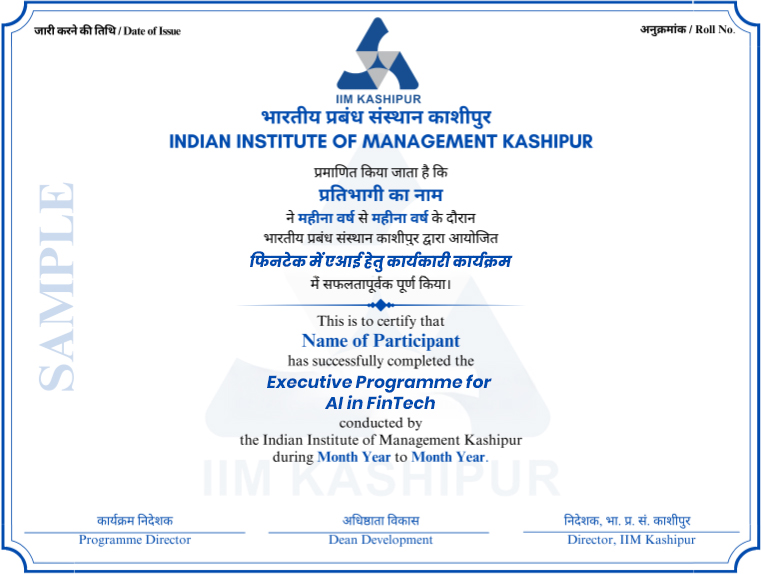
Course Participation Certificate

- Certificate of Completion : A Certificate of Completion will be issued to the participant who will fulfil all criteria (minimum 50% Attendance and minimum 50% marks in overall Evaluation both) related to completion of course. Participant Attendance will be tracked and monitored by the EDP partner.
- Certificate of Participation : A Certificate of Participation will be issued to the participant who fails to fulfil criteria (minimum 50% Attendance minimum 50% marks in overall Evaluation both) related to completion of course.
Pedagogy
Conceptual Learning Integrated with Application
The programme is designed to balance theoretical understanding with practical implementation, ensuring participants can apply concepts in real scenarios.

Use of Financial Case Contexts
Concepts are explained through financial examples and use cases, helping learners understand their relevance in real-world settings.

Hands-On Exercises and Labs
Participants engage in guided exercises and labs that simulate financial problem-solving environments.

Collaborative Learning Experience
The programme encourages interaction among participants from diverse professional backgrounds, enabling shared learning.
Structured and Progressive Learning Journey
The curriculum is designed in a way that builds from foundational concepts to advanced applications, ensuring continuity in learning.
Campus Immersion :
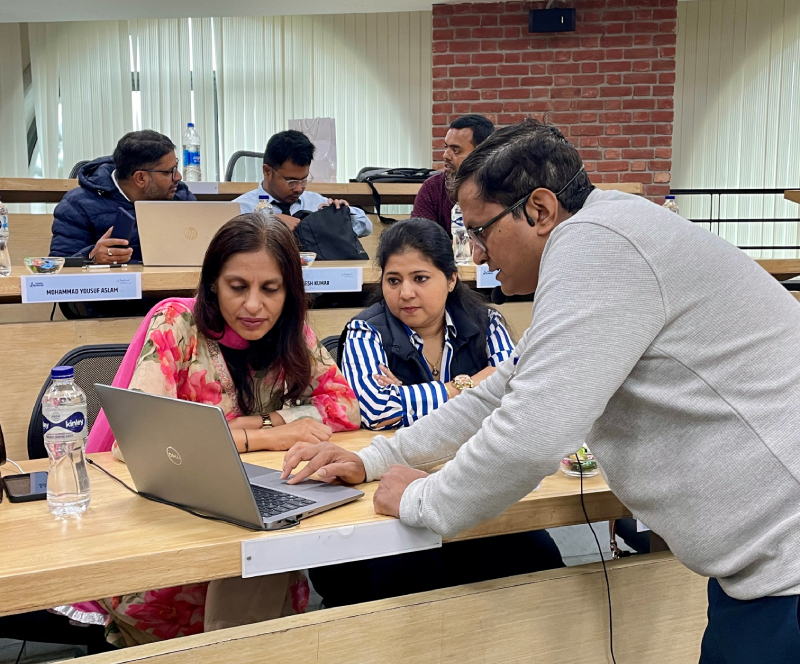
Strengthen your learning journey through a focused 12-hour on-campus immersion (spread across 2 days) at IIM Kashipur, scheduled in the final week of the programme. Designed as a culmination of your AI in FinTech learning experience, this module brings together academic depth and industry context—allowing you to engage more closely with concepts explored throughout the course.
This immersive experience complements your live online sessions by creating space for meaningful interaction, applied discussions, and peer learning in a collaborative campus environment.
What You Will Experience:
In-Person Faculty Sessions : Engage directly with IIM Kashipur faculty through interactive sessions designed to deepen your conceptual understanding and provide additional academic perspective.
Peer & Industry Interaction : Connect with a diverse group of professionals, exchange ideas, and build meaningful relationships that extend beyond the programme.
Collaborative Learning Environment : Participate in group interactions and discussions that encourage knowledge sharing and enhance your overall learning experience.
Programme Reflection & Integration : Use this immersion as an opportunity to consolidate your learning, reflect on key concepts, and connect them to broader industry trends.
Program Director
 Prof. Dilip Kumar
Associate Professor, IIM Kashipur
Prof. Dilip Kumar
Associate Professor, IIM Kashipur
Prof. Dilip Kumar is an Associate Professor in the Finance and Accounting area at IIM Kashipur. He holds a PhD in Finance and completed his doctoral research at the Institute for Financial Management and Research (IFMR), Chennai.
Before joining IIM Kashipur, Prof. Kumar served as a faculty member in the Financial Engineering Department at IFMR, Chennai. His work primarily focuses on asset pricing, financial management, and financial risk analysis. His current research interests include systemic risk, extreme risk interconnection, and corporate sustainability.
He also works in areas such as extreme value volatility estimation, bias correction methods for efficient volatility estimation, and robust volatility estimators. Prof. Kumar is also a Chartered Financial Analyst charter holder from the Institute of Chartered Financial Analysts of India.
Fee Structure
- Programme Fee
- Installment
(non-refundable)
*Total Programme Fee - Rs. 94400 (Including GST)

Refund Policy:
Prior to course commencement, students who request for a refund will receive 80% of the fees paid, after deducting the registration charges. Once the batch starts, no refund will be applicable on course fees. GST Paid during enrolment is not refundable.
Frequently Asked Questions
It is a 7-month fintech certificate program designed to help professionals understand how AI in FinTech is transforming financial systems. The programme covers key areas such as machine learning, financial data analysis, blockchain, and AI-driven applications across finance.
This fintech certification course is ideal for professionals in BFSI, NBFCs, and FinTech startups, as well as engineers, data professionals, consultants, and entrepreneurs looking to build expertise in fintech and AI applications.
The programme runs for 7 months and is delivered through live online sessions with recordings. It includes a total of 80 learning hours, comprising 68 hours of online sessions and a two-day on-campus immersion.
The curriculum includes FinTech fundamentals, blockchain, financial data analysis, machine learning models, algorithmic trading, portfolio analytics, NLP, deep learning, and generative AI in finance, along with a capstone project.
Applicants must be graduates from a recognized university with Mathematics/Statistics at the 10+2 level, have a minimum of 2 years of work experience, and demonstrate proficiency in English.
Participants will be evaluated through assignments, quizzes, and a final examination. A minimum of 50% overall score and 50% attendance is required for successful completion.
The programme helps learners understand the application of fintech artificial intelligence across areas such as lending, trading, risk analytics, and compliance, enabling them to build relevant skills for roles in FinTech and financial analytics.