
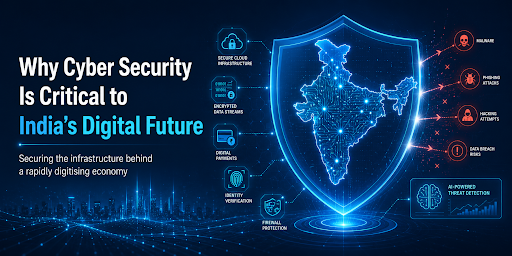
India's digital economy has scaled at a pace few countries have matched. Payments move instantly, identity verification happens in seconds, and government services that once required physical paperwork are now delivered through apps and portals used by hundreds of millions of people. This speed has created enormous economic value, but it has also outpaced something equally important: the security maturity needed to protect the systems this growth depends on. Industry assessments tracking this gap have found that digital adoption in India has scaled considerably faster than security readiness, and that mismatch is where most of the country's emerging cyber risk now concentrates.
This piece examines why cybersecurity has moved from a specialised technical concern to a foundational requirement for India's digital future, what specific pressures are driving that shift, and what kind of technical capability the country now needs to build to keep pace with it.
Table of Contents
- A Threat Landscape That Is Becoming More Sophisticated
- Why the Talent Gap Has Become the Central Constraint
- How Regulation Has Changed the Stakes
- What Building Real Resilience Requires
- Why Flexible, Advanced Learning Has Become Essential
- Why Leadership-Level Training Matters as Much as Technical Depth
- Why Institutional Rigour Matters in This Domain
- Closing Thoughts
- Frequently Asked Questions
A Threat Landscape That Is Becoming More Sophisticated
The nature of cyber risk in India is changing in ways that go beyond simple volume. Security researchers tracking the threat landscape have noted that attacks are increasingly defined by complexity and strategic intent rather than opportunistic, low-effort intrusion, with adversaries using AI-assisted social engineering and exploiting weaknesses in cloud supply chains as standard tactics rather than edge cases.
A significant share of this activity exploits human trust rather than pure technical vulnerability. Fraudulent applications disguised as legitimate services have been used to intercept one-time passwords and hijack user sessions, often succeeding less through technical sophistication than through the sheer scale of digital adoption itself, which gives attackers access to an enormous and often under-protected user base.
Why the Talent Gap Has Become the Central Constraint
Technology alone cannot close India's cybersecurity gap. Workforce researchers tracking the sector have identified India as facing one of the largest cybersecurity workforce shortfalls globally, with over a million unfilled positions, a gap large enough to constrain how effectively even well-resourced organisations can detect and respond to incidents in real time.
- Detection capability: organisations can purchase advanced security tools, but without trained analysts, that investment delivers limited real-world protection.
- Incident response speed: a shortage of skilled responders extends the time between a breach occurring and an organisation containing it.
- Secure architecture design: building systems that are secure from the outset requires specialised expertise that remains scarce relative to demand.
- Regulatory compliance: meeting evolving data protection requirements demands professionals who understand both the technical and legal dimensions of compliance.
- Sector-wide resilience: a shortage in any one organisation creates indirect exposure for its partners, vendors, and the wider digital ecosystem.
How Regulation Has Changed the Stakes
Cybersecurity in India has shifted from being treated as a good practice to being treated as an operating requirement, largely driven by regulatory change. The introduction of the Digital Personal Data Protection Act has pushed organisations to examine far more closely how data moves through their systems, not only where it is stored, but who has access to it and under what justification.
This regulatory tightening extends well beyond a single law. Compliance frameworks from sector regulators are increasingly treated as binding operating rules rather than guidelines, and frameworks once seen as optional best practice, such as CERT-In's incident reporting requirements, now carry real consequences for organisations that fail to meet them. This shift has made cybersecurity capability a board-level governance issue rather than a technical afterthought.
What Building Real Resilience Requires
Closing India's cybersecurity gap requires more than reactive defence. It requires a structural shift toward designing systems that anticipate risk, anticipate regulation, and anticipate the scale at which attacks now operate. The table below outlines the major forces driving this need and the kind of capability each one demands.
| Driver of Risk | Why It Matters in India's Context | Capability Required to Address It |
|---|---|---|
| Rapid digital adoption | Payments, identity, and services moved online faster than security maturity could follow | Secure-by-design architecture and continuous risk assessment |
| AI-assisted attacks | Social engineering and fraud are scaling through automation | AI-aware threat detection and adversarial defence skills |
| Regulatory tightening | The Digital Personal Data Protection Act and CERT-In rules now function as operating requirements, not guidelines | Compliance-integrated security governance |
| Cloud migration | Misconfigured cloud environments are a growing entry point for breaches | Cloud security architecture and identity management expertise |
| Talent shortage | India faces one of the largest cybersecurity workforce gaps globally | Structured, advanced technical training at scale |
Each row in this table points to the same underlying requirement: India needs significantly more professionals capable of operating at this level of technical depth, not simply more awareness of the problem.
Why Flexible, Advanced Learning Has Become Essential
Closing a workforce gap of this scale cannot rely solely on entry-level training. It requires experienced engineers and IT professionals deepening their expertise without stepping away from active careers, since the country cannot afford to wait years for a new generation of specialists to be the only source of supply.
An Online M.Tech in Cyber Security addresses this directly, allowing working professionals to pursue rigorous, postgraduate-level security education while remaining active in their current roles, applying new techniques to live systems as they learn rather than waiting until after graduation to do so.
Why Leadership-Level Training Matters as Much as Technical Depth
Technical depth alone does not close the gap at the organisational level. Security decisions increasingly require leaders who can translate technical risk into business and regulatory language for boards, regulators, and executive teams, a capability that pure technical training does not automatically build.
This is the specific gap that a structured Executive M.Tech in Cybersecurity is designed to close, combining an advanced technical curriculum with the strategic and governance fluency that senior security leaders are increasingly expected to bring to the table.
Why Institutional Rigour Matters in This Domain
Given how high the stakes of cybersecurity failure have become, both financially and in terms of national digital trust, the credibility of the institution behind a security credential carries real weight. Employers and regulators alike place greater confidence in expertise validated by a rigorous, research-driven academic environment than in informal or loosely structured training.
A rigorously designed M.Tech in Cyber Security IIIT reflects exactly that kind of institutional grounding, combining an advanced technical curriculum with a research culture and faculty expertise built specifically around the demands of securing complex digital systems.
Closing Thoughts
India's digital future is not in question. The scale of adoption already underway makes that clear. What remains genuinely uncertain is whether the country's security capability can be built fast enough to match it. Closing that gap will require sustained investment in advanced training, stronger regulatory enforcement, and a cultural shift that treats cybersecurity as core infrastructure rather than an optional safeguard. The professionals and institutions that commit to building this capability now, ahead of the next wave of digital expansion, are the ones who will determine whether India's digital growth remains an asset or becomes its most exposed vulnerability.