
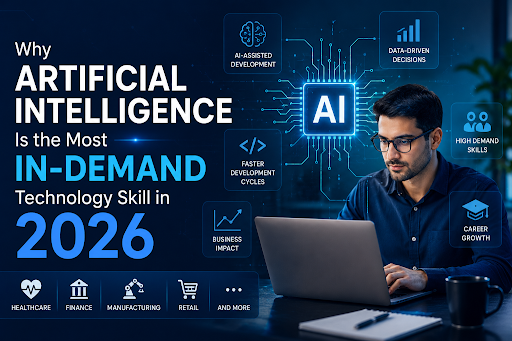
Data has changed shape over the past two decades. What once lived in static tables, read quarterly and summarised in slide decks, now moves in real time, shapes decisions as they are being made, and increasingly generates its own narrative through AI systems rather than waiting for an analyst to interpret it. That shift in how data behaves is the clearest signal of why artificial intelligence has moved from a specialised technical interest to the dominant hiring priority across the technology sector in 2026.
This piece looks at why AI fluency has overtaken other technical skills in employer demand, what that means specifically for engineers who built their careers before this shift, and how working professionals can position themselves for the roles this transition is creating.
Table of Contents
- The Numbers Behind the Shift
- Why This Shift Is Structural, Not Cyclical
- What This Means for Engineers Who Built Their Careers Before This Shift
- Why Depth Matters as Much as Breadth
- Making Advanced Learning Compatible With a Working Career
- Who This Path Is Built For
- Closing Thoughts
- Frequently Asked Questions
The Numbers Behind the Shift
The scale of this shift is visible in how quickly AI-related hiring has moved relative to the rest of the technology sector. Industry hiring trackers have reported that job postings for AI, machine learning, and data science roles rose sharply through 2025, even as overall technology hiring remained comparatively flat, and several 2026 hiring trend reports place artificial intelligence, alongside data analytics and cybersecurity, at the very top of employer skill priorities.
What makes this trend different from earlier technology cycles is its reach. AI skill requirements are no longer confined to research labs or specialised AI product teams. They are appearing in postings for product management, quality assurance, systems architecture, and operations roles that, a few years ago, had no AI component at all. Workforce researchers tracking this pattern have described AI fluency spreading well beyond the technology sector itself, into healthcare, finance, and manufacturing, which signals a structural shift in how technical careers are evaluated rather than a temporary hiring trend.
Why This Shift Is Structural, Not Cyclical
Three forces are converging to make AI fluency a baseline expectation rather than a specialised add-on. First, generative AI tools have matured to the point where they can meaningfully accelerate software development, data analysis, and decision support, which means organisations that lack AI-capable engineers are now visibly slower than competitors who have it. Second, the cost of experimentation has dropped: testing an AI-driven feature or workflow no longer requires a dedicated research team, which has pushed AI literacy down into mainstream engineering roles. Third, and perhaps most significantly, business leaders are now expected to make AI-related decisions on tooling, governance, and deployment that require engineers who can translate technical capability into business judgement.
- Faster development cycles: AI-assisted coding and testing tools compress timelines that once required larger teams.
- Lower experimentation costs: pre-trained models and accessible APIs reduce the barrier to building AI-driven features.
- Cross-functional expectations: AI decisions now touch product, compliance, and customer experience, not just engineering.
- Talent scarcity at the senior level: experienced engineers who can lead AI initiatives remain in short supply relative to demand.
- Expanding reach beyond tech: industries from healthcare to manufacturing are now competing for the same AI-capable talent pool.
What This Means for Engineers Who Built Their Careers Before This Shift
For engineers with a decade or more of experience, this shift can feel less like an opportunity and more like a moving target. Skills that defined strong engineering careers, deep systems knowledge, disciplined software architecture, and rigorous testing practices have not become irrelevant. What has changed is that they are no longer sufficient on their own. Employers are increasingly looking for engineers who can layer AI fluency on top of that existing technical depth, rather than choosing between the two.
Key Insight
This is precisely the gap that well-designed Artificial Intelligence Courses are built to close: rather than starting from first principles, they are designed for engineers who already understand systems, data, and software, and need a structured way to extend that expertise into AI-specific capability.
| Engineering Role | 2024 Skill Emphasis | 2026 Skill Emphasis |
|---|---|---|
| Software Engineer | Feature delivery and code quality | AI-assisted development and model integration |
| Data Engineer | Pipeline reliability and storage | Feature engineering for ML and LLM-ready data |
| Product Manager | Roadmap and stakeholder management | AI capability scoping and responsible deployment |
| QA / Test Engineer | Manual and scripted test coverage | AI-driven test generation and model validation |
| Systems Architect | Scalability and infrastructure design | AI-native architecture and inference optimisation |
The shift is not about replacing existing expertise. It is about extending it. Engineers who pair their domain depth with AI fluency are emerging as the most sought-after profile across nearly every category in this table.
Why Depth Matters as Much as Breadth
Short courses and certifications are useful for building familiarity with specific tools, but the engineers moving into AI leadership roles, architecting systems, setting technical direction, and mentoring teams through this transition typically need a deeper, more rigorous grounding than a short course can provide. This is where postgraduate-level study becomes relevant.
A rigorous MTech Artificial Intelligence curriculum goes beyond tool familiarity, building the mathematical and systems-level understanding needed to evaluate AI architectures critically, rather than simply operating tools built by others.
That depth matters because the engineers most valued in this market are not the ones who can use an AI tool, but the ones who can judge whether a given AI approach is the right one for a specific business problem, understand its limitations, and design around them responsibly.
Making Advanced Learning Compatible With a Working Career
The challenge for most experienced engineers is not motivation. It is time. Few senior professionals can step away from a career for two years to pursue full-time postgraduate study, which is why the format of advanced learning has had to evolve alongside its content.
An Online M.Tech in AI addresses this directly, allowing engineers to pursue rigorous, credit-bearing technical education without stepping away from their current role, applying new concepts to live work problems as they learn rather than waiting until after graduation to do so.
This format also tends to produce stronger learning outcomes for experienced professionals specifically, because they are testing new AI concepts against real systems and real constraints in parallel with coursework, rather than learning in a purely academic vacuum.
Who This Path Is Built For
Not every engineer needs the same depth of AI training, and it is worth being clear about who benefits most from a rigorous, structured programme rather than shorter-format learning. The clearest fit tends to be engineers who are already leading technical decisions, mentoring teams, or expected to set direction on tooling and architecture, where AI fluency is becoming a prerequisite rather than a differentiator.
Recognising this, programmes built specifically as an M.Tech in AI for working professionals are structured around the realities of that audience: part-time, often weekend or evening formats, project work tied to real organisational problems, and cohorts made up of peers navigating the same transition from established engineering careers into AI-capable leadership.
Closing Thoughts
Artificial intelligence has not become the most in-demand technology skill in 2026 by accident. It reflects a genuine shift in how organisations create value, make decisions, and compete, and that shift shows no sign of slowing. For engineers who built deep technical careers before this wave arrived, the opportunity is not to start over, but to extend what they already know with the rigour and structure that this moment demands. The engineers who do this deliberately, rather than waiting for their organisations to mandate it, are the ones who will be leading AI-driven technical strategy well before the rest of the market catches up.