
Digital transformation has stopped being a discrete project with a start and end date. It has become a continuous condition of doing business, where the technologies, expectations, and competitive benchmarks shift faster than most organisational structures can naturally absorb. Recent workforce research has found that a clear majority of organisations recognise the need to build stronger digital leadership capability, yet only a small fraction feel genuinely prepared to lead transformation initiatives with confidence. That gap between recognised need and actual readiness is precisely where formal, structured learning earns its relevance.
This piece looks at who specifically stands to benefit most from pursuing rigorous, executive-level training in this space, what gaps such training is designed to close, and how professionals at different career stages should think about the decision to invest in it.
Table of Contents
- The Readiness Gap That Makes This Question Urgent
- The Professional Profiles
- Matching the Programme to the Professional Profile
- Why Credentialing Matters as Much as Capability
- Why AI Fluency Has Become Inseparable From This Decision
- Closing Thoughts
- Frequently Asked Questions
The Readiness Gap That Makes This Question Urgent
The scale of the problem is not a lack of awareness. Most organisations already understand, often acutely, that digital capability has become a board-level concern rather than a back-office function. What they consistently lack is leadership bench strength: people equipped to translate that awareness into a coherent, executable transformation strategy. Workforce studies tracking this gap have repeatedly found that only a small minority of leaders feel adequately prepared to drive transformation initiatives, even as the overwhelming majority of organisations rate this capability as a pressing development priority.
This mismatch is not confined to any single industry. Surveys spanning telecommunications, professional services, construction, and supply chain leadership have each surfaced their own version of the same pattern: technical infrastructure for change is often in place well before the leadership capability needed to direct that change has caught up.
The Professional Profiles
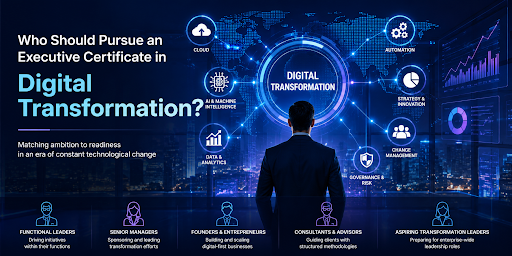
Not every professional needs the same depth of training, and being specific about fit matters more than treating this as a universal recommendation. The clearest candidates tend to fall into a few recognisable profiles: functional leaders who already own a piece of a digital initiative but lack enterprise-level context for it, senior managers expected to sponsor transformation work without having received formal grounding in how to lead it, founders building digitally native businesses without a systematic playbook for scaling that capability, and consultants or advisors whose client recommendations would carry more weight with a credentialed methodology behind them.
- Functional leaders in IT, operations, or marketing who are driving a transformation initiative without enterprise-wide context for how it fits the broader strategy.
- Senior managers and directors are expected to sponsor or champion transformation work, often without having received structured training in how to lead it.
- Founders and entrepreneurs building digitally oriented businesses who want a systematic framework rather than an improvised approach to scaling technology capability.
- Consultants and advisors who already discuss transformation with clients and want a recognised, structured methodology to anchor those conversations.
- Professionals aspiring to transformation leadership roles who have strong functional skills but limited exposure to how change is led across an entire organisation.
Why Self-Directed Learning Often Falls Short
Many capable professionals attempt to close this gap independently, through articles, webinars, and scattered online resources. This approach builds awareness, but it rarely builds the structured judgement that enterprise-level transformation work demands.
Recognising that gap is exactly why a growing number of professionals are turning to a structured digital transformation course online rather than relying on fragmented self-study, since a well-designed curriculum sequences concepts deliberately, builds toward applied capstone work, and exposes learners to peer perspectives that solitary research cannot replicate.
Matching the Programme to the Professional Profile
The value of this kind of training varies depending on where a professional currently sits and what gap they are trying to close. The table below maps common professional profiles against the specific challenges this kind of programme is designed to address.
| Professional Profile | Current Challenge | What the Programme Addresses |
|---|---|---|
| Functional manager (IT, ops, marketing) | Owns a digital initiative without enterprise context | Strategic framing of technology decisions beyond the function |
| Senior leader / Director | Expected to sponsor transformation without formal grounding | Structured frameworks for leading change at scale |
| Founder / Entrepreneur | Building digitally but lacking a transformation playbook | Systematic approach to scaling digital and AI capability |
| Consultant / Advisor | Advises on transformation without a credentialed framework | Recognised methodology to back client-facing recommendations |
| Aspiring transformation leader | Strong domain skill, limited enterprise-wide exposure | Cross-functional perspective and peer benchmarking |
Across every profile in this table, the underlying pattern is the same: strong functional or technical ability already exists, but the enterprise-level framing needed to lead transformation at scale is what remains underdeveloped.
Why Credentialing Matters as Much as Capability
Capability alone is often not enough to be entrusted with enterprise-wide transformation responsibility, particularly for professionals moving into more senior or client-facing roles. Boards, hiring committees, and clients increasingly look for a credible external signal that strategic judgement has been tested and validated, not simply assumed.
A recognised digital transformation certificate provides exactly that signal, converting capability that might otherwise remain informal and undocumented into a credential that can be communicated clearly during hiring, promotion, or client engagement conversations.
Why AI Fluency Has Become Inseparable From This Decision
It is no longer possible to discuss transformation leadership without addressing artificial intelligence directly, since AI has become both the most disruptive force driving transformation and the clearest test of whether a leader's strategic toolkit is current. Workforce researchers have noted that the same forces accelerating technological change are also accelerating the skills gap among leaders expected to manage it, which makes this combination increasingly central to how serious programmes are designed.
Programmes that integrate digital transformation & AI into a single curriculum, rather than treating them as separate subjects, tend to reflect how these forces actually operate inside real organisations: intertwined, mutually reinforcing, and rarely addressed effectively in isolation.
Closing Thoughts
The professionals best positioned to benefit from this kind of programme are not necessarily the most senior in the room, nor the most technically advanced. They are the ones who can already sense the gap between what their organisation expects of them and what their current training has equipped them to deliver.
For functional leaders, senior sponsors, founders, and advisors alike, a rigorously designed Executive Certificate in Digital Transformation offers a structured way to close that gap deliberately, rather than waiting for the pressure of an unmet expectation to force the issue.
In a landscape where the pace of change shows no sign of slowing, that kind of deliberate preparation is increasingly what separates leaders who drive transformation from those who are simply asked to manage its consequences.