
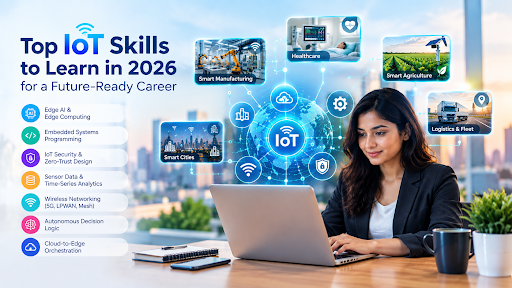
The connected-device count sitting quietly inside modern factories, hospitals, farms and vehicles has grown past the point where any single engineer can reasonably claim to understand the full stack end to end. That specialisation is precisely what is reshaping which skills actually matter for a professional trying to build a durable career in this space, rather than simply keeping up with the latest sensor release.
Table of Contents
- Why IoT Skillsets Are Being Rewritten
- The Skill Radar
- Where These Skills Actually Get Used
- Learning Systematically
- Building a Personal Learning Roadmap
- Frequently Asked Questions
Why IoT Skillsets Are Being Rewritten
Three shifts are driving the rewrite. Processing is moving closer to the device itself rather than round-tripping every reading to a distant cloud server, which changes what "IoT engineering" actually demands day-to-day. Security expectations have hardened considerably after a string of high-profile device compromises, turning what was once an afterthought into a design requirement from day one. And devices are increasingly expected to act on what they sense rather than simply report it, which pulls control-systems and decision-logic skills into a field that used to be dominated by networking and hardware alone.
The Skill Radar
Rather than listing skills alphabetically or by popularity, the Skill Radar below orders them by how urgently each is being demanded in current hiring and project scoping a more useful lens than a generic "top skills" list that treats every entry as equally pressing.
| Skill | Why It Matters Now | Urgency |
|---|---|---|
| Edge Computing & Edge AI | Processing moves onto the device itself, cutting latency and bandwidth cost for real-time decisions. | High |
| Embedded Systems Programming | The foundational layer every device-level skill above eventually depends on. | High |
| IoT Security & Zero-Trust Design | Device compromise incidents have made security a design requirement, not an afterthought. | High |
| Time-Series & Sensor Data Analytics | Raw sensor streams are only useful once patterns and anomalies can be reliably extracted. | Growing |
| Low-Power & Wireless Networking | 5G, LPWAN and mesh protocols each solve a different range-versus-power trade-off. | Growing |
| Autonomous Decision Logic | Devices increasingly act on what they sense rather than simply reporting it upstream. | Growing |
| Cloud-to-Edge Orchestration | Coordinating workloads across cloud and edge layers as deployments scale past a handful of devices. | Medium |
Where These Skills Actually Get Used
It is easy to associate this field narrowly with consumer gadgets, but the highest-value deployments sit elsewhere entirely. Predictive maintenance on factory machinery, remote patient monitoring in healthcare, precision irrigation in agriculture and fleet telemetry in logistics are where budgets for IoT technologies have grown fastest, precisely because the return on a working deployment is measured in avoided downtime and saved lives rather than convenience alone.
The most significant shift in the field over the past two years is the move from devices that simply report data to devices that act on it directly, within tightly scoped boundaries. A factory sensor that once only flagged a temperature spike for a human to review might now trigger a shutdown sequence independently. This category of autonomous IoT deployment demands a fundamentally different skill combination: control theory and decision-logic design alongside the traditional networking and hardware base, and it is where the steepest current skills shortage sits.
Learning Systematically
Self-directed learning can cover individual skills from the radar above reasonably well, but assembling all of them into a coherent systems-level understanding is where most self-taught professionals plateau. A structured M.Tech IoT course addresses that specific gap by sequencing the skill layers deliberately: embedded foundations first, then networking and data, then security and autonomous systems, rather than leaving a learner to stitch the pieces together from scattered tutorials.
For professionals already working in adjacent hardware or software roles, stepping away entirely to pursue this depth is rarely realistic. An online M.Tech IoT format with recorded and live sessions structured around a working week, with lab components that can often be completed on affordable development-board hardware at home, removes that obstacle without diluting the technical depth of the curriculum.
The practical shape of an M.Tech IoT career built on this foundation spans embedded systems engineer, IoT security specialist, industrial automation engineer, and increasingly, autonomous systems engineer roles, the last of which currently commands the sharpest premium given how thin the qualified talent pool remains relative to demand.
Building a Personal Learning Roadmap
Given limited learning time, sequencing matters more than trying to absorb every skill on the radar simultaneously. The grouping below offers a reasonable starting sequence for most professionals building this skill set from scratch.
| NOW | NEXT | LATER |
|---|---|---|
|
|
|