
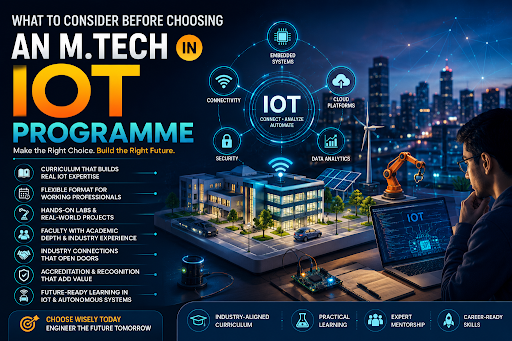
The Internet of Things has passed the stage where its relevance needs defending. Smart manufacturing floors equipped with predictive sensors, hospital environments where wearable devices monitor patients continuously, agricultural fields that self-regulate irrigation and fertilisation based on real-time soil data, logistics networks that track inventory across continents with millisecond precision, these are not projections. They are operating realities, and they are expanding. Behind every one of them is an engineer who understands how physical objects are made to sense, communicate, and respond.
That reality has produced a parallel expansion in postgraduate programmes claiming to prepare engineers for this field. Some of these programmes are genuinely excellent, rigorous, applied, industry-connected, and intellectually demanding. Others are not. They carry the right labels and offer the right assurances, but their curriculum is thin, their infrastructure is limited, and their graduates enter the job market with credentials that do not accurately represent their capabilities. The proliferation of options, in other words, has created a problem of signal: how does a serious candidate distinguish between a programme that will genuinely transform their professional capability and one that will merely occupy two years of their life?
Answering that question requires a framework, a set of specific, investigable criteria that cut through marketing language and institutional brand to the substance underneath. The considerations outlined in this piece are drawn from years of engagement with engineering education, from observing what separates high-performing graduates from average ones, and from understanding what the IoT industry actually requires from the engineers it employs. They are offered not as a ranking exercise, but as a thinking tool for candidates who are serious about making the right choice.
Table of Contents
- The Curriculum Is the Programme
- Format Is Not a Secondary Consideration – It Is a Determinant of Outcome
- Laboratories, Projects, and the Discipline of Working with Real Systems
- Seven Questions Worth Asking Before You Enrol
- The Horizon: Why Autonomous Systems Belong in the Conversation
- Faculty Composition and What It Signals
- Accreditation and Institutional Recognition: Not Bureaucratic Details
- Choosing Deliberately in a Field That Rewards Precision
- FAQs
The Curriculum Is the Programme
The single most revealing document about any programme's quality is its detailed curriculum. Not the programme overview, not the faculty biopics, and not the placement statistics, but the curriculum. A well-constructed IoT course at the postgraduate level should be readable as an argument: each module should connect logically to the ones before and after it, building capability across a coherent arc rather than assembling disconnected topics under a broad label. The arc should run from physical hardware microcontrollers, sensors, actuators, communication modules through networking protocols and middleware, to cloud platforms, data pipelines, and analytics, with security woven through as a thread rather than isolated in a single elective.
The sophistication of the curriculum's treatment of each layer matters as much as its coverage. Are communication protocols discussed conceptually, or are students expected to implement them? Is cloud architecture introduced through vendor platforms, or through underlying architectural principles that will remain relevant even as specific platforms evolve? Is data analytics taught in the context of constrained IoT devices, where resource limitations shape every algorithmic choice, or as a general subject imported from a data science programme? These distinctions reveal whether the curriculum has been designed by people who understand IoT as a discipline with its own specific demands, or assembled from adjacent fields without sufficient integration.
Format Is Not a Secondary Consideration – It Is a Determinant of Outcome
For the significant proportion of candidates who are already working in engineering, technology, or allied fields, the format of an M.Tech in IoT is not a logistical preference to be sorted after the academic selection has been made. It is one of the primary determinants of whether the programme can be completed successfully. This is a point that deserves more directness than it typically receives in programme literature. A candidate who is managing a full professional workload while attempting to keep pace with a programme designed for full-time students is not in an equivalent position to a full-time student. The learning outcomes suffer, the professional performance suffers, or both. The candidates who benefit most from executive or part-time formats are those who choose programmes that have been genuinely redesigned for that audience, not merely rescheduled.
What does a genuinely redesigned format look like in practice? It means that contact sessions are scheduled for times when working professionals can attend evenings, weekends, and intensive block modules without requiring extended leave from employment. It means that asynchronous resources are rich enough to support independent learning between contact sessions, not thin supplementary materials. It means that assessments are structured to accommodate professional schedules while maintaining academic rigour. And it means that the faculty understand their students' professional contexts well enough to make those contexts assets in the classroom rather than complications around it.
Laboratories, Projects, and the Discipline of Working with Real Systems
Engineering competence is built through practice with real systems, not through the study of systems in the abstract. This principle holds everywhere in engineering, but it carries particular weight in IoT, where the interaction between physical hardware, communication infrastructure, and software logic creates a category of problem that simulation cannot reproduce. An IoT programming course that confines its practice to virtual environments produces graduates who are unfamiliar with the unpredictability that characterises actual deployments: sensors that drift, protocols that behave differently under radio frequency interference, power budgets that force trade-offs between communication frequency and device longevity, and embedded systems that require careful memory management in ways that high-level programming environments conceal. These are not edge cases. They are the daily reality of IoT engineering.
Prospective students should ask specific, concrete questions about a programme's laboratory provision. What hardware platforms are students expected to work with across the programme and at what level of complexity? Are capstone projects designed in collaboration with industry partners, or are they entirely internally supervised? Has the laboratory produced outcomes publications, patents, or prototypes that have been piloted outside the institution that testify to the depth of its engagement? A laboratory that produces commercially validated outcomes is a different environment from one that functions primarily as a teaching facility. Both can be valuable, but they signal different things about the programme's relationship with the field.
Seven Questions Worth Asking Before You Enrol
The decision to pursue a postgraduate programme is rarely straightforward, and the information that matters most is often not what appears in a prospectus. The table below consolidates the most important questions a prospective student can raise and explains why each one deserves a substantive answer before any commitment is made:
| # | The Question to Ask | Why It Matters |
|---|---|---|
| 1 | Does the curriculum cover the full IoT stack from embedded hardware to cloud analytics? | Narrow programmes produce narrow engineers. The field demands end-to-end fluency. |
| 2 | Are lab sessions built around real hardware, or primarily software simulation? | Connected systems behave unpredictably in physical environments. Simulation cannot replicate that. |
| 3 | What industry partnerships does the programme maintain, and how do they translate into student opportunities? | Industry linkage is the bridge between academic learning and professional readiness. |
| 4 | How is the programme structured for students who are continuing to work full-time? | Format determines feasibility. A poorly designed schedule makes dropout, not graduation, the likely outcome. |
| 5 | Is the institution accredited, and is the programme recognised by a regulatory body such as AICTE or UGC? | Unrecognised credentials can create obstacles in employment, further study, and government sector roles. |
| 6 | Does the faculty include practitioners with active IoT industry or research exposure? | Practitioner-faculty bring current problems into the classroom. Theory alone cannot prepare students for real deployments. |
| 7 | What does the capstone or final project look like, and has it led to publications, patents, or industry pilots? | The capstone is the clearest signal of what the programme actually produces, not what it promises. |
These questions are not adversarial; they are the natural due diligence of a candidate who is treating the programme selection as the significant professional investment that it is. Institutions that are confident in the quality of what they offer will answer them readily. Institutions that deflect, generalise, or respond with marketing language rather than specifics are telling the candidate something important.
The Horizon: Why Autonomous Systems Belong in the Conversation
One of the clearest indicators of a programme's intellectual seriousness is whether it engages substantively with the trajectory of the field, not just its current state. The IoT landscape is converging with robotics, machine learning, and control theory in ways that are producing systems capable of acting on the data they collect, not merely reporting it. Evaluating a programme that includes a serious autonomous system course component, or that connects IoT principles explicitly to autonomous decision-making architectures, is increasingly a signal of forward orientation rather than mere specialisation. Autonomous drones conducting infrastructure inspection, self-governing energy management systems in smart buildings, and agricultural robots guided by IoT sensor arrays. These applications are not nascent. They are operational, and they are creating demand for engineers who can work across the IoT-autonomy interface.
A programme that treats IoT purely as a data collection and transmission problem, without engaging with what modern systems are expected to do with that data in real time, is preparing students for a field that is already evolving past that framing. The best programmes embed this awareness structurally through electives, through capstone scope, through faculty research that crosses the boundary between connected systems and intelligent behaviour. Candidates who are thinking about where they want to be professionally in a decade, not just in the first role after graduation, should weigh this dimension carefully.
Faculty Composition and What It Signals
The faculty of an engineering programme is its intellectual infrastructure. They determine the depth at which topics are taught, the relevance of the problems students are asked to engage with, and the professional networks through which opportunities flow. Evaluating a faculty team requires looking beyond titles and qualifications to active engagement: Are they publishing in relevant venues? Are they named on funded research projects? Do their research profiles show genuine specialisation in IoT or closely related fields, or are they generalists who have been assigned to teach modules in an area where the programme has a gap?
The composition of the faculty also matters. A programme staffed entirely by academic researchers may produce graduates who are sophisticated theoretically but underprepared for the realities of industrial deployment. A programme staffed entirely by practitioners may produce strong applied skills without the conceptual depth that distinguishes engineers who can adapt to new problems from those who can only execute familiar ones. The strongest programmes balance both ensuring that students understand why systems work the way they do, and what it looks like when they have to be made to work in conditions that the textbooks did not anticipate.
Accreditation and Institutional Recognition: Not Bureaucratic Details
In the Indian higher education context, the regulatory recognition of a programme is not a technicality. It carries direct implications for a graduate's eligibility for certain employment categories, for the transferability of the degree in international contexts, and for the credibility of the credential in employer background verification processes. AICTE approval for an engineering programme, UGC recognition for the awarding institution, and accreditation from bodies such as NBA are independently verifiable signals that the programme meets a defined standard of infrastructure, faculty qualification, and curriculum design. They are floors, not ceilings. Accreditation does not guarantee excellence, but the absence of accreditation is a significant risk that candidates should not underestimate.
The appropriate response to any ambiguity about a programme's accreditation status is direct verification through official channels, not reliance on institutional assurances. AICTE and UGC both maintain publicly accessible databases. NBA publishes its accredited programme list. A candidate who spends ten minutes verifying a programme's status before investing two years and a significant sum in it is exercising the minimum standard of due diligence.
Choosing Deliberately in a Field That Rewards Precision
IoT, as a discipline, is defined by precision. Devices that communicate on tolerances measured in milliseconds, sensors calibrated to detect changes in parts per million, systems that must remain reliable in environments ranging from arctic cold to industrial heat, precision is not optional. It is the engineering standard. Applying that same standard to the selection of a postgraduate programme is not excessive diligence. It is the natural extension of an engineering mindset into a domain where the stakes are professional rather than technical.
The landscape of IoT education will continue to evolve as the field does. Programmes that are genuinely strong today will update their curricula as new protocols emerge, as edge computing matures, and as the relationship between IoT and artificial intelligence deepens. Programmes that are not genuinely engaged with the field will not. The candidates who choose well will enter an industry that is still in a formative period, with the foundational competence to grow alongside it. Those who choose poorly will find themselves recalibrating spending time and resources correcting a deficit that a better initial decision could have prevented.
The considerations outlined here are intended to make that initial decision as informed as possible. They will not choose any candidate. But they should make it harder to choose badly, and in a field as consequential as IoT engineering, that is a contribution worth making.