
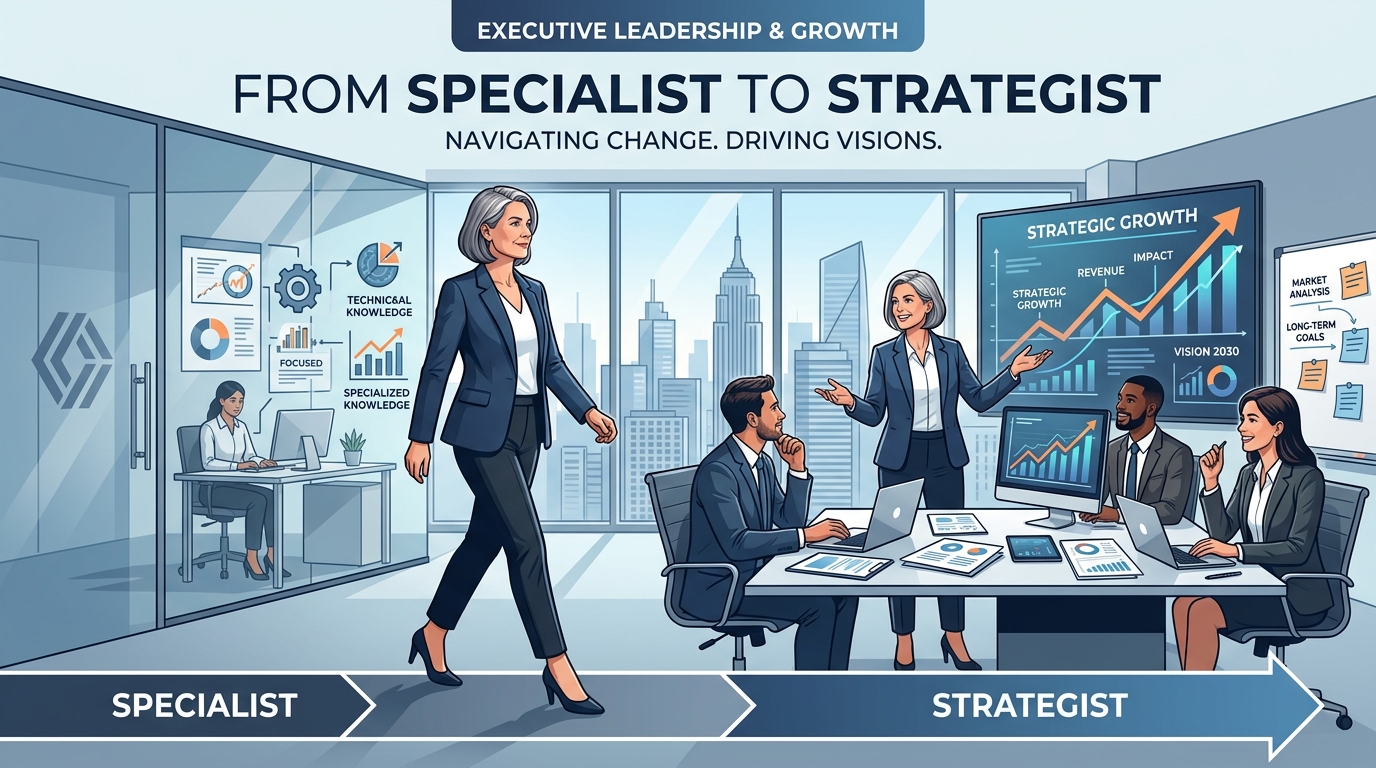
Technical or functional mastery earns a professional the right to be promoted, but it rarely sustains the promotion. Beyond a certain seniority, performance is judged on commercial judgement: how resources are allocated, how trade-offs are priced, and how a function’s work connects to revenue, risk, and strategy.
Senior professionals who add this layer of business capability move from being the people who execute decisions to the people who shape them.
Table of Contents
- Why expertise alone stops compounding
- The Commercial Fluency Ladder
- Specialist and strategist compared
- The Indian setting
- Beyond India
- Ways to build commercial capability
- Self-assessment checklist
- Mistakes that slow the transition
- Frequently asked questions
Why expertise alone stops compounding
Early careers reward accuracy, speed, and depth. Mid-career roles begin rewarding a different set of outputs: persuading stakeholders, defending budgets, and deciding what not to do. The skills that produced the first promotion are therefore not the ones that produce the third.
Gallup’s research on managerial selection has reported that organisations pick the candidate with the right talent for a management role only about two times in ten. The business conclusion is that strong individual performance is a poor predictor of managerial effectiveness, and that capability for the next level must be built deliberately rather than assumed.
The World Economic Forum’s Future of Jobs Report 2025 identifies analytical thinking as the most sought-after core skill among employers. It also reports that employers expect roughly four in ten existing worker skills to change by 2030, with leadership, influence, and resilience rising alongside technical capabilities. Senior roles are therefore being redefined around judgement, not only expertise.
The Commercial Fluency Ladder
Business capability is often discussed as one undifferentiated skill. It develops in stages instead. The Commercial Fluency Ladder describes five rungs, each of which depends on the one below it.
| Rung | Capability | What it looks like in practice | Common gap among specialists |
|---|---|---|---|
| 1. Read | Interpreting financial statements and operating metrics | Explaining why margin fell while revenue grew | Familiarity with departmental metrics but not company-level accounts |
| 2. Translate | Converting technical work into commercial language | Presenting a system upgrade as a cost, risk, or revenue decision | Describing outputs rather than outcomes |
| 3. Price | Weighing trade-offs with explicit costs and returns | Choosing between two initiatives using payback and opportunity cost | Treating all quality improvements as equally worthwhile |
| 4. Align | Negotiating priorities across functions with competing incentives | Securing agreement between sales, operations, and finance | Relying on technical authority rather than influence |
| 5. Direct | Setting direction for a portfolio of initiatives or a business unit | Deciding which products, markets, or capabilities to fund or exit | Limited exposure to profit-and-loss accountability |
Most specialists operate comfortably on the first two rungs within their own function. Promotion to director level and above usually requires the third to fifth, which are seldom taught on the job.
Specialist and strategist compared
| Dimension | Specialist orientation | Strategist orientation |
|---|---|---|
| Primary question | Is it correct? | Is it worth doing, and for whom? |
| Time horizon | Current project or quarter | Multi-year, across market cycles |
| Measure of success | Quality of output | Contribution to enterprise value |
| Handling uncertainty | Reduce it through analysis | Decide with incomplete information |
| Source of influence | Expertise | Judgement, relationships, and credibility with finance |
| Relationship with other functions | Interface | Integration |
The Indian setting
Two features of the Indian market make this transition especially visible. First, global capability centres have grown rapidly. NASSCOM and Zinnov have reported more than 1,700 such centres employing close to two million people, and many are expanding from delivery work into product ownership, analytics leadership, and enterprise strategy. These mandates require leaders who can negotiate with global headquarters in commercial terms.
Second, engineers, chartered accountants, doctors, and technologists make up a large share of India’s senior workforce and founder base. Such professionals frequently reach management positions through technical distinction, then face profit-and-loss responsibility without formal preparation in strategy, finance, or organisational design.
Beyond India
The pattern is global. Technology firms increasingly appoint product, engineering, and data leaders to business-unit roles. Healthcare systems are placing clinicians in executive positions, and manufacturers are moving operations heads into commercial leadership. In each case, functional credibility opens the door while commercial literacy determines how long the leader remains effective.
Ways to build commercial capability
Professionals generally choose among four routes. The suitability of each depends on current seniority and the size of the gap.
| Situation | On-the-job stretch assignment | Mentoring | Short courses | Structured postgraduate study |
|---|---|---|---|---|
| Needs exposure to one missing skill, such as budgeting | Strong fit | Good fit | Strong fit | Excessive |
| Preparing for a first people-and-budget role | Good fit | Strong fit | Partial fit | Strong fit |
| Moving from a functional head to a general management role | Limited by available openings | Good fit | Partial fit | Strong fit |
| Changing industry or function while retaining seniority | Rarely available | Partial fit | Partial fit | Strong fit |
| Founding or leading a business | Limited | Good fit | Partial fit | Strong fit |
Where the gap spans finance, strategy, marketing, operations, and leadership at once, a general management degree is the most comprehensive route. The Master of Business Administration originated at Harvard Business School in 1908 and has since become the most widely recognised credential for integrating these disciplines.
Delivery format is a major consideration for those already holding demanding roles. The growth of the MBA course for working professionals reflects a recognition that a career break carries a high cost for senior employees, and that learning can be applied to live work problems as it happens.
Cohort composition affects learning quality as much as the curriculum. A programme designed as MBA for Experienced Professionals places participants with a decade or more of experience alongside peers from different industries, so case discussion draws on real decisions rather than hypothetical ones.
Scheduling then determines whether a participant can sustain the effort. A Weekend MBA for Working Professionals concentrates teaching into non-working days, allowing a participant to remain in role while building the capability described by the upper rungs of the Ladder.
Self-assessment checklist
- Can the individual explain how the organisation makes money, by product and by customer segment?
- Can a profit-and-loss statement be read and questioned, not only accepted?
- Are recommendations framed with cost, return, and risk rather than technical merit alone?
- Has the individual influenced a budget decision outside their own function in the past year?
- Can the individual describe the organisation’s top three strategic priorities and where their own work fits?
- Is there a track record of persuading peers without direct authority?
- Has the individual been accountable for a commercial outcome, not only a delivery outcome?
Mistakes that slow the transition
- Assuming deeper technical expertise will substitute for commercial judgement.
- Delaying business learning until a promotion makes it urgent.
- Studying finance or strategy in isolation, without connecting it to the organisation’s actual decisions.
- Presenting initiatives without a cost, benefit, or risk case.
- Choosing a learning route by convenience alone, without considering the size of the capability gap.