
Beyond the Obvious: What Is Actually Changing Underneath the Interface
It is tempting to reduce AI's role in financial services to the visible layer: chatbots, app-based recommendations, faster loan approvals. That framing understates what is actually happening. The more accurate account is that AI has become the primary engine behind four specific capabilities: risk assessment, fraud detection, personalisation, and decision speed, each of which used to run on static rules and periodic human review, and now runs on continuous, adaptive models. The visible customer-facing improvements are a downstream effect of that shift, not the shift itself.
Table of Contents
- Fintech and AI, as a Single Operating Layer
- The Four Capability Areas Doing the Real Work
- An Original Model: The FinTech AI Value Radar
- Comparing Traditional and AI-Powered Operating Models
- Where the Evidence Is Strongest
- What This Means for Professionals in the Sector
- Building the Capability to Work Across This Shift
- Frequently Asked Questions
Fintech and AI, as a Single Operating Layer
It is worth being precise about how tightly these two are now intertwined. Fintech and AI have moved from being separate categories, one describing the industry, the other describing a supporting technology to functioning as a single operating layer, where core financial products such as lending, payments, and wealth management are designed around AI-driven decisioning from the outset rather than having AI layered on afterwards. A meaningful share of new FinTech products would simply not be economically viable without it, since the margins depend on the accuracy and speed that only continuous model-driven decisioning can provide.
The Four Capability Areas Doing the Real Work
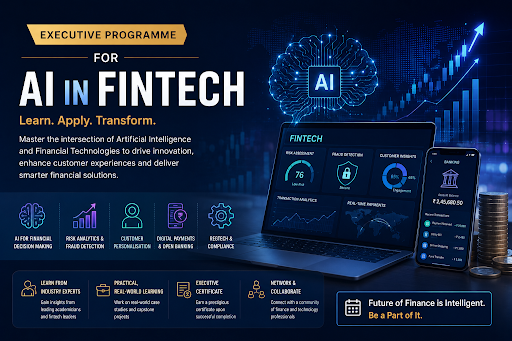
Underneath most customer-facing FinTech innovation sit four capability areas, and it is worth separating them because they mature at different rates and carry different levels of regulatory scrutiny. Risk assessment has moved from static, periodically reviewed credit scoring toward continuous, multi-signal scoring that updates as new data arrives. Fraud detection has moved from rule-based flagging toward real-time anomaly detection across transaction patterns that no fixed rule set could anticipate. Personalisation has moved from segment-based offers toward individual-level product and pricing recommendations. Decision velocity has moved from multi-day underwriting cycles toward automated decisioning measured in minutes.
An Original Model: The FinTech AI Value Radar
Mapping these four capability areas against their traditional and AI-powered states, and the business value each transition unlocks, gives a clearer picture than treating "AI in FinTech" as a single undifferentiated trend.
| Capability Axis | Traditional Approach | AI-Powered Approach | Business Value |
|---|---|---|---|
| Risk Intelligence | Static credit scoring, periodic review | Continuous, multi-signal risk scoring | Fewer defaults, faster approvals |
| Fraud Defense | Rule-based flagging, manual review queues | Real-time anomaly detection across transaction patterns | Lower fraud losses, fewer false positives |
| Personalisation | Segment-based generic offers | Individual-level product and pricing recommendations | Higher conversion, stronger retention |
| Decision Velocity | Manual underwriting cycles are measured in days | Automated decisioning measured in minutes or seconds | Lower cost to serve, faster customer response |
Comparing Traditional and AI-Powered Operating Models
| Dimension | Traditional Banking Operations | AI-Powered FinTech Operations |
|---|---|---|
| Data usage | Structured, periodically updated records | Continuous ingestion of structured and unstructured signals |
| Underwriting | Manual review against fixed criteria | Model-driven scoring with human oversight on exceptions |
| Customer interaction | Branch or call-centre led, largely reactive | App-led, proactive, and personalised at the individual level |
| Compliance monitoring | Periodic audits and sampling | Continuous monitoring with automated flagging |
Where the Evidence Is Strongest
The clearest, most measurable evidence sits in fraud defence and risk intelligence, where the cost of failure is immediate and quantifiable, making the return on investment easiest to isolate compared with subtler personalisation gains. Institutions that have deployed AI for Fintech risk and fraud functions consistently report faster detection of anomalous transaction patterns and a reduction in manual review workload, freeing compliance and risk teams to focus on genuinely ambiguous cases rather than high-volume, low-risk flags.
What This Means for Professionals in the Sector
Risk analysts, fraud investigators, and product managers in financial services are increasingly expected to interpret and act on model output rather than apply fixed rules manually. This does not eliminate the need for domain judgment; if anything, it raises the bar, since professionals must now understand enough about how a model reaches a conclusion to know when to override it, particularly in regulated decisions such as credit denial or fraud escalation.
- Deploying personalisation models before risk and fraud models are mature, chasing visible customer wins ahead of foundational controls.
- Treating model outputs as final decisions rather than inputs requiring human oversight on regulated outcomes.
- Underinvesting in explainability creates compliance exposure when a model-driven decision must be justified to a regulator or customer.
- Assuming existing fraud or risk staff can interpret model output without structured training on how the models actually work.
- Benchmarking progress against traditional banking competitors rather than against AI-native FinTech platforms already operating at higher decision velocity.
A professional checklist for evaluating readiness:
- Has each capability area risk, fraud, personalisation, and decision velocity been assessed separately rather than as one undifferentiated "AI initiative"?
- Are human review and override thresholds clearly defined for regulated decisions?
- Is there a plan for explainability sufficient to satisfy regulatory and customer queries?
- Do risk and fraud teams have structured training on interpreting model output, not just consuming dashboards?
- Is the institution's AI maturity being benchmarked against FinTech-native competitors rather than traditional peers alone?
Building the Capability to Work Across This Shift
Closing this skills gap tends to require structured, applied exposure rather than informal on-the-job learning alone, given the regulatory stakes involved in getting model-driven decisions wrong. A well-designed Fintech Certificate Program gives risk, compliance, and product professionals a faster, more defensible route to this fluency than piecing it together informally.
When evaluating specific options, the quality bar matters more than the label. Credible Fintech Certification Courses should include applied case work across risk, fraud, and decisioning scenarios, with attention to explainability and regulatory context, rather than generic data-science content repackaged for a financial-services audience.