
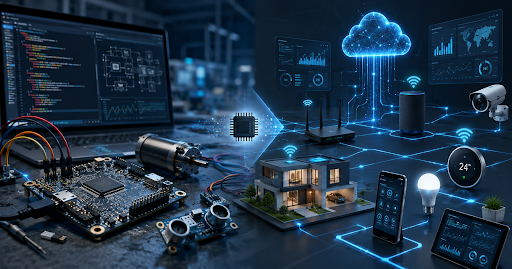
The comparison is usually posed as a rivalry, but embedded systems and IoT are not competing skill sets in the way the question implies. Embedded systems engineering is the foundation the discipline of making a single device work reliably within real-time and hardware constraints. IoT is the layer built on top of that foundation, responsible for networking devices, transmitting their data, and coordinating them at scale. For an engineer deciding where to concentrate effort, the more defensible answer is that embedded fundamentals remain non-negotiable groundwork, while IoT-specific skills determine how far that groundwork can be leveraged into system-level and enterprise-facing roles. Treating the two as an either/or choice undersells both.
Table of Contents
- Two Layers of the Same Stack, Not Two Competing Fields
- Where the Convergence Is Accelerating
- An Original Model: The Engineering Convergence Ladder (ECL)
- Comparing the Two Skillsets Directly
- Where the Career Opportunities Are Actually Concentrated
- A Decision Matrix for Choosing a Focus Area
- Mistakes Engineers and Hiring Teams Keep Making
- A Professional Checklist Before Choosing a Learning Path
- Building the Missing Layer, Deliberately
- Frequently Asked Questions
Two Layers of the Same Stack, Not Two Competing Fields
Embedded systems engineering concerns itself with a bounded function: a microcontroller reading a sensor, actuating a motor, or managing a real-time control loop within a single device. The engineering discipline here is about precision under constrained timing, power budgets, and hardware-software integration for one unit doing one job reliably.
IoT engineering builds on that base to network many such devices, aggregate their data, and enable monitoring, control, and analytics at a scale no single embedded unit could manage alone. This is why Internet of Things applications are best understood not as an extension of embedded engineering but as an orchestration layer above it: a hospital's remote patient-monitoring network, a factory's predictive-maintenance system, or a city's traffic-sensor grid all depend on individual embedded devices functioning correctly, but their value only becomes visible once IoT engineering coordinates them into a system that produces usable, fleet-level data.
Where the Convergence Is Accelerating
Manufacturing modernisation initiatives, smart-infrastructure programmes, and agri-tech deployments are pushing Indian engineering employers toward hiring profiles that combine both layers rather than either in isolation. Globally, Industry 4.0 programmes and connected-product strategies across automotive, healthcare-device, and industrial-equipment sectors are following the same pattern: embedded-only engineers are being asked to acquire connectivity and data skills, while networking-focused engineers are being asked to understand the embedded constraints of the devices they connect. The convergence is not a future prediction; it is already visible in how engineering job descriptions are being rewritten.
An Original Model: The Engineering Convergence Ladder (ECL)
A more precise way to resolve the embedded-versus-IoT debate is to place both skill sets on a single four-rung ladder, rather than as opposing categories. Each rung builds on the one beneath it.
| Rung | Engineering Focus | Typical Output |
|---|---|---|
| Rung 1: Device Engineering | Microcontroller programming, real-time constraints, hardware-software integration for a single device | A functioning embedded unit performing a bounded task reliably |
| Rung 2: Connectivity Engineering | Networking protocols, edge connectivity, device-to-cloud communication | A fleet of devices reporting data reliably to a central system |
| Rung 3: Systems Intelligence | Data pipelines, fleet-level analytics, anomaly detection across connected devices | Actionable insight drawn from aggregated device data |
| Rung 4: Autonomous Systems | Closed-loop decision-making with minimal human intervention | Systems that sense, decide, and act without step-by-step human input |
The top rung deserves particular attention for career planning. Autonomous systems engineering, robotics, self-driving platforms, and closed-loop industrial automation represent the highest-value destination on this ladder, and it is reachable only by engineers who have solid footing in the rungs beneath it. Attempting to specialise in autonomous systems without embedded and connectivity fundamentals tends to produce engineers who can discuss the concepts but cannot debug the systems.
Comparing the Two Skillsets Directly
| Dimension | Embedded Systems Engineer | IoT Engineer |
|---|---|---|
| Primary unit of work | A single device or bounded function | A network of devices and the data flowing between them |
| Core toolset | RTOS, microcontroller firmware, hardware debugging | Communication protocols, cloud platforms, data pipelines |
| Failure mode to manage | Timing, power, and hardware-level faults | Connectivity loss, data integrity, fleet-scale anomalies |
| Career ceiling without the other skill | Strong at device-level roles; limited visibility into system-wide decisions | Strong at system-level roles; dependent on embedded fundamentals holding up underneath |
Where the Career Opportunities Are Actually Concentrated
Roles such as IoT solutions architect, industrial-IoT specialist, and connected-systems engineer are appearing across manufacturing, healthcare-device, agriculture, and smart-infrastructure employers at a pace that outstrips the supply of engineers who hold both embedded and networking competence. IoT career opportunities are consequently opening fastest for engineers positioned in the middle of the convergence ladder, those with credible embedded grounding who have deliberately added connectivity and data-pipeline skills, rather than engineers strong in only one layer.
A Decision Matrix for Choosing a Focus Area
| Engineer Profile | Career Goal | Recommended Focus |
|---|---|---|
| Electronics/embedded graduate | Move into system-level architecture roles | Add connectivity and cloud-integration skills on top of existing embedded strength |
| Software/CS graduate | Enter hardware-adjacent product roles | Build embedded fundamentals before advancing to fleet-level IoT work |
| Working professional in electronics/manufacturing | Transition into connected-systems or Industry 4.0 roles | Formal upskilling combining embedded revision with IoT-specific modules |
| Engineer targeting robotics or self-driving systems | Reach autonomous-systems roles | Progress deliberately through all four ECL rungs rather than skipping to advanced topics |
Mistakes Engineers and Hiring Teams Keep Making
- Treating embedded systems and IoT as competing specialisations rather than sequential layers of the same engineering stack.
- Hiring for IoT roles based on cloud or software skills alone, without verifying embedded fundamentals underneath.
- Promoting engineers into autonomous-systems or robotics work without confirming grounding in the rungs beneath it on the convergence ladder.
- Assuming a short bootcamp-style course can substitute for structured, sequenced learning across both layers.
- Overlooking working professionals with strong embedded backgrounds who only need targeted upskilling, in favour of hiring externally for connectivity skills.
A Professional Checklist Before Choosing a Learning Path
- Has the current skill set been mapped against the four rungs of the convergence ladder to identify the actual gap?
- Does the target role require device-level depth, system-level breadth, or both?
- Is there a credible plan to close the embedded gap before attempting autonomous-systems specialisation?
- Does the chosen course include applied, hardware-linked project work rather than purely theoretical content?
- Is the learning format compatible with continuing in a current engineering role without a career break?
Building the Missing Layer, Deliberately
For engineers with a strong embedded foundation looking to move up the convergence ladder, a well-structured IoT engineering course is a more efficient route than attempting to piece connectivity and data-pipeline knowledge together informally, provided the course is evaluated on applied project work rather than credential recognition alone.
For working professionals already employed in electronics, manufacturing, or embedded roles who want to reach Rung 3 or Rung 4 of the ladder without stepping away from their current job, an MTech in IoT for working professionals offers structured, part-time depth across connectivity, data systems, and increasingly autonomous-systems content, making format compatibility as important a selection criterion as curriculum depth when evaluating options.