
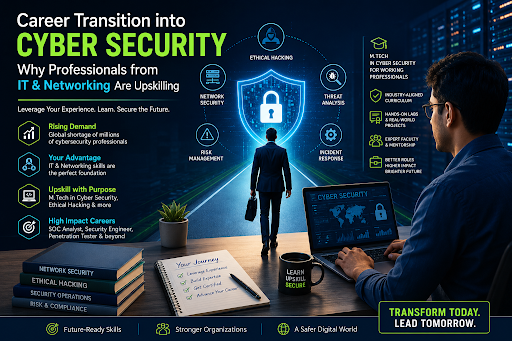
In over seventeen years of teaching engineering and analytics, I have watched technologies rise, plateau, and sometimes fade. But nothing has quite matched the urgency and the opportunity I have witnessed in the last few years around cybersecurity. The conversations in my classroom changed. The questions from working professionals changed. And perhaps most tellingly, the job descriptions that my former students were forwarding me changed. What was once a niche domain tucked into a corner of IT departments has become the beating heart of every serious organisation. Cybersecurity is no longer a specialisation. It is a survival skill.
I have always believed that the best students are often those who already have skin in the game, professionals who come to learning not out of obligation but out of necessity. And nowhere is this more evident than in the wave of IT and networking professionals who are actively seeking to transition into cybersecurity. These are not beginners. They are experienced technologists who have recognised a window of opportunity and are determined to step through it.
Table of Contents
- The Demand Is Real & It Is Growing
- Why IT and Networking Professionals Are Ideally Positioned
- The Right Educational Pathway Makes All the Difference
- The Role of Ethical Hacking in a Serious Cybersecurity Career
- Choosing the Right Credential: What to Look For
- For Those Further Along: Executive-Level Programs
- What the Journey Looks Like: A Realistic Picture
- A Final Word from Across the Classroom
- FAQs
The Demand Is Real & It Is Growing
Let me put some context to what I mean. According to multiple industry reports, the global cybersecurity talent shortage runs into the millions. India alone is projected to need hundreds of thousands of cybersecurity professionals over the next five years. Every sector, from banking and healthcare to manufacturing and government, is grappling with threats that grow more sophisticated by the quarter. Ransomware attacks, data breaches, zero-day vulnerabilities, and social engineering exploits are not hypothetical scenarios from textbooks. They are headlines.
When I speak to industry partners and placement cells, the message is consistent: we need people who understand systems deeply, who can think like attackers, and who can build resilient defences. This is precisely where IT and networking professionals have a head start that no fresh graduate can replicate overnight. The question is how to channel that expertise purposefully.
Why IT and Networking Professionals Are Ideally Positioned
From my years of teaching and interacting with working professionals, I can say with conviction: the foundation already exists. A network engineer who has spent years configuring routers, managing firewalls, and troubleshooting packet loss already has an intuitive understanding of how data flows and, therefore, how it can be intercepted or compromised. A system administrator who has managed Active Directory, set up patch management protocols, and dealt with server vulnerabilities is halfway to being a security analyst.
The table below illustrates how common IT backgrounds translate directly into cybersecurity roles, something I often use to help professionals understand just how much of a running start they already have:
| Professional Background | Transferable Skills | Cybersecurity Application |
|---|---|---|
| Network Administrator | Firewall management, routing, TCP/IP | Network Security, Intrusion Detection |
| System Administrator | OS hardening, patch management, scripting | Endpoint Security, Vulnerability Management |
| IT Support / Helpdesk | Incident response, user access management | SOC Analyst, Identity & Access Management |
| Software Developer | Secure coding, API design, DevOps | Application Security, DevSecOps |
| Database Administrator | Data integrity, access control, encryption | Data Security, Compliance & Governance |
The transition, in many cases, is less about starting over and more about redirecting existing knowledge toward security-focused outcomes. What professionals typically need is structured upskilling, a rigorous, industry-aligned curriculum that bridges the gap between where they are and where the industry needs them to be.
The Right Educational Pathway Makes All the Difference
This is the part I feel most strongly about, having guided hundreds of professionals through career pivots. The choice of program is not merely administrative; it defines the trajectory of the transition. A rigorous M.Tech in Cyber Security for Working Professionals is, in my view, one of the most powerful tools available to someone at this juncture. It provides the academic credibility of a postgraduate degree while being structured to accommodate the realities of a working professional's schedule, evening classes, weekend modules, and asynchronous components that do not require one to press pause on a career.
What distinguishes a well-designed program is not just the curriculum on paper but the depth of its applied components. Cybersecurity is a discipline where theory without practice is essentially decoration. Students need to work through real-world threat scenarios, simulate attack and defence exercises, and engage with live case studies from the industry. The best programs blend academic rigour with hands-on labs, making the learning both intellectually stimulating and professionally immediately relevant.
The Role of Ethical Hacking in a Serious Cybersecurity Career
One of the most consistent requests I receive from professionals exploring this field is clarity on offensive security. There is often some hesitation, a feeling that "hacking" belongs in the realm of the shadowy and illicit. I spend a fair bit of time dispelling this misconception. Enrolling in a credible ethical hacking program is among the most practical decisions a cybersecurity professional-in-training can make. Understanding how systems are attacked methodically, legally, and with explicit permission is foundational to building systems that can withstand those attacks.
Ethical hacking encompasses penetration testing, vulnerability assessment, social engineering simulations, and red team exercises. These are not fringe skills. They are among the most sought-after competencies by cybersecurity employers today. When I teach or interact with professionals who have completed such training, the change in their analytical thinking is unmistakable. They stop seeing systems only as administrators and start seeing them as adversaries, which paradoxically makes them far better defenders.
Choosing the Right Credential: What to Look For
Not all programs are created equal, and I tell this to every professional who reaches out to me for guidance. When evaluating an M.Tech Cyber Security Course , there are several dimensions worth scrutinising beyond the name on the brochure. First, examine the faculty; are they practitioners with real industry exposure, or purely academic? Second, look at the curriculum's alignment with global frameworks like NIST, ISO 27001, and MITRE ATT&CK. Third, investigate the lab infrastructure. Does the institution offer sandboxed environments for penetration testing, network simulation, and forensics? Fourth, consider the peer network learning alongside other working professionals with diverse industry backgrounds is itself a significant part of the value.
Additionally, look for programs that have strong industry partnerships, placement support, and recognised certifications embedded within the curriculum, such as CompTIA Security+, CEH (Certified Ethical Hacker), or CISSP preparatory modules. These are not just additions to a resume; they are signals to employers that a candidate has been vetted against international standards.
For Those Further Along: Executive-Level Programs
In my interactions with senior professionals, those who are not just looking to transition but to lead, I often recommend exploring an advanced executive program in cybersecurity. These programs are designed for those with substantial work experience who want to develop strategic competencies in addition to technical ones. The curriculum tends to go beyond implementation into governance, risk management, compliance frameworks, and cyber policy. They are ideal for IT managers, CTOs, and senior architects who want to take ownership of their organisation's security posture rather than simply contribute to it.
The executive framing also matters from an organisational standpoint. Cybersecurity decisions are increasingly boardroom conversations. An executive-level credential signals that the holder can translate technical risk into business impact, a skill that is profoundly rare and disproportionately valuable.
What the Journey Looks Like: A Realistic Picture
I want to be honest with anyone considering this path: it is rewarding, but it is not effortless. Cybersecurity is a field that demands continuous learning. The threat landscape evolves faster than any single curriculum can capture, which means that the mindset of a lifelong learner is not optional it is the job description. The professionals who thrive in this space are those who develop intellectual curiosity about systems and adversarial thinking as a core habit, not just during their program but throughout their career.
That said, the structured pathway of a postgraduate program provides something invaluable: a scaffold. It gives working professionals a coherent map of the domain, connects isolated knowledge into a unified framework, and provides the credentials that open organisational doors. I have seen network engineers who felt stuck in their careers completely reinvent their professional identity through a well-chosen cybersecurity program. I have seen database administrators move into cloud security architect roles. I have seen helpdesk professionals become SOC leads. The transformations are real.
A Final Word from Across the Classroom
Every year, I stand in front of classrooms filled with people who have made a deliberate choice to invest in their growth. The ones who stand out are not necessarily the most technically brilliant at the outset; they are the most purposeful. They know why they are there. They have a specific problem they want to solve, a specific role they want to grow into, or a specific gap they want to close.
If you are an IT or networking professional reading this and wondering whether a move into cybersecurity is the right call, I would argue the question is less about whether and more about when and how. The demand is structural, not cyclical. The skills you already possess are a genuine advantage. The educational pathways are more accessible than they have ever been. And the impact of the work protecting data, systems, and people from harm is about as meaningful as professional work gets.
Do not wait for the perfect moment. Invest in the right program. Show up with your experience and your curiosity. The field will meet you more than halfway.