
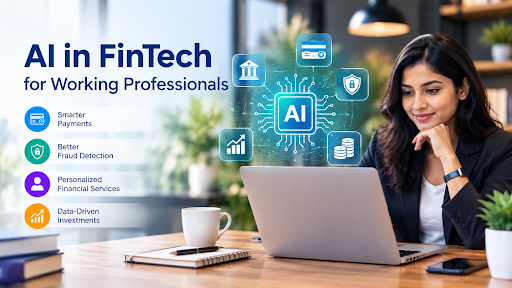
Every fintech vendor pitch deck in 2026 claims an AI layer somewhere in the product, which has made it genuinely difficult for a working professional to tell which claims reflect real operational deployment and which are marketing gloss applied to a conventional rules engine. That gap between what is claimed and what is actually running in production is exactly where career risk and career opportunity both concentrate for professionals deciding whether to invest in formal training right now.
Table of Contents
- The Hype-to-Proof Gap
- Where the Argument Falls Apart
- The FinTech AI Adoption Curve
- Which Certificate Actually Counts
- Picking a Course Without Guessing
- Career Payoff
- Frequently Asked Questions
The Hype-to-Proof Gap
Consolidation across the fintech sector over the past two years has quietly separated genuine AI deployment from marketing narrative. Firms that survived funding tightening are, almost without exception, the ones that could show measurable outcomes from AI in fraud detection, credit risk scoring or personalisation, not simply that they had adopted the technology. That shift has changed what employers are actually screening for: proof of applied outcome, not familiarity with a tool.
It is worth stating the sceptical position plainly before making any case for enrolling. A meaningful share of executive programmes in this space were assembled quickly to capture demand, and their curricula have not always kept pace with how fast the underlying models and regulatory expectations have shifted. A professional who enrols expecting a credential alone to guarantee a role change is very likely to be disappointed, and that disappointment is common enough to be a legitimate reason for hesitation.
Where the Argument Falls Apart
The sceptical case weakens considerably, however, once it is tested against actual hiring behaviour rather than programme marketing. Risk, compliance and product roles inside banks, NBFCs and fintech firms increasingly list applied AI exposure as an explicit filter criterion, not a bonus qualification, and internal mobility toward these roles has slowed for candidates who cannot demonstrate that exposure through anything more concrete than day-to-day tool usage.
The distinction that matters is between a professional who has used an AI-powered dashboard and one who understands why the model behind it makes the calls it makes; the second profile is who gets pulled into governance and model-risk conversations, and formal training is currently the fastest credible way to move from the first profile into the second.
The FinTech AI Adoption Curve
Positioning oneself accurately on this curve is more useful than debating the technology in the abstract. The five stages below describe a progression most professionals in financial services recognise once it is laid out plainly.
Observer
Aware of AI use cases in the sector but has not worked directly with a live system or model output.
Experimenter
Has used AI-powered tools day-to-day but cannot yet explain the underlying model logic or its failure modes.
Operator
Works competently within an AI-assisted workflow and understands its practical limitations in a specific function.
Integrator
Can connect AI system outputs to business, risk and compliance decisions across functions, not just within one.
Architect
Shapes how AI is deployed, governed and trusted across the organisation, and is consulted before systems go live.
The gap between the Operator and Integrator stages above is precisely where most professionals get stuck without external validation, since day-to-day tool use rarely produces evidence a hiring panel can independently verify. A recognised AI FinTech certification closes that specific gap it gives a hiring manager a verifiable signal that a candidate understands the mechanics behind the tools, not just their interface.
Which Certificate Actually Counts
Not every credential carries equal weight, and candidates researching this space quickly discover that the market is crowded with options of wildly varying rigour. A general FinTech certification without a specific AI or machine-learning component is increasingly treated by hiring panels as evidence of domain familiarity only, whereas credentials with a demonstrated applied-AI component are weighted noticeably higher for the risk, fraud and personalisation roles currently expanding fastest.
Rising
HIRING DEMAND FOR APPLIED AI ROLES
Widening
SKILL PREMIUM VS GENERALIST PEERS
Shortening
HALF-LIFE OF TOOL-ONLY FAMILIARITY
Format matters as much as content for professionals who cannot step away from an active role, and the strongest options in this space are built explicitly around that constraint. An executive FinTech programme structured around weekend and evening delivery, with faculty drawn from both academia and practising industry backgrounds, tends to close the Operator-to-Integrator gap fastest because it pairs theoretical grounding with case material pulled from live financial-services problems rather than generic business scenarios.
Picking a Course Without Guessing
Given how crowded this space has become, evaluating options systematically matters more than acting quickly. Before enrolling in any FinTech course, it is worth requesting the actual case-study list and faculty backgrounds directly rather than relying on the marketing page alone, since curriculum depth in this fast-moving space varies far more between programmes than the marketing copy typically reveals.
- Identify honestly which stage of the adoption curve above best describes current capability, rather than assuming Integrator-level readiness by default.
- Request the specific case studies and datasets used in the programme; generic business-school cases rarely reflect live financial-services problems.
- Confirm faculty include practitioners currently working in applied AI roles within financial services, not only academic researchers.
- Weigh a general fintech credential against an AI-specific one deliberately; they are not interchangeable signals to employers.
- Treat the credential as the beginning of the Integrator transition, not the end of it; applied project work after completion matters just as much.
Career Payoff
The realistic shape of an AI in FinTech career built on this foundation tends to move through recognisable roles: model risk analyst, fraud and AML strategy lead, AI product manager for financial services, credit risk modelling lead, each of which sits squarely at the Integrator stage or beyond on the adoption curve above, and each of which currently commands a premium over generalist financial-services roles at comparable seniority.