Executive Programme in AI in Finance from IIM Lucknow
Enquire Now
11 Months
Online + Campus Immersion
Sundays
₹2,40,000 + GST
Programme Overview
Artificial intelligence is transforming financial services, reshaping how organisations forecast performance, evaluate investments, manage risk and make strategic decisions. As finance becomes increasingly data-driven, professionals need the expertise to integrate AI and advanced analytics into financial decision-making.
The Executive Programme in AI in Finance from IIM Lucknow equips working professionals with a strong foundation in corporate finance, valuation, investment analysis and risk management, complemented by machine learning, predictive analytics and generative AI.
Spanning 11 months, the programme explores applications in AI-powered investment research, algorithmic trading, treasury analytics and responsible AI governance. Through industry-relevant tools, applied financial modelling and a mentored capstone project, participants develop the capabilities to address complex financial challenges and contribute to AI-led transformation across the financial services sector.
Programme Eligibility:
Note: Selection will be based on the candidate's background and experience.

Who Is This Programme For?
This programme is designed for professionals seeking to strengthen their financial expertise and analytical capabilities while integrating AI into financial decision-making.
Finance & FP&A Professionals
Seeking to integrate advanced forecasting, financial modelling and AI-driven insights into planning, analysis and strategic business decisions.
Banking, NBFC & Financial Services Professionals
Looking to apply AI and analytics across lending, financial operations, customer intelligence and financial decision-making.
Investment & Wealth Management Professionals
Seeking to strengthen capabilities in portfolio analytics, investment research, predictive modelling and AI-assisted market analysis.
Risk, Compliance & Audit Professionals
Interested in quantitative risk modelling, stress testing, continuous controls monitoring and responsible AI implementation.
Data, Analytics & Technology Professionals
Looking to apply technical expertise to financial forecasting, machine learning, enterprise AI systems and BFSI applications.
Finance Leaders & Transformation Professionals
Seeking to evaluate AI-led opportunities, oversee financial innovation and lead data-driven organisational transformation.
Industry Insights
Of financial services firms globally are adopting AI.
AI-related jobs projected in India's BFSI sector in 2026.
Annual salary range for senior data science roles in Indian financial services.
Global fintech industry revenue in 2025, growing 21% year-on-year.
The IIM Lucknow Edge

(Financial Times – Master’s in Management Rankings 2026)
Ranked #72 globally, placing IIM Lucknow among the world’s leading business schools; ranked 6th among IIMs and 9th among Indian B-Schools.

(AACSB | AMBA | EQUIS)
Triple Crown Accredited, placing IIM Lucknow among a select group of globally accredited business schools

(NIRF India Rankings 2025)
Ranked #5 in the Management category in the NIRF 2025 Rankings.

(Financial Times – Global MBA Rankings 2026)
Ranked 58th globally in the Financial Times Global MBA Rankings 2026
Programme Highlights
Applied AI Across Financial Functions
Examine AI applications in forecasting, investment research, algorithmic trading, treasury management, ESG analytics and financial risk assessment.
Exposure to Industry-Relevant Tools
Work with technologies including Python, Power BI, Excel, ChatGPT, Claude and Microsoft Copilot across finance-focused use cases.
From Financial Models to Enterprise AI Systems
Progress from conventional financial analysis to predictive models, financial document intelligence and enterprise AI copilots.
Responsible AI & Financial Governance
Engage with model validation, explainability, risk controls and AI governance frameworks relevant to regulated financial environments.
Mentored Applied Capstone Project
Apply programme concepts to a real-world finance challenge through a faculty-mentored group project and final evaluation.
IIM Lucknow Executive Alumni Status
Participants will receive IIM Lucknow Executive Alumni Status, subject to the applicable institute criteria.
Programme Objectives
Strengthen Financial Analysis & Valuation Competencies
Develop a rigorous understanding of financial reporting, capital budgeting, corporate valuation, investment assessment and international finance principles.
Develop Data-Driven Financial Modelling Capabilities
Apply quantitative methods, statistical analysis and financial datasets to assess business performance, evaluate financial risks and support analytical decision-making.
Integrate Predictive Analytics into Financial Planning
Understand machine learning and time-series forecasting techniques for applications such as cash-flow prediction, customer analytics and financial performance estimation.
Apply Generative AI to Financial Intelligence
Explore prompt engineering, retrieval-augmented generation and LLM-based systems for analysing financial documents, extracting insights and supporting research.
Evaluate AI Applications in Investment & Treasury Functions
Examine analytical techniques used in portfolio management, trading, liquidity planning, alternative data analysis and financial market intelligence.
Establish an Understanding of Responsible AI Implementation
Build familiarity with model explainability, validation, governance and organisational considerations for deploying Executive Programme in AI in Finance.
Programme Curriculum
The comprehensive curriculum consists of 10 structured modules and an applied capstone project:
| Understanding financial statements (Balance Sheet, Profit & Loss, Cash Flow Statement) |
| Financial statement analysis and ratio analysis |
| Business economics and managerial economics for finance |
| Time Value of Money |
| Indian financial system and capital markets ecosystem |
| Taxation fundamentals for finance professionals (direct tax basics, GST/indirect tax overview, corporate tax planning essentials) |
| Statutory & internal audit fundamentals (audit process, internal controls, compliance reporting) |
| Capital budgeting and investment decisions (NPV, IRR) |
| Cost of capital (WACC) and capital structure |
| Working capital management |
| Corporate valuation — DCF and relative valuation methods |
| Mergers & Acquisitions: deal structuring, synergy valuation, funding of M&A deals, post-merger integration (PMI) basics |
| International Finance: foreign exchange risk & hedging, cross-border valuation & capital budgeting, international capital markets |
| Financial markets and instruments (equity, fixed income, derivatives basics) |
| Efficient Market Hypothesis and market anomalies |
| Markowitz Portfolio Theory and the Capital Asset Pricing Model (CAPM) |
| Equity and fixed-income valuation |
| Portfolio construction, diversification, and performance evaluation |
| Quantitative risk measurement: Value-at-Risk (VaR) and Expected Shortfall |
| Enterprise Risk Management (ERM) design for financial institutions |
| Stress testing, scenario analysis, and tail-risk modelling |
| Derivatives for hedging (forwards, futures, swaps, options) |
| Advanced Excel for finance (Power Pivot, DAX, What-If Analysis) |
| Python fundamentals for finance (Pandas, NumPy) |
| Data visualisation, storytelling, and finance dashboard building |
| AI/ML foundations — supervised vs. unsupervised learning |
| Linear and logistic regression for financial prediction |
| Ensemble methods (decision trees, random forests, gradient boosting) and model explainability (SHAP/LIME) |
| Model validation, backtesting rigour, and overfitting controls |
| Time series forecasting for finance (ARIMA, exponential smoothing, Prophet, introduction to LSTM) — applications in cash-flow, interest-rate, and demand forecasting |
| Applied model deployment across cash-flow forecasting, customer lifetime value, churn, and trading-signal contexts |
| LLM fundamentals — architecture, training, fine-tuning |
| Prompt engineering for structured financial data extraction and analysis |
| Building Retrieval-Augmented Generation (RAG) pipelines over financial documents and filings |
| Evaluating LLM outputs: hallucination checks, output verification, and guardrails for financial use cases |
| Hands-on build: AI copilots and finance chatbots for research and report drafting |
| Algorithmic and quant trading strategies |
| AI-powered equity research and sentiment analysis |
| Predictive analytics for market forecasting |
| Treasury & liquidity: AI-driven cash-flow forecasting and working-capital optimisation |
| ESG and climate-risk analytics for financial institutions and asset managers |
| InsurTech: climate-linked parametric insurance design and catastrophe-risk modelling |
| Alternative data (satellite, transaction, unstructured web/social) for credit and market signals |
| Continuous audit and controls monitoring — extending automated document review into always-on assurance |
| Model Risk Management (MRM) frameworks: validation, documentation, and model-risk tiering for AI/ML models in finance |
| Board-level data storytelling and communicating AI/model risk to non-technical stakeholders |
| Leading AI-driven organisational transformation and change management for finance teams |
| Building an AI Centre of Excellence: talent, structure, and operating-model design |
| Group project applying programme learnings to a real-world business case (e.g., a valuation report with AI-assisted research, or an ML-based cash-flow/treasury forecasting model) |
| Mentored by faculty throughout |
| Final presentation to an evaluation panel |
Programme Outcomes
Contribute to AI-Enabled Financial Strategy
Be better positioned to support financial planning, valuation and investment decisions using a combination of financial expertise and data-driven intelligence.
Take on Advanced Analytics & Forecasting Responsibilities
Strengthen your ability to contribute to predictive financial planning, risk analysis and performance management across complex business environments.
Work Across Finance, Analytics & Technology Teams
Develop the perspective to collaborate effectively with finance leaders, data scientists, risk specialists and technology teams on AI-enabled financial initiatives.
Support Investment & Risk Decision-Making
Apply a broader understanding of quantitative models and AI-based insights to evaluate investment opportunities, financial exposures and portfolio performance.
Contribute to Financial AI Implementation
Gain the perspective to evaluate AI solutions, assess model reliability and participate in the responsible adoption of intelligent systems across financial operations.
Prepare for Broader Finance & Transformation Roles
Strengthen capabilities relevant to responsibilities across financial analytics, AI-enabled FP&A, investment analytics, quantitative risk, finance transformation and related leadership functions.
Campus Immersion
As part of the programme, participants will experience a 3-day Campus Immersion at IIM Lucknow, combining focused classroom learning with opportunities for faculty engagement and meaningful peer interactions.
What to Expect
Experience in-person academic sessions at IIM Lucknow, complementing the programme’s online learning experience.
Engage in approximately 6 hours of structured classroom learning each day over the three-day immersion.
Interact with professionals from diverse industries, share experiences and gain perspectives through collaborative engagement.
Gain firsthand exposure to the institute’s academic environment and become part of its vibrant campus learning experience.

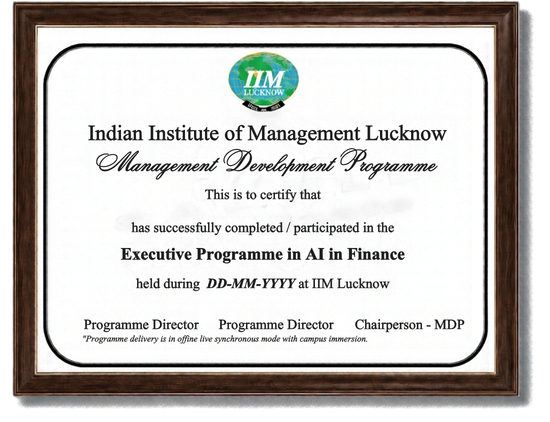
Programme Certificate
For the Certificate of Successful Completion, participants must fulfil:
- Minimum 75% attendance
- COPM (Cumulative Overall Percentage of Marks) of 50% or above
Participants who do not meet either of the above criteria will receive a Certificate of Participation from IIM Lucknow.
Participants with attendance below 40% will not receive a certificate.
Programme Fees
Fee Structure
| PARTICULARS | AMOUNTS |
|---|---|
| Application Fee | ₹ 2,000 + GST |
| Programme Fee | ₹ 2,40,000 + GST |
| Executive Alumni Status | ₹ 10,000 + GST (Optional) |
| Total Programme Fee | ₹ 2,40,000 + GST (Excluding Application & Alumni Fee) |
Fee Schedule
| PAYMENT MODE | INSTALLMENT DATE | AMOUNT(₹) |
|---|---|---|
| Installment 1 | Due within 3 days of offer letter release | ₹ 80,000 + GST |
| Installment 2 | 1st March 2027 | ₹ 80,000 + GST |
| Installment 3 | 30 March 2027 | ₹ 80,000 + GST |

Note:
- Loan and EMI facility is offered by the Service Provider, TeamLease EdTech. IIM Lucknow is not responsible for the same.
Admission Process
Submit the completed application form with all relevant enclosures/attachments
IIM Lucknow will review applications and shortlist candidates
All shortlisted candidates will be emailed the offer letter
Block your seat by paying the booking amount
- *The schedule will be 3 hours/week and will be confirmed closer to the programme start date. If a programme session corresponds with a public holiday, the session would be held on the following weekend.
- Some sessions with faculty and/or industry experts could be rescheduled at a different time, in case of exceptional circumstances.
- The session recordings may be made available on the LMS portal in a non-downloadable format for a limited period subject to the condition of faculty discretion regarding the allowance of recordings of their classes.
Programme Directors

Prof. Vikas Srivastava
ONGC Chair Professor,
Finance and Accounting Area
Vikas Srivastava is Professor in the area of Finance and Accounts at IIM Lucknow. Earlier he was the Dean of Programmes and Member of IIML Board from 2022-25 and also the ONGC Chair of Finance from 2021-25. He is a MBA, PhD and a visiting Doctoral Fellow at the Helsinki School of Economics under a scholarship by the European Union. His primary research areas are Project Finance, Corporate Banking and Credit Risk Management.
He has conducted more than 226 specialized training programs mostly for Government, Public Sector and Banks based in India, South Asia, Central Europe and Africa. He was also an Advisor to Axis Bank Corporate Banking and Project Finance Group. He has handled consulting assignments for IFC Washington and ADB Manila on Sustainable Lending, besides giving consulting and training support to RBI, Large Public Sector banks, Centre for Banking Studies, Central Bank of Srilanka and Bangladesh Bank. He has co authored a text book on Project Finance published by Oxford University Press, besides publications in International Journals and articles in Financial dailies.

Dr. Sowmya Subramaniam
Associate Professor,
Finance and Accounting
Dr. Sowmya Subramaniam is an Associate Professor in the Finance and Accounting area at IIM Lucknow, with over nine years of academic and executive teaching experience. She holds a doctorate in Finance from the Indian Institute of Technology Madras and brings deep domain expertise in financial markets, asset pricing, and the emerging intersection of artificial intelligence and machine learning with financial decision-making.
Her research, published extensively in leading ABDC and ABS-ranked journals, spans financial markets, sustainability financing, and global financial connectedness—increasingly incorporating data-driven and computational methods that align closely with AI/ML applications in finance, including predictive modeling, market network analysis, and quantitative risk assessment.
Dr. Subramaniam has translated this research strength into practice through long-term executive education programs on Artificial Intelligence in Business and Advanced Capital Markets, equipping senior professionals to apply AI/ML tools to real-world financial and business problems. She has trained Group A officers from India Post, the Central Revenue Laboratory, NTPC, the Indian Statistical Institute, PFRDA, and the IRS, along with defence officers from all three armed forces. Her corporate engagement includes leading training initiatives for State Bank of India employees on digital transformation, reflecting her ability to bridge advanced technology concepts with institutional and organizational needs.