
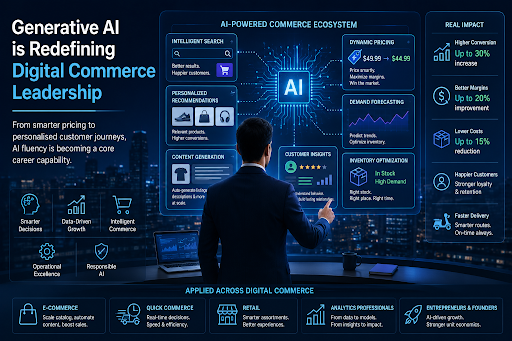
Across executive education, one shift stands out in conversations with working professionals over the past two years: the urgency has moved from data literacy to AI fluency. Professionals in e-commerce, retail, and digital-first businesses are no longer asking whether they need to understand artificial intelligence. They are asking how quickly they can build that understanding in a way that applies directly to their work.
This shift is not driven by hype. It is driven by observable business pressure: competitors deploying AI-powered pricing engines, platforms using generative models to produce thousands of product listings per hour, and logistics networks that self-optimise in real time. The professional who cannot speak to these capabilities, let alone lead them, is already navigating a narrowing career corridor.
What makes this moment particularly consequential for digital commerce is the arrival of large language models and generative tools that are natively applicable to the sector. The capabilities now embedded in Generative AI in E-commerce applications, from intelligent search to automated catalogue enrichment to hyper-personalised customer journeys, are not peripheral features. They are becoming the competitive surface itself.
"The competitive advantage in digital commerce is no longer who has the data. It is those who can build intelligent systems that act on them faster, more accurately, and at a greater scale than their competition."
Table of Contents
- Who Needs This Knowledge, and Why It Cannot Wait
- Skills Professionals Need for Generative AI in Digital Commerce
- Why the Credential Architecture Matters
- The Moment to Upskill Is Structural, Not Cyclical
Who Needs This Knowledge, and Why It Cannot Wait
The demand for AI capability in commerce contexts is not confined to technical roles. Three distinct professional cohorts are finding themselves at the intersection of urgency and opportunity, each for different reasons, each with different stakes.
E-Commerce, Quick Commerce, and Retail Professionals
Professionals working in e-commerce, quick commerce, retail, and digital businesses are experiencing a fundamental shift in what their roles require. Category managers, growth marketers, operations leads, and product owners are now expected to interpret AI-generated insights, evaluate model recommendations, and make decisions about automation that have direct revenue consequences. The capability gap is not about coding; it is about understanding AI-driven decision-making well enough to lead through it, challenge it, and integrate it into organisational strategy.
In quick commerce specifically, where the operational window is measured in minutes, and the margin for error is narrow, AI systems are already making real-time decisions about inventory positioning, slot allocation, and dynamic pricing. The professional who understands how these systems work and what they optimise for is not just better at their job. They are operating at a different level of strategic influence.
A structured Quick Commerce Certification Course that integrates AI application is not a supplement to this professional's career; it is the credentialing mechanism for a new standard of competence in the sector.
Data and Analytics Professionals in Transition
There is a cohort of analytics professionals who spent years mastering Excel, SQL, and BI dashboards and who now find themselves adjacent to, but not yet inside, the machine learning ecosystem. The transition from traditional analytics tools to Python-based AI and ML workflows is technically achievable but professionally disorienting. The tools have changed, the vocabulary has changed, and the output expectations have changed.
What this cohort needs is not a computer science degree. They need a structured pathway that builds Python fluency in the context of the business problems they already understand, demand forecasting, customer segmentation, price elasticity and that connects those models to production environments where they can deliver measurable value. The conceptual leap is smaller than it appears; the credential signals that the leap has been made.
An AI in E-commerce course that is built for domain practitioners, not software engineers, provides exactly this: applied machine learning in the context of commerce-specific datasets, challenges, and deployment scenarios. It validates not just theoretical knowledge but the ability to bring AI into a business workflow that already exists.
Entrepreneurs and Founders in E-Commerce and Quick Commerce
For founders, the AI question is fundamentally about unit economics. AI is not a feature it is a cost structure. Founders who understand how to apply AI to customer acquisition, retention modelling, logistics optimisation, and catalogue management are building businesses with structurally lower cost-to-serve and higher margin potential than those who are not. This is not a marginal advantage. In a sector where unit economics often determine survival, the ability to deploy applied AI is a business model decision.
The challenge for founders is that most AI education is designed for either technical practitioners or large enterprise contexts. The applied, outcomes-oriented framing that a founder needs, one that connects AI capability directly to growth levers, capital efficiency, and investor-facing metrics, is rarely the default mode of an AI programme. The exceptions are worth seeking out.
An Executive Program in AI for E-Commerce that is structured around applied outcomes, real business scenarios, live data challenges, and frameworks for scaling operations through intelligent automation speaks directly to the founder's calculus. It is not about learning AI in the abstract. It is about learning to scale with it.
CORE COMPETENCY FRAMEWORKSkills Professionals Need for Generative AI in Digital Commerce
The following framework maps the capability areas required for professionals to move from AI-aware to AI-capable in digital commerce environments.
| Skill Category | Key Competencies | Application in E-Commerce |
|---|---|---|
| Prompt Engineering | Crafting structured prompts, chain-of-thought reasoning, and few-shot learning techniques | Automated product descriptions, customer query resolution, and content personalisation |
| Large Language Model (LLM) Literacy | Understanding model architecture, fine-tuning concepts, and RAG (Retrieval-Augmented Generation) | Building AI-powered search, dynamic recommendation engines, and virtual shopping assistants |
| Python for AI Workflows | Pandas, NumPy, scikit-learn, Hugging Face APIs, LangChain integration | Demand forecasting models, churn prediction, and inventory optimisation scripts |
| AI-Driven Data Analytics | Transitioning from BI tools to ML pipelines, feature engineering, and model evaluation | Basket analysis, cohort modelling, real-time pricing intelligence |
| Generative AI for Marketing | Text-to-image tools, AI copywriting, multimodal content generation | Ad creative generation, personalised email campaigns, visual merchandising at scale |
| AI Ethics & Governance | Bias detection, explainability frameworks, data privacy compliance (DPDP Act) | Responsible AI deployment in customer-facing systems, audit readiness |
| Unit Economics & AI ROI | Contribution margin analysis, LTV: CAC modelling, AI cost-benefit frameworks | Measuring ROI of AI interventions in quick commerce logistics and fulfilment |
| MLOps & AI Deployment | Model versioning, CI/CD for ML, and monitoring model drift | Deploying recommendation and forecasting models in production e-commerce environments |
| Conversational AI Design | Dialogue flows, intent mapping, NLP pipeline design | WhatsApp commerce bots, voice search, and post-purchase support automation |
| Strategic AI Leadership | AI roadmap planning, cross-functional alignment, vendor evaluation | Leading AI adoption across merchandising, logistics, and customer experience teams |
Source: Compiled from industry skill demand analysis, NASSCOM Future of Work Report 2024, and executive education programme outcomes · For guidance purposes
Why the Credential Architecture Matters
In a market flooded with short-form AI certifications, the question of credential quality has become genuinely consequential. Hiring managers, venture investors, and growth-stage organisations are increasingly capable of distinguishing between a certificate of completion and evidence of applied capability. The former signals exposure; the latter signals readiness.
For professionals evaluating ecommerce certifications with an AI component, the relevant questions are not about duration or price. They are about faculty quality, assessment rigour, cohort composition, and the degree to which the curriculum engages with real commerce problems rather than generic AI use cases. A programme built in partnership with practitioners and assessed through live business challenges rather than standardised tests produces a different quality of learning outcome.
The professionals who will lead the next generation of digital commerce businesses are not those who know the most about AI in general. They are those who understand how to apply AI specifically, responsibly, and with commercial precision to the problems that define their sector. That combination of domain depth, applied AI capability, and executive judgment is what a genuinely rigorous programme is designed to produce.
"AI fluency in digital commerce is not a technical upgrade. It is a leadership capability, one that determines whether a professional shapes how their organisation uses intelligent systems, or simply responds to the choices others have already made."
The Moment to Upskill Is Structural, Not Cyclical
It would be a mistake to read the current urgency around AI upskilling as a market cycle. The professionals who have watched previous technology waves, such as mobile commerce, cloud infrastructure, and big data, understand that the window in which domain expertise and technical capability can be combined at a career level is narrow. After that window closes, the integration is assumed, and professionals who do not possess it are filtered out structurally, not individually.
The AI wave in commerce is not at its peak. It is at its inflexion point, the moment where those who build capability now will define the roles, the teams, and the organisations that shape the sector for the next decade. Executive programmes aligned with this reality are not a hedge against disruption. They are the most direct path through it.