
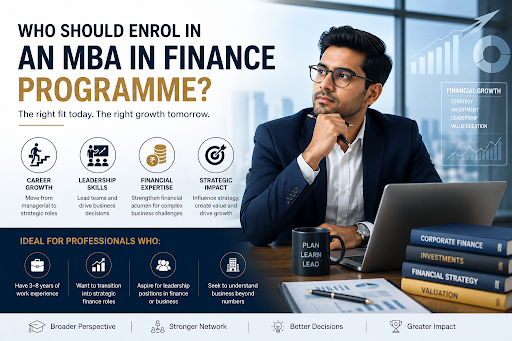
A Readiness-Based Way to Answer the Fit Question, Rather Than an Ambition-Based One
An MBA in Finance is not simply for anyone with ambition or a general interest in career change. It earns its place for professionals who have already accumulated a specific kind of experience gap, typically several years into a finance-adjacent role but lacking exposure to strategic decision-making, cross-functional leadership, or capital-allocation reasoning. Professionals without that functional base, and professionals already operating at senior finance-leadership or governance level, often gain less from a general MBA than the enthusiasm around the degree suggests. The honest answer to "who should enrol" depends far more on where a professional currently sits in their career trajectory than on how motivated they feel.
This shift is what is driving more mid-career finance professionals to ask whether a broader business degree, rather than another functional certification, is the more relevant next step, and it is also why the fit question deserves a more careful answer than "finance professionals should get an MBA."
Table of Contents
- The Finance Career Altitude Model (FCAM)
- Reading Fit by Professional Profile
- What Actually Follows After the Degree
- What Employers Are Actually Looking For
- Matching the Format to the Professional's Situation
- Frequently Asked Questions
The Finance Career Altitude Model (FCAM)
A more precise way to answer the fit question is to place a professional's current role along a four-altitude scale describing the nature of their finance responsibility, since the value of an MBA in Finance varies considerably by altitude rather than being uniformly high or low.
| Altitude | Typical Responsibility | Value of an MBA in Finance |
|---|---|---|
| Altitude 1 – Functional Execution | Analysing, reporting, and processing finance transactions within a defined scope | Limited immediate value; functional certifications usually matter more at this stage |
| Altitude 2 – Managerial Coordination | Managing budgets, small teams, and departmental finance processes | Moderate to high value; builds the cross-functional and leadership base that this altitude lacks |
| Altitude 3 – Strategic Influence | Business partnering, capital allocation input, shaping company-level financial strategy | Highest value: this is the transition the degree is most directly built to support |
| Altitude 4 – Governance & Enterprise Leadership | Board-facing, enterprise risk, CFO-level accountability | Lower incremental value; governance-specific executive credentials are typically more relevant here |
The clearest fit sits at the Altitude 2 to Altitude 3 transition professionals with managerial finance experience who are trying to move into strategic influence. Both the altitude below and the altitude above tend to be better served by other forms of preparation.
Reading Fit by Professional Profile
Altitude alone does not capture the full picture; motivation and starting point matter as well. The table below maps common candidate profiles against a realistic fit assessment.
| Profile | Typical Motivation | Fit Assessment |
|---|---|---|
| Finance analyst, 2–4 years' experience | Wants faster progression into managerial roles | Reasonable fit if paired with 2–3 more years of managerial exposure first |
| Mid-level finance manager, 5–8 years | Wants to move into strategic or business-partnering roles | Strongest fit; this is the transition the degree is most built for |
| Non-finance professional pivoting into finance | Wants a credible entry point into finance leadership | Reasonable fit only with a clear plan to close foundational finance knowledge gaps |
| Senior finance leader, 12+ years, already strategic | Wants continued credibility for board-facing roles | Often better served by a governance-focused executive credential than a general MBA |
What Actually Follows After the Degree
It is worth setting expectations accurately here, since overstated claims about outcomes are one of the more common sources of buyer's remorse. The typical career after MBA in Finance for a mid-career professional involves movement into business-partnering, financial strategy, or divisional leadership roles within two to four years a meaningful step up, but rarely an immediate jump to the C-suite, regardless of how the degree is sometimes marketed. Professionals expecting the latter outcome on a fixed timeline are usually setting themselves up for disappointment rather than evaluating the degree of its actual, more incremental return.
What Employers Are Actually Looking For
Employers evaluating candidates with an MBA in Finance on their resume are typically less interested in the credential itself than in the evidence of cross-functional reasoning it is meant to represent, the ability to connect a finance decision to a marketing trade-off, an operations constraint, or a talent decision. Candidates who can demonstrate that connection in an interview, rather than simply listing the degree, tend to see a materially stronger return on the qualification than those relying on the credential to speak for itself.
The finance function itself is changing shape. CFOs and finance leaders are increasingly expected to operate as strategic partners to the business rather than as controllers of historical reporting, taking on responsibility for capital allocation trade-offs, ESG-linked disclosure, and cross-functional strategy conversations that a purely technical finance background does not prepare professionals for.
- Assuming the degree is equally valuable at every career stage, rather than concentrated around the managerial-to-strategic transition.
- Treating an MBA in Finance as a substitute for foundational finance knowledge for professionals pivoting from unrelated functions.
- Expecting an automatic jump to C-suite roles on a fixed post-graduation timeline.
- Choosing a programme based on brand recognition alone, without checking whether the curriculum matches the professional's actual altitude gap.
- Underestimating how much of the value depends on the professional's ability to apply cross-functional reasoning afterwards, not just complete the coursework.
Matching the Format to the Professional's Situation
Format fit deserves as much attention as curriculum fit. An MBA in Finance for working professionals is generally the right category to evaluate for candidates in the Altitude 2 profile described above, since most cannot or should not step away from their current role to pursue the transition the degree is meant to support.
Within that category, format flexibility varies considerably, and it is worth evaluating carefully rather than assuming all options are interchangeable. An Online MBA in Finance can work well for candidates who need geographic and scheduling flexibility, provided the programme still includes live cohort interaction and applied project work rather than purely self-paced content.
Whatever the format, the underlying curriculum quality is what ultimately determines the return on the degree. A credible MBA Finance course should be evaluated against the altitude-gap it is meant to close, cross-functional case work, capital-allocation simulations, and strategic decision-making content rather than judged on reputation or marketing material alone.