
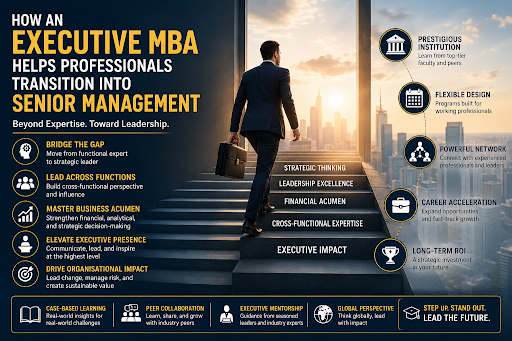
Mid-career professionals in India are hitting a wall — not because they lack ambition, but because a traditional degree no longer signals what modern organizations need at the top.
The core difference between an executive MBA and MBA comes down to one thing: who's in the room with you. A standard MBA fills classrooms with fresh graduates building foundational business literacy. An EMBA draws mid-to-senior professionals — typically with 8–15 years of experience — who are already making consequential decisions and need frameworks to sharpen, not introduce, their leadership instincts.
This distinction matters enormously in the Indian corporate context. According to the Emeritus India Executive Education Survey, 72% of Indian employers value upskilling through executive education as a primary factor when considering internal promotions to senior management roles. Generic degrees are losing ground to programs that deliver applied, peer-driven learning.
The shift, at its core, is from learning to work to learning to lead. When every classmate brings a decade of real-world scar tissue into the discussion, strategy debates stop being theoretical. The peer quality in an EMBA cohort is arguably its single greatest differentiator — something no case study library can replicate.
That elevated caliber comes with a price tag worth scrutinizing — and a return on investment that deserves an equally hard look.
Table of Contents
- Calculating the ROI: Salary Hikes and Global Recognition
- The Rise of the Online Executive MBA in India's Premier Institutes
- Top Options for Executive MBA in India: Navigating the Elite Landscape
- Balancing the Grind: Can You Really Do an EMBA While Working?
- The Bottom Line: What You Need to Know Before Applying
- Securing Your Seat: How to Choose the Right Executive Path
Calculating the ROI: Salary Hikes and Global Recognition
An Executive MBA from a premier Indian institution delivers measurable financial returns that consistently outpace the program's total cost — often within two years of graduation.
According to ET Rise, EMBA graduates in India report average salary increases of 30% to 50% within two years of completion. For a mid-career professional earning ₹20–30 LPA, that's a meaningful jump — one that compounds over the remaining arc of a 20-year career.
The financial case becomes stronger when you factor in what the degree actually unlocks:
- Immediate compensation gains through promotions, lateral moves, or role expansions triggered by the credential
- Global mobility via Triple Crown accreditation (AACSB, AMBA, and EQUIS) — a distinction held by select Indian B-schools that places their programs in the top 1% worldwide
- Brand equity from IIT and IIM affiliations, which functions as a lifelong career hedge — recognized by recruiters and boards decades after graduation
- Zero workforce exit cost since Executive MBA formats keep you employed throughout, unlike full-time programs that demand two years of lost income and seniority
Stat Callout
Professionals who pursue an mba online university india route through an accredited IIT or IIM program retain their salary continuity and unlock post-graduation income growth — a dual financial advantage no traditional full-time MBA can replicate.
The "is it expensive?" question deserves a direct answer: yes, tuition is substantial. But the true cost comparison runs between investing in the degree versus not investing — and watching peers who did accelerate past you into CXO roles. If you're weighing whether the timing is right, this breakdown of the professional sweet spot makes the calculus concrete.
The financial ROI is compelling. What's shifting even faster is how these programs are delivered — and that's where elite Indian institutions are rewriting the rulebook entirely.
The Rise of the Online Executive MBA in India's Premier Institutes
Online no longer means second-tier — for executive education in India's top institutions, it has become the dominant delivery standard.
The word "online" still triggers skepticism among some mid-career professionals. That skepticism, however, is increasingly misplaced. When evaluating an online MBA in India universities like IIT Bombay, IIM Calcutta, or IIM Bangalore, you're looking at the same faculty, the same case-study rigor, and the same peer cohorts — delivered through a format designed specifically for people who cannot pause their careers for a full-time classroom.
Hybrid models have been the real equalizer. As the Director of IIM Ahmedabad noted, "The shift toward hybrid and online delivery models has democratized access to elite faculty at IITs and IIMs, allowing professionals to apply classroom learnings to their jobs in real-time." That last phrase matters enormously. A strategy framework taught on a Saturday morning can be tested in a Monday leadership meeting. This applied learning loop — theory to practice within 48 hours — is something a traditional full-time program structurally cannot replicate. If you're weighing whether the format holds up, the case for pursuing it now is stronger than at any previous point.
The "is it worth it" question deserves a direct answer: yes, provided the institution carries genuine brand equity. Recruiters and boards evaluate the name on the degree, not the delivery mode. What matters is choosing wisely — and that starts with understanding which programs actually offer the credential, the network, and the curriculum that move careers forward.
Top Options for Executive MBA in India: Navigating the Elite Landscape
India's EMBA landscape has three distinct tiers — and knowing which one aligns with your career trajectory is the decision that matters most.
The institution you choose shapes not just your credential, but the entire professional ecosystem you step into.
The Big Three (IIMs) remain the gold standard for general management leadership. IIM Sambalpur, Ahmedabad, Bangalore, and Bodh Gaya command unmatched alumni networks across Indian boardrooms, making them particularly powerful for managers targeting CFO, COO, or CEO tracks within domestic conglomerates and MNCs.
Technical Leaders (IITs) serve a different ambition. If your career runs through Product Management, Digital Transformation, or deep-tech strategy, IIT-affiliated programs blend engineering rigor with business acumen in ways the IIMs simply don't replicate. The standout example here is the IIT Bombay–Washington University in St. Louis joint degree — India's first and only joint EMBA — which delivers genuine global-local synergy by combining Silicon Valley-influenced curriculum design with India's top technical institution.
Global Partnerships fill a third lane: programs built around international faculty exchanges, dual credentials, or cross-border cohorts. For managers whose growth path includes emerging market leadership, understanding how EMBAs perform across global contexts adds a critical dimension to the decision.
Across all three tiers, two filters consistently separate strong choices from average ones: alumni network density in your target industry, and active industry tie-ups that translate into live projects and recruiting pipelines. The rise of the executive mba degree online has made geographic barriers largely irrelevant — what still matters is the caliber of the cohort sitting beside you. That cohort question, and how you actually survive the workload while holding down a demanding role, is exactly where the next piece of this conversation begins.
Balancing the Grind: Can You Really Do an EMBA While Working?
Pursuing an executive online MBA while holding down a demanding job is one of the most common anxieties prospective students carry — and it deserves an honest answer.
The double-shift is real, but it's also manageable by design. Most top-tier Indian EMBAs are now built specifically around working professionals, with weekend modules, asynchronous lectures, and evening live sessions that protect your weekday output. IIM Sambalpur and platform data from Cep confirm this is now the standard format — not the exception.
Four strategies that consistently help students stay on track:
- Block calendar time early. Treat study hours like client meetings — non-negotiable.
- Communicate with your manager. Framing the program as a company investment, not a personal side project, opens the door to sponsorship conversations.
- Batch your assignments. Most platforms allow content access on demand, so weekend sprint sessions beat daily fragments.
- Lean on your cohort. Peer accountability inside a cohort of fellow working managers is one of the most underrated productivity tools available.
The Power of the Cohort: Your classmates aren't just study partners — they're a live professional network of cross-industry leaders solving the same real-time challenges you face. That peer learning compounds alongside the curriculum in ways a solo certification never can.
Understanding how structured peer learning drives promotions helps frame the EMBA not as a burden, but as a career accelerator — which sets up the real question: is the return on that investment worth it?
The Bottom Line: What You Need to Know Before Applying
Choosing the best MBA for working professionals in India comes down to four non-negotiable factors — and understanding them now saves you from a costly misstep later.
The financial case is straightforward. Professionals who complete a premier EMBA program typically see 30–50% salary growth within 24 months of graduation. That's not anecdotal optimism; it's a pattern consistent across IIT and IIM alumni networks. When you factor in the program cost against that earnings trajectory, the return on a senior management credential becomes one of the stronger investments a mid-career professional can make.
Prestige still drives decisions in the Indian market. An IIT or IIM brand on your resume signals readiness for the C-suite in a way that few other qualifications can replicate. Hiring committees and promotion panels recognize these names immediately — that instant recognition is a competitive asset you carry for the rest of your career.
Flexibility is no longer a compromise. Today's hybrid and online formats from premier institutes let you build an elite credential without stepping away from your current role. Institutions like IIM Bodh Gaya have structured their online EMBA curriculum specifically around the schedules of senior professionals.
Finally, employer alignment matters more than most candidates realize. According to the Emeritus India Executive Education Survey , 72% of Indian companies prioritize upskilling credentials when evaluating candidates for senior promotions. That statistic reframes the EMBA from a personal goal into an organizational expectation. With those fundamentals clear, the next step is figuring out which specific path fits your industry and ambitions.
Securing Your Seat: How to Choose the Right Executive Path
The managers who lead India's next growth decade won't just outwork their peers — they'll out-credential them. As 2026 approaches, an executive MBA from a recognized institution isn't a nice-to-have; it's the signal that separates candidates shortlisted for C-suite conversations from those stuck in mid-management holding patterns. Elite credentials carry real weight in hiring committees, promotion reviews, and boardroom introductions.
Match your program to your industry trajectory, not just your resume. A professional pivoting into AI-driven product management needs different frameworks than a supply chain leader targeting operations leadership — and the right EMBA cohort, curriculum, and faculty mix reflects that distinction. Evaluate programs by the sectors they specialize in, the peer networks they attract, and whether their case studies mirror the business problems you're actually solving at work. Generic programs produce generic outcomes.
That's precisely where Cep by Digivarsity changes the equation. Cep provides a centralized platform for exclusive online programs from India's premier institutes — IITs, IIMs, and institutions actively pursuing global triple-crown accreditation — removing the friction of researching, comparing, and applying across scattered sources. One destination, India's most credible programs.
The choice is straightforward: don't just work harder in 2026 — credential smarter. Explore the executive programs available through Cep and take the step that separates ambition from achievement.