
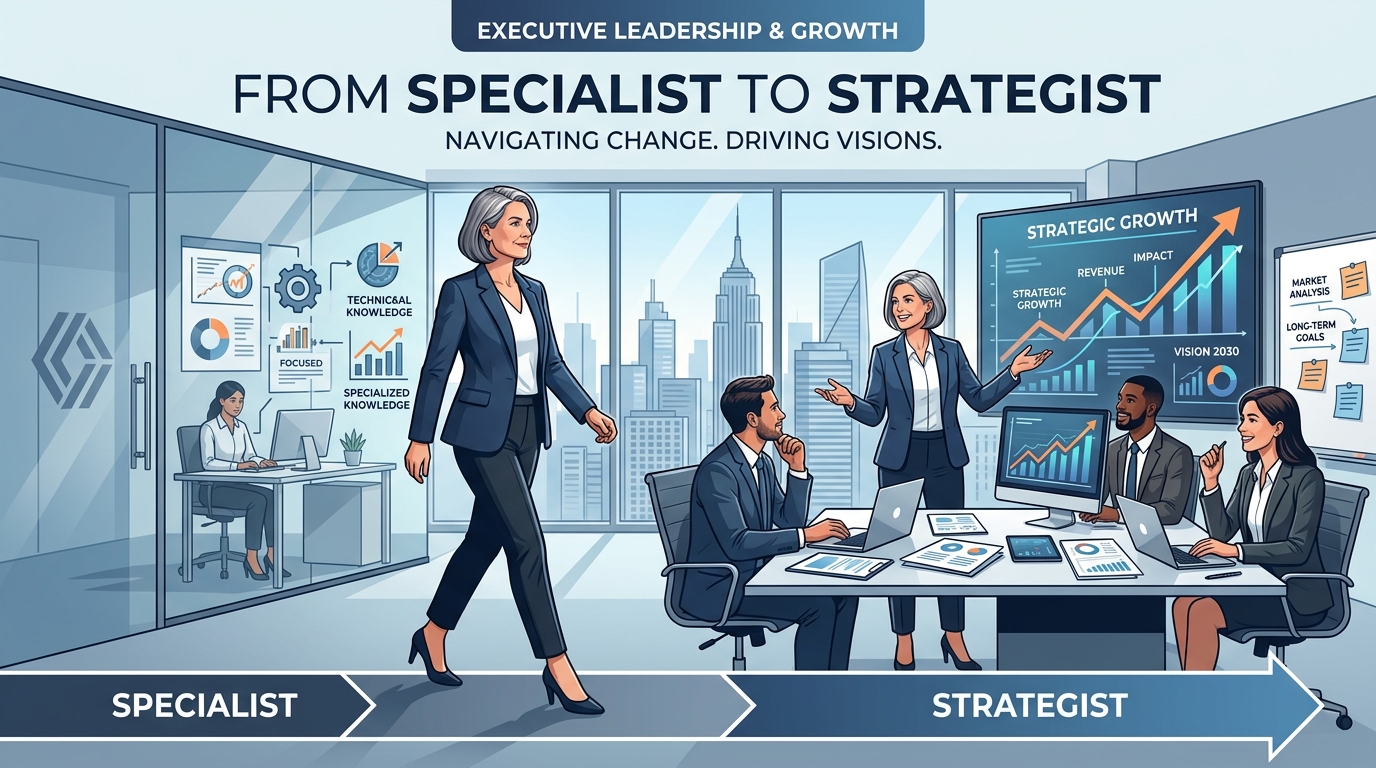
A cross-functional leader is a professional who delivers results that span several functions without holding line authority over all of them. Typical examples include a product manager aligning engineering, sales and compliance, a programme lead running a transformation across business units, or a finance partner shaping decisions in operations. The defining feature is that outcomes depend on people who report elsewhere.
The category is growing because most consequential work no longer fits inside one function. Launching a product, entering a market, adopting AI, or meeting a new regulation each touches technology, finance, operations, legal and people management at the same time. Organisations therefore reward professionals who can lead across those boundaries, not only within them.
Table of Contents
- Why the Boundary Is Moving
- The Hidden Cost of Collaboration
- A Working Model: The Influence Span Ladder
- Skills Needed at Each Rung
- Self-Audit: Which Rung Is the Constraint?
- Common Stalls
- Building the Capability Deliberately
- Frequently Asked Questions
Why the Boundary Is Moving
Four developments explain the shift.
- Skills are changing quickly. The World Economic Forum's Future of Jobs Report 2025 estimates that 39% of workers' core skills are expected to change by 2030. Analytical thinking is named as a core skill by roughly seven in ten employers, and leadership and social influence also appear among the core skills.
- Work is organised around outcomes. Platform, product and project structures place people from different functions in the same team for a shared result.
- Technology links functions more tightly. Data, automation and AI initiatives need business, technical and risk perspectives together.
- Flatter structures remove escalation routes. When fewer layers exist above a team, cross-functional problems must be resolved by peers.
The Hidden Cost of Collaboration
Cross-functional leadership is not simply "more collaboration". Rob Cross, Reb Rebele and Adam Grant wrote in Harvard Business Review that the time managers and employees spend in collaborative activities has "ballooned by 50% or more" over two decades. In an interview with MIT Sloan Management Review, Cross described how the time and energy costs of collaboration are largely invisible, and said that reducing collaborative overload can recover roughly 18% to 24% of a person's time.
The implication is that cross-functional leaders do not need to collaborate more. They need to collaborate selectively and structurally: clear decision rights, defined handoffs and a small number of well-chosen relationships.
A Working Model: The Influence Span Ladder
The Influence Span Ladder describes four rungs of cross-functional leadership. Each rung widens the span of influence, and each requires a different dominant skill. Professionals often stall because they keep applying the skills of one rung to the problems of the next.
The progression of professional influence can be understood through four stages.
- An Owner operates within a single function, using specialised knowledge to deliver expert results within a defined area of responsibility.
- A Translator works across two adjacent functions, bridging the gap between technical and commercial language to improve mutual understanding.
- An Orchestrator coordinates multiple functions towards a shared outcome by clarifying decision ownership, identifying contributors and informed stakeholders, and sequencing work across teams.
- At the highest level, a Steward considers the organisation as a whole, applying enterprise-level judgement to weigh competing priorities and accepting local trade-offs when they serve the wider organisational goals.
Skills Needed at Each Rung
| Skill | Rung where it becomes decisive | What it involves |
|---|---|---|
| Functional literacy | 2 | Understanding the economics, constraints and language of neighbouring functions |
| Influence without authority | 2 to 3 | Persuading through evidence, relationships and shared goals rather than rank |
| Decision orchestration | 3 | Clarifying who decides, who contributes and who is informed |
| Boundary and role management | 3 | Defining handoffs so work does not fall between teams |
| Conflict fluency | 3 to 4 | Treating disagreement between functions as input to a better decision |
| Balancing autonomy and alignment | 4 | Setting guardrails while letting teams act locally |
| Enterprise thinking | 4 | Optimising for the whole organisation instead of the home function |
| Capital and risk fluency | 4 | Reading financial statements, allocating resources and pricing risk |
Self-Audit: Which Rung Is the Constraint?
Professionals can test their current position with five questions.
- Can the economics of two neighbouring functions be explained without notes?
- When a cross-functional project stalls, is the cause usually unclear decision rights rather than lack of effort?
- Are handoffs documented, or do they rely on goodwill?
- Has a decision recently been accepted that hurt the home function but helped the organisation?
- Does the professional's network extend beyond the immediate team, and is it used deliberately?
A "no" on questions 1 and 2 points to rung two or three skills. A "no" on question 4 suggests the fourth rung is the next constraint.
Common Stalls
- Staying too deep. Expertise that earned the first promotion becomes the reason for avoiding broader questions.
- Collaborating by default. Adding stakeholders to every discussion increases load without improving decisions.
- Confusing consensus with clarity. A project can be fully agreed and still have no named decision owner.
- Skipping financial fluency. Cross-functional proposals are judged in financial terms, so leaders who cannot read the numbers lose influence.
Building the Capability Deliberately
Experience across functions can be built through rotations, special projects and cross-functional task forces, but opportunities depend on the employer and are not guaranteed. Formal learning can speed the process, particularly for rungs three and four, where finance, strategy, operations and people management must be understood together rather than separately.
For working managers, an Online Executive MBA allows study alongside a full-time role, which also means that each module can be tested immediately on live work problems.
Professionals comparing an Executive MBA India offers should look for case-based teaching across functions, faculty who have led cross-functional work, and a cohort drawn from different industries and functions, since peer diversity trains the translation skills that rung two demands.
An MBA for experienced professionals is most suitable when the person already has depth in a function and now needs breadth, which is the transition between rungs one and three.
Frequently Asked Questions
A cross-functional leader delivers outcomes that span several functions without direct authority over all of them, relying on influence, clear decision rights and shared goals.
General management carries line authority over a unit. Cross-functional leadership frequently operates through peers and partners, so persuasion, role clarity and decision orchestration matter more than formal control.
The most consistent skills across sources are influence without authority, decision orchestration, role and boundary clarity, conflict fluency and enterprise thinking.
Common routes include joining task forces, taking on projects that need other functions, rotating into adjacent roles and learning the financial language of the business.
Formal learning becomes valuable when professionals have established expertise in one function but need broader capabilities in strategy, finance, operations and people management.