
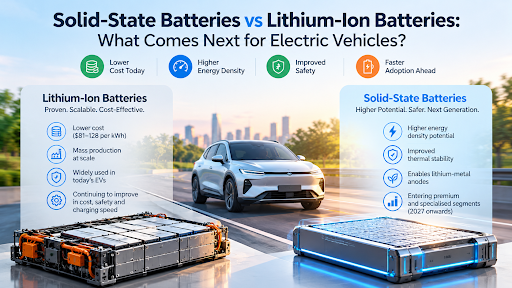
Solid-state batteries are the most closely watched successor to lithium-ion, but they will not replace it in the near term. The realistic outlook for the rest of this decade is coexistence: lithium-ion, especially lithium iron phosphate (LFP), will continue to dominate mass-market electric vehicles, while solid-state batteries enter premium and specialised segments from around 2027 and scale gradually after that.
Three facts frame the transition:
- Lithium-ion keeps getting cheaper. BloombergNEF's 2025 survey put average battery pack prices at a record low of $108 per kWh, with electric vehicle packs below $100 per kWh for a second year.
- Solid-state is moving from laboratory to pilot line. Toyota is targeting a market launch of electric vehicles with all-solid-state batteries in 2027–28, and QuantumScape opened its Eagle Line pilot production facility in February 2026.
- Definitions are being formalised. China has developed its first national standard on solid-state battery terminology, which separates true all-solid-state batteries from "solid-liquid" designs often marketed as semi-solid.
For engineers and industry professionals, the question is less about which chemistry wins and more about how vehicle design, manufacturing and safety engineering must adapt as several battery technologies run side by side.
Table of Contents
- How the Two Technologies Work
- Where Lithium-Ion Stands Today
- The State of Solid-State in 2026
- The Five-Gate Commercialisation Test
- What Changes for Vehicle Engineering
- Skills the Battery Transition Demands
- Learning Pathways for Professionals
- Frequently Asked Questions
How the Two Technologies Work
Both battery types move lithium ions between a cathode and an anode. The difference lies in the electrolyte, the material that carries the ions between the two electrodes.
Lithium-ion battery: Uses a liquid organic electrolyte soaked into a porous separator. The technology is mature, well understood and manufactured at enormous scale, but the liquid electrolyte is flammable and limits the use of higher-energy anode materials.
All-solid-state battery: Replaces the liquid electrolyte with a solid material, typically a sulfide, oxide or polymer. This can enable lithium-metal anodes, higher energy density and improved thermal stability.
Semi-solid or "solid-liquid" battery: Combines solid electrolyte materials with a reduced amount of liquid electrolyte. It offers some of the benefits of solid-state chemistry while staying closer to existing manufacturing processes.
| Parameter | LFP lithium-ion | NMC lithium-ion | Semi-solid (solid-liquid) | All-solid-state |
|---|---|---|---|---|
| Electrolyte | Liquid | Liquid | Mostly solid with some liquid | Solid |
| Typical cell energy density | Moderate | High | High | Highest potential, especially with lithium-metal anodes |
| Thermal safety | Strong for lithium-ion | Requires careful thermal management | Improved | Potentially strongest, depending on chemistry |
| Manufacturing maturity | Mass production | Mass production | Limited production | Pilot lines |
| Cost position | Lowest | Moderate | Higher | Highest at present |
| Main remaining challenge | Lower energy density | Cost and raw-material exposure | Scaling and cost | Interfaces, durability, manufacturing yield |
Where Lithium-Ion Stands Today
Lithium-ion is not a static technology waiting to be displaced. It continues to improve on cost, safety and charging speed.
BloombergNEF's 2025 Battery Price Survey found that average pack prices fell 8% to $108 per kWh. LFP packs averaged $81 per kWh, compared with $128 per kWh for nickel-based NMC packs, and China recorded the lowest regional average at $84 per kWh. BloombergNEF expects prices to fall further, and identifies solid-state electrolytes among the emerging technologies that could drive the next round of cost reductions.
India's market shows why cost matters. According to Autocar Professional, electric vehicle sales in FY2026 reached about 2.45 million units, up 25%, taking EVs to 8.27% of all vehicle sales. Electric three-wheelers accounted for 61% of all three-wheeler sales, and electric car sales rose 84% to nearly 2 lakh units. In a market dominated by price-sensitive two- and three-wheelers, affordable and durable chemistries such as LFP will remain central for years.
Observation: In price-sensitive markets, a battery's success depends less on peak energy density than on cost per kilometre over the vehicle's life. Solid-state batteries will reach Indian two-wheelers and three-wheelers only after they win on total cost of ownership, not merely on range.
The State of Solid-State in 2026
Solid-state development has moved decisively from research papers to industrial programmes, but commercial volumes remain small.
Toyota: In October 2025, Toyota and Sumitomo Metal Mining announced a collaboration to mass-produce cathode materials for all-solid-state batteries. Toyota is targeting a market launch of electric vehicles using these batteries in 2027–28, citing longer range, shorter charging times and higher output.
QuantumScape: According to its February 2026 shareholder letter, the company inaugurated its Eagle Line pilot production facility on 4 February 2026, shipped cells to the Volkswagen Group in 2025, and demonstrated its technology in a Ducati electric race bike at IAA Mobility in September 2025. It has added two further global automakers as development partners.
China: China has developed a national standard titled Solid-state batteries for electric vehicles, Part 1: Terminology and classification. Reporting in February 2026 indicated a release target of July 2026, with batteries classified as liquid, solid-liquid or all-solid-state. The standard is significant because it limits the loose use of the term "solid-state" for products that still contain liquid electrolyte.
The engineering challenges still being solved
- Interface stability: Solid electrolytes must maintain intimate contact with electrodes as they expand and contract during charging.
- Dendrite suppression: Lithium-metal anodes can grow filaments that short-circuit cells if the electrolyte does not block them.
- Manufacturing yield: Thin, defect-free solid electrolyte layers are difficult to produce at high speed and low cost.
- Material handling: Some sulfide electrolytes react with moisture, requiring tightly controlled dry-room production.
- Stack pressure: Many solid-state designs need external pressure to perform, which affects module and pack design.
The Five-Gate Commercialisation Test
The Five-Gate Commercialisation Test is a framework for judging how close a battery technology is to mainstream electric vehicle use. It replaces headline claims about energy density with five sequential gates that every chemistry must clear before it reaches mass-market vehicles.
- Cell performance: Energy density, power and charging speed demonstrated in cells.
- Durability and safety: Cycle life, calendar life and abuse testing validated to automotive standards.
- Manufacturing at scale: High-yield, high-speed production in dedicated facilities.
- Cost competitiveness: Cost per kWh and per kilometre over the vehicle's life, competitive with incumbent chemistries.
- Vehicle integration: Packs, thermal systems, battery management and supply chains proven in production vehicles.
Reading the assessment
Cell performance is no longer the bottleneck. Most solid-state programmes have demonstrated attractive cell-level results; the delay lies in the later gates.
Manufacturing at scale and cost competitiveness are the hardest gates. They explain why first deployments are expected in premium vehicles, where higher battery costs can be absorbed.
The test is sequential in practice. A technology that skips validation to reach market faster risks recalls, which can set an entire chemistry back by years.
Using the framework: When a new battery announcement appears, the most useful question is which gate it has cleared. A record energy density in a laboratory cell clears gate one; a production vehicle on public roads indicates progress through gate five.
What Changes for Vehicle Engineering
Even when solid-state batteries reach production, they will change far more than the cell. The table below summarises the main system-level implications.
- Pack Structure: Current lithium-ion batteries use modules or cell-to-pack designs with liquid-electrolyte cells. Solid-state batteries may require controlled stack pressure and redesigned mechanical structures.
- Thermal Management: Lithium-ion batteries need active cooling to reduce thermal runaway risks. Solid-state batteries have different thermal requirements, with some solid electrolytes performing best at elevated temperatures.
- Battery Management System: Existing systems use established state-of-charge and state-of-health algorithms. Solid-state batteries will require new models to account for their distinct degradation patterns and failure behaviour.
- Charging: Fast charging in lithium-ion batteries is limited by heat generation and lithium plating. Solid-state batteries may support faster charging, depending on interface stability.
- Safety Validation: Lithium-ion batteries follow established abuse-testing standards, while solid-state batteries require further characterisation of new failure modes as safety standards evolve.
- Supply Chain: Lithium-ion battery production relies on established suppliers of cathodes, anodes, separators and electrolytes. Solid-state adoption will require new supply chains for materials such as solid electrolytes and lithium metal.
- Recycling: Existing lithium-ion recycling processes are developing at scale, whereas solid-state batteries will require new recovery methods suited to their solid electrolytes and other materials.
Skills the Battery Transition Demands
Because multiple chemistries will coexist, the most valuable professionals will understand batteries as part of the whole vehicle system rather than as isolated components.
| Skill area | Why it matters | Typical roles |
|---|---|---|
| Electrochemistry and materials | Explains how chemistries differ in performance, ageing and failure | Cell engineer, materials scientist |
| Battery management systems | Every chemistry needs accurate state estimation and protection | BMS engineer, embedded engineer |
| Thermal and mechanical pack design | Packs must manage heat, pressure, crash safety and serviceability | Pack design engineer, thermal engineer |
| Power electronics and drivetrains | Motors, inverters and chargers must match battery characteristics | Power electronics engineer, powertrain engineer |
| Testing and validation | New chemistries require new test methods and safety standards | Validation engineer, homologation specialist |
| Manufacturing and quality | Yield and consistency decide commercial viability | Process engineer, quality engineer |
| Data and modelling | Simulation and analytics shorten development and predict battery life | Battery modelling engineer, data scientist |
Professionals already working in automotive, electrical or energy roles are well placed to move into these areas. The common requirement is a working knowledge of electric vehicle technology as an integrated system: how the battery, motor, power electronics, charging and vehicle controls interact, and how a change in one affects the others.
Learning Pathways for Professionals
The transition from internal combustion to electric vehicles, and from one battery generation to the next, has created a sustained need for structured, industry-relevant learning.
An EV course for working professionals is most valuable when it is designed around the constraints of full-time employment, combining online learning with practical sessions and projects that relate directly to participants' current roles. Engineers moving from conventional automotive, electrical or manufacturing backgrounds can build electric-vehicle expertise without leaving their careers.
The content should reflect the system view described above. A strong EV systems course covers battery chemistry and management, electric machines, power electronics, charging infrastructure, vehicle dynamics and thermal management together, rather than treating each topic as a separate specialisation. It should also prepare learners to evaluate emerging technologies, including solid-state batteries, against criteria such as the Five-Gate Commercialisation Test.
For engineers aiming at design leadership, research and development, or senior technical roles, an Executive MTech in EV offers the depth those positions require: advanced electrochemistry, battery modelling, power electronics design and system integration, delivered in a format compatible with professional work. A postgraduate qualification also strengthens credibility when leading cross-disciplinary teams through technology transitions.