
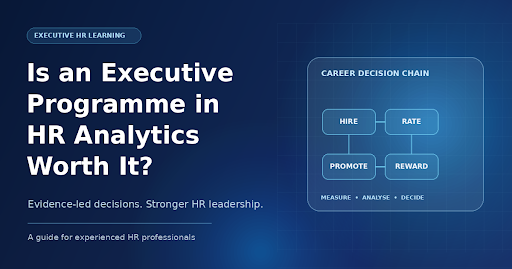
Every hiring call, rating, pay revision, promotion and exit made by an HR function becomes a line in someone's working life. A rating can follow a person across teams. A hiring screen can decide whether a career begins at an organisation at all. A promotion list can set the direction of a decade.
Table of Contents
- Your Decisions Can Shape Someone's Career
- A Working Model: The Career Decision Chain
- Why the Standard of Evidence Is Rising
- Where the Learning Pays Off
- When It Is Not Worth It
- Evaluating the Learning Options
- Frequently Asked Questions
Your Decisions Can Shape Someone's Career
Experienced HR professionals already know this from practice. What is changing is the expectation that such decisions are supported by evidence that can be explained, audited and defended. The question of whether advanced study in people analytics is worthwhile therefore turns on one test: does it improve the quality of the decisions that shape careers?
Advanced study in people analytics is worth the time and cost for experienced HR professionals in three situations: when the role involves decisions that are currently made without usable data, when the function is expected to explain those decisions to executives, regulators or employees, and when the next step in the career is a leadership role that owns workforce strategy. It is worth less when the role is largely transactional, and no data is available to analyse.
A Working Model: The Career Decision Chain
The Career Decision Chain maps six decision points in the employee journey and names the evidence each should rest on. It is a way of locating where analytical capability changes outcomes for individuals, rather than a list of analytics techniques.
Applying the chain takes four steps. First, list the decisions the function makes in a year. Second, locate each on the chain. Third, record what evidence currently supports it. Fourth, rank the gaps by how much of a person's career a single decision can change.
A shorter HR analytics course suits professionals who need a specific skill, such as basic statistics or dashboarding, without committing to a full executive format.
Why the Standard of Evidence Is Rising
Three pressures are raising the bar for how HR decisions are justified.
Executive expectations
A May 2026 report in HR Executive cites Mercer research finding that only 27% of executives believe their HR team effectively advises them on human capital risks, while executives and investors rank improved people analytics among their top priorities for return on investment in 2026. The gap between priority and confidence is the space experienced HR professionals are being asked to close.
Regulation of automated employment decisions
The EU AI Act classifies AI used for recruitment, promotion, termination, task allocation and performance monitoring as high-risk, according to Hunton Andrews Kurth's analysis. Employers using such systems must inform candidates and employees, keep human oversight, check that input data is relevant and representative, and ensure staff using the systems have adequate AI literacy. The original application date for most high-risk obligations was 2 August 2026. A provisional agreement reached in May 2026 moves the obligations covering employment-related systems to 2 December 2027, as Gibson Dunn reported at the time, and a later Mondaq item, which was not reviewed in full, is headlined as the omnibus entering into force. The current legal position should be confirmed before relying on either date. Indian employers with European operations, or with vendors that use such systems, are indirectly affected.
Data protection in India
India's Digital Personal Data Protection Rules were finalised in November 2025, with full compliance for core data-handling duties due by mid-May 2027, according to Fisher Phillips. Employers are expected to give itemised privacy notices, secure employee data, report breaches within defined timelines and delete data once its purpose is served. Penalties reach up to ₹250 crore for failures in security safeguards. Analytical work on employee data therefore needs governance built in from the start.
Where the Learning Pays Off
Data-driven people decisions require more than access to analytics tools. HR professionals need the ability to interpret evidence, assess fairness, protect sensitive information and communicate findings clearly. The following capabilities help ensure that data supports better decisions across hiring, performance measurement, rewards, promotions and employee exits.
- Measurement Design: Determines what should be measured and whether the chosen metrics accurately reflect the work being performed. This is particularly important for decisions related to employee performance measurement and rewards.
- Statistical Reasoning: Helps distinguish meaningful patterns from random variation, especially when analysing data from small employee groups. It supports sound judgement across all people-related decisions.
- Fairness and Bias Testing: Identifies differences in outcomes across employee groups during hiring, promotions and exits, helping organisations detect potential bias before it becomes embedded in decision-making processes.
- Data Governance and Privacy: Ensures that employee data is collected, accessed and analysed lawfully, securely and proportionately. This capability is essential across all stages of people management.
- Storytelling with Data: Translates analytical findings into clear explanations that executives and employees can understand. It is particularly valuable when communicating decisions about rewards and promotions.
- Technology Evaluation: Enables HR professionals to assess vendor claims and test the reliability of technology before using it to influence hiring or employee placement decisions.
An HR analytics programme designed for working professionals should include applied projects on the organisation's own data, since the transfer from classroom to decision is where most value is created.
When measurement, analytical rigour, fairness and communication work together, organisations can use people analytics more responsibly and make decisions that are transparent, defensible and aligned with business objectives.
When It Is Not Worth It
- No decision to change. If the function has no authority over hiring, rating, pay or promotion decisions, the analytical skills have little to attach to.
- No data foundation. Where records are fragmented or unreliable, data cleaning and governance come before advanced analysis.
- Tool training mistaken for capability. Learning a dashboard tool is different from learning to design a measure or to test an outcome for fairness.
- No executive sponsorship. Analysis that cannot influence decisions rarely changes outcomes for anyone.
Evaluating the Learning Options
Experienced professionals can choose between short courses, certifications and extended executive formats. The most useful test is whether the content maps to the capability table above and gives practice on real decisions.
An HR analytics certification for professionals is useful as an external signal of capability when it includes assessed work and not only attendance.
An executive programme in HR management is better matched to those moving from analysis into leadership, where analytical skill must be combined with workforce strategy, organisational design and board-level communication.
Frequently Asked Questions
It is worth it when the role carries decision authority and current decisions lack usable evidence. Senior professionals gain most when they can pair their judgement with measurement, because the combination makes decisions easier to explain.
Most professional formats assume basic numeracy rather than programming skills. Statistical reasoning, measurement design and data interpretation are usually taught from first principles.
Evidence-based practices make hiring, rating, pay and promotion criteria more consistent and easier to examine. Differences in outcomes across groups can be identified and investigated earlier.
Risks include biased training data, over-reliance on automated scores, invasive monitoring and weak data security. Regulations such as the EU AI Act and India's data protection rules add legal exposure for poorly governed use.
Check whether it includes applied work on real workforce decisions, assessed outcomes, faculty with practical experience and coverage of fairness and data governance. Alignment with the professional's next career step should decide the choice.