
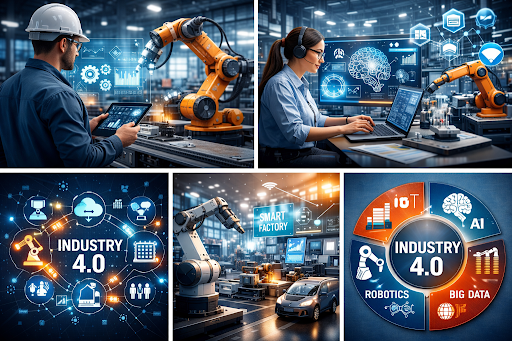
There is a particular clarity that comes from standing at an inflexion point long enough to see it clearly. Over seventeen years of teaching engineering — spanning the era of manual circuit design, through the emergence of FPGA-based programmable logic, into the current moment where a thumb-sized chip can run a neural network, and a factory floor can communicate with itself in real time — I have watched the discipline transform in ways that would have been difficult to anticipate at any one point along the way.
What Industry 4.0 represents is not simply the next iteration of industrial technology. It is a convergence of intelligent hardware, connected systems, and secure infrastructure that is restructuring the foundations of how physical industries operate and how engineers contribute to them. The term itself, coined in Germany's manufacturing policy discourse and now adopted globally, describes the integration of automation, cyber-physical systems, the Internet of Things, and data intelligence into a single operating paradigm.
Three engineering disciplines sit at the structural core of this transformation: VLSI and chip design, which provides the intelligent hardware on which everything runs; IoT and autonomous systems, which enable machines, devices, and infrastructure to sense, communicate, and act; and cybersecurity, which ensures that the integration of digital and physical systems does not create attack surfaces that exceed the value of the connectivity they provide.
Table of Contents
- Industry 4.0: The Convergence That Changes Everything
- M.Tech in VLSI Design: Engineering Intelligence at the Silicon Level
- M.Tech in IoT and Autonomous Systems: Connecting the Physical and Digital Worlds
- M.Tech in Cybersecurity: Securing the Infrastructure of Automation
- Comparative Overview: The Three M.Tech Programmes at a Glance
- The Intersection: Why These Three Programmes Form a Coherent Ecosystem
- The M.Tech for Working Professionals: Why the Format Fits the Moment
- Looking Forward: Engineering Careers in the Industry 4.0 Decade
- FREQUENTLY ASKED QUESTIONS
Industry 4.0: The Convergence That Changes Everything
Industry 4.0 is sometimes presented as primarily a manufacturing phenomenon — a set of technologies that is transforming factory floors and supply chains. That is accurate but incomplete. The same convergence of intelligent hardware, connectivity, and secure infrastructure is reshaping healthcare, energy, logistics, defence, agriculture, and urban systems.
What makes the current moment distinct from earlier waves of industrial automation is the depth of integration. Earlier automation replaced specific manual tasks with mechanical or electronic equivalents. Industry 4.0 creates systems that can perceive their operational context, communicate that context across networks, apply machine intelligence to generate decisions, and act on those decisions — all in real time.
The enabling technologies are not independent. A smart manufacturing line requires sensors and actuators designed at the hardware level, embedded in a connected architecture that transmits operational data to edge and cloud processing layers, and protected by a security framework that ensures the integrity of both the data and the control signals.
"Industry Perspective: The engineers who are most effective in Industry 4.0 environments are those who can reason across the stack — from the hardware layer where sensing and computation occur, through the connectivity layer where data moves, to the security layer that determines whether the system can be trusted."
M.Tech in VLSI Design: Engineering Intelligence at the Silicon Level
There is a tendency, in technology discourse oriented toward software and data, to treat hardware as solved infrastructure — the stable substrate on which the interesting work happens. The semiconductor renaissance of the current decade has decisively corrected that tendency. The demand for custom chip design capability, the strategic significance of semiconductor supply chains, and the specific requirements of AI workloads for specialised hardware have returned hardware engineering to the centre of the technology landscape.
India's national semiconductor policy — with its substantial incentive framework for chip fabrication and design — has reinforced this shift domestically. The Semiconductor Mission is creating a talent pipeline requirement for VLSI designers, verification engineers, and physical design specialists that the existing educational system is not equipped to fill at scale. The M.Tech in VLSI Design addresses this gap directly.
- What the Programme Develops: The M.Tech in VLSI Design builds
expertise across the complete digital design flow. Students develop fluency in
hardware description languages — primarily VHDL and Verilog — which are the
languages in which digital circuits are specified and simulated.
- Advanced Modules: Advanced modules address system-on-chip (SoC)
design, where multiple functional blocks — processor cores, memory interfaces,
accelerators, and communication controllers — are integrated on a single die.
- AI Intersection: The intersection with AI is direct and
increasingly commercially significant. The demand for neural processing units
(NPUs), tensor processing units (TPUs), and edge AI accelerators is growing across
automotive, consumer electronics, industrial, and defence applications.
- Industry 4.0 Relevance: In the Industry 4.0 context, VLSI design is
the discipline that determines what intelligence is possible at the hardware level.
The smart sensor that detects a machine anomaly, the embedded controller that
adjusts a robotic arm's trajectory in real time, the edge computing module that
processes camera feeds on a factory floor without transmitting raw video to the
cloud.
- Programme Link:
M.Tech in VLSI Design — Online M.Tech · M.Tech for
Working Professionals
M.Tech in IoT and Autonomous Systems: Connecting the Physical and Digital Worlds
If VLSI design provides the intelligent hardware of Industry 4.0, IoT and autonomous systems provide its nervous system — the architecture of sensors, communication protocols, edge computing, and cloud integration through which physical environments generate data, and through which digital decisions translate into physical actions.
The scale of the IoT deployment underway is genuinely difficult to comprehend in its aggregate form. By most industry projections, the number of connected devices globally is on a trajectory that will exceed several tens of billions within this decade. In India specifically, the combination of smart city programmes, precision agriculture initiatives, industrial automation investment, and consumer device proliferation is driving IoT adoption across sectors and scales.
What the Programme Develops:
The M.Tech in IoT and Autonomous Systems develops a full-stack capability that spans
from the hardware layer to the cloud analytics layer, with the autonomous systems
dimension adding the real-time decision and control capability that distinguishes
advanced IoT deployments from simple telemetry systems.
Industry 4.0 Relevance:
The IoT and autonomous systems engineer is, in the Industry 4.0 context, the
professional who makes the connected factory, the smart building, or the autonomous
vehicle technically coherent. They design the architecture that determines how data
flows from physical sensors to digital intelligence, and how digital decisions translate
back into physical actuation.
" M.Tech in IoT and Autonomous Systems — Online M.Tech for Working Professionals"
M.Tech in Cybersecurity: Securing the Infrastructure of Automation
Industry 4.0's promise — the integration of digital intelligence into physical infrastructure — carries a risk that its early advocates did not always foreground with sufficient candour: connectivity creates attack surfaces. A factory floor that cannot be reached by a remote adversary is inherently more difficult to disrupt than one whose operational technology is networked to enterprise systems and cloud platforms.
What the Programme Develops:
The M.Tech in Cybersecurity at the postgraduate level develops technical depth that
extends well beyond operational security competency. The curriculum addresses network
security architecture and protocol analysis; applied cryptography and public key
infrastructure; ethical hacking and structured penetration testing methodology; digital
forensics and incident response.
Industry 4.0 Relevance:
Every connected system deployed in an Industry 4.0 context — every smart sensor, every
autonomous vehicle, every industrial robot connected to an enterprise network —
expands
the attack surface that cybersecurity professionals must defend. The cybersecurity
engineer in an Industry 4.0 environment is not defending a perimeter; they are designing
security into the fabric of a distributed, heterogeneous, constantly evolving technical
infrastructure.
Programme Link:
M.Tech in Cybersecurity — Online M.Tech · M.Tech for Working Professionals
Comparative Overview: The Three M.Tech Programmes at a Glance
The table below positions the three programmes across the dimensions most relevant to prospective learners — from technical foundations and tooling through to career trajectories and India-specific demand signals.
Core Domains: VLSI (Chip architecture), IoT (Connected devices),
Cybersecurity (Threat detection).
Industry 4.0 Role: VLSI (Intelligent hardware), IoT (Machine
communication), Cybersecurity (Secures infrastructure).
Hiring Sectors: VLSI (Semiconductor, defence), IoT (Manufacturing, smart
cities), Cybersecurity (BFSI, IT services).
"Cross-Domain Insight: The most consequential engineering careers of the Industry 4.0 decade will belong to professionals who developed genuine depth in one of these domains and sufficient breadth across the others to reason about the connections."
The Intersection: Why These Three Programmes Form a Coherent Ecosystem
Looking across the comparison table, what is most instructive is not the differences but the connections — the ways in which each programme's domain creates dependencies on and opportunities within the others.
VLSI designers who understand the IoT deployment context of the chips they design make better hardware design decisions. IoT engineers who understand the VLSI layer are better positioned to make the hardware selection and co-design decisions that separate outstanding IoT systems from adequate ones. Cybersecurity professionals who understand the hardware and IoT layers they are defending are more effective security architects than those who approach security purely from the network and application layers.
The M.Tech for Working Professionals: Why the Format Fits the Moment
Each of the three programmes addressed in this piece is available in an online format designed specifically for working professionals. The professional case for that format, in the Industry 4.0 context, is particularly compelling.
An engineer working in semiconductor design who pursues the M.Tech in VLSI Design is not studying abstract hardware principles — they are developing a theoretical and technical framework that applies to the exact challenges they encounter in their daily work. The module on static timing analysis connects to the timing closure problem they are working on in their current project.
The quality standard is what matters. A credible online M.Tech for working professionals is delivered by faculty who are active in research and industry engagement, assessed to the same rigorous standards as the residential programme, and structured to develop genuine depth rather than broad familiarity.
Looking Forward: Engineering Careers in the Industry 4.0 Decade
The three technology pillars addressed in this piece — intelligent hardware, connected systems, and secure infrastructure — are not going to become less important as Industry 4.0 matures. They are going to become more important, more deeply integrated, and more demanding of the professionals who work within them.
The semiconductor cycle that has made VLSI design a strategic national priority is not a temporary correction; it reflects a structural recognition that the countries and companies that control chip design capability will have a foundational advantage in every technology domain that depends on custom silicon.
The engineers who are investing in postgraduate depth in these domains now — through the M.Tech programmes designed for working professionals, delivered by institutions with genuine research cultures and industry connections — are making career investments whose returns will compound through the decade and beyond.