
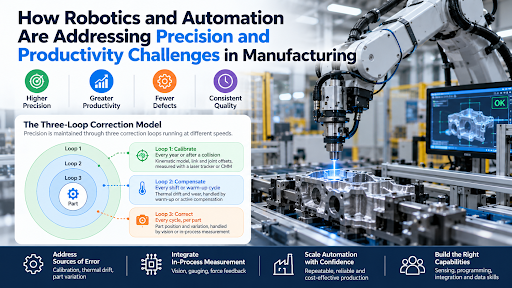
Manufacturers are asked to produce faster and to hold tighter tolerances at the same time. Speed tends to introduce vibration, heat and variation, while precision tends to slow a process through extra measurement and adjustment. Robotics and automation are being deployed to resolve this tension, not by choosing one pressure over the other, but by moving measurement and correction into the production process itself.
The central finding of current practice is that robots are far more repeatable than they are accurate, and that closing the gap depends on calibration, compensation and sensing, not on the robot arm alone. The sections below set out the market context, the sources of error, an original model for organising corrections, and the capabilities plants need to apply it.
Table of Contents
- Where the Industry Stands
- Why Robots Miss Their Targets: Repeatability Versus Accuracy
- A Working Model: The Three-Loop Correction Model
- Productivity Without Giving Up Precision
- Common Deployment Pitfalls
- Capabilities Plants Need
- Frequently Asked Questions
Where the Industry Stands
The International Federation of Robotics (IFR) published its World Robotics 2026 figures on 24 September 2026. Reporting of the release by The Robot Report provides the following picture for 2025.
| Indicator | 2025 figure |
|---|---|
| Global operational stock of industrial robots | 5 million, up 9% |
| Global annual installations | More than 600,000, up 11% |
| China | 354,000 units, 59% of global installations |
| United States | About 38,500 units, now second |
| India | About 10,500 units, up 15%, sixth worldwide |
| India, 2020 to 2025 | Installations grew at a 27% compound annual rate |
| IFR forecast | 655,000 installations in 2026 and 806,000 in 2029 |
IFR President Jane Heffner said that "industrial automation is progressing at high speed." The same reporting notes that the IFR expects AI, machine vision and sensing to raise robot capability, and easier programming and integration to lower deployment costs. For India, the IFR's earlier release on 2024 data attributed much of the growth to the automotive industry, where parts suppliers installed 2,100 units, up 40%, according to the IFR India release.
Why Robots Miss Their Targets: Repeatability Versus Accuracy
Precision problems in robot cells often begin with two terms that are easily confused. The Association for Advancing Automation (A3) defines accuracy as how closely a robot reaches a commanded position compared with the true target, and repeatability as how consistently it returns to the same position over repeated attempts.
| Measure | Typical industrial value | What drives it |
|---|---|---|
| Repeatability | ±0.02 to ±0.1 mm | Mechanical quality: backlash, bearings, encoder resolution, rigidity |
| Accuracy, uncalibrated | About ±1 to ±5 mm | How well the controller's model matches the real robot: link lengths, joint offsets, compliance |
| Accuracy, after calibration | About ±0.3 mm or better, from roughly ±3 mm | External measurement used to correct the kinematic model |
Source for the table: A3 glossary entry on robot accuracy and repeatability.
This explains why a taught point works reliably while a point sent from a computer model can miss. A teach pendant records where the robot actually went, so absolute offsets matter less.
Temperature adds a second source of error. A 2018 study in Eksploatacja i Niezawodność examined how temperature variation affects robot positioning during assembly. It found that thermally induced errors can be a small share of total error or the dominant one, depending on location in the workspace and on temperature fluctuation, and that they can be treated as systematic once thermal conditions stabilise.
A Working Model: The Three-Loop Correction Model
The Three-Loop Correction Model organises precision measures by how fast the underlying drift occurs. Each loop addresses a different kind of error and carries a different cost in production time.
| Loop | Frequency | Error addressed | Typical measures | Cost to productivity |
|---|---|---|---|---|
| 1. Calibrate | Annually or after a collision or component change | Differences between the real robot and its software model | Laser-tracker or coordinate-measuring calibration | Planned downtime, low per part |
| 2. Compensate | Each shift or warm-up cycle | Thermal drift and wear | Warm-up routines, temperature compensation | Short stabilisation time or sensor cost |
| 3. Correct | Every cycle | Part position, fixture variation, tool wear | Vision guidance, in-process gauging, force feedback | Added cycle time unless designed in |
How to use the model: start with the loop that matches the dominant error. A cell that is precise at the start of a shift and drifts afterwards needs loop 2. A cell that is accurate on a master part but misses on real parts needs loop 3. A cell that has never been calibrated may gain most from loop 1 alone, since A3 reports improvements from roughly ±3 mm to ±0.3 mm.
The trade-off between precision and productivity largely lives in loop 3. In-process correction avoids scrap and rework, but it needs sensing and computing time inside each cycle. Cell design therefore determines whether the correction is nearly free or is a bottleneck.
Productivity Without Giving Up Precision
Collaborative robots are one route to higher productivity in smaller batches and varied tasks. An IDTechEx overview republished on Automation.com reports setup times falling to hours, payback periods of 12 to 30 months compared with 36 to 60 months for traditional robots, and defect reductions of about 30% against manual inspection in electronics. These are analyst- and vendor-sourced claims, several attributed to unnamed sources, and the article contains an internal inconsistency in its growth rate, so they should be validated against plant data before being used in a business case.
Productivity gains also depend on the surrounding system. Material flow, fixture design, programming time and changeover all affect output as much as robot speed does.
Common Deployment Pitfalls
- Buying on repeatability alone. A robot with excellent repeatability can still miss absolute positions by millimetres if its model is uncalibrated.
- Ignoring thermal behaviour. Cells that run cold at start-up and warm during the shift can drift through a production run.
- Adding sensing without budgeting cycle time. A vision step that adds seconds to each cycle can erase the productivity gain.
- Underestimating changeover. Programming and fixture changes can dominate where product variety is high.
- Treating the cell as a purchase rather than a system. Software, sensors, fixtures and people all need ownership.
Capabilities Plants Need
Applying the model requires people who can work across mechanical design, sensing, control and data, because the causes of error cross those boundaries.
| Capability | Why it matters |
|---|---|
| Kinematics and calibration | Understanding why accuracy and repeatability differ |
| Sensors and machine vision | Designing correction into each cycle |
| Control and motion systems | Tuning performance without losing speed |
| Data and diagnostics | Linking drift to temperature, wear and production events |
| Systems integration | Making the cell perform reliably as a whole |
Engineers who hold these capabilities are in demand as installations rise, and plants cannot always train them internally. Structured postgraduate study is one route to build them.
An M.Tech in Mechatronics and Robotics is suited to engineers who want depth in kinematics, control, sensing and integration together, ideally with laboratory work on real robot cells.
A mechatronics and robotics course at the certificate or diploma level can suit professionals who need a defined skill, such as robot programming or vision integration, without a full degree.
Professionals who want to apply learning directly to plant problems can look for applied mechatronics and robotics content built around live cell commissioning, calibration exercises and failure analysis.
For those already working in automation roles, a mechatronics upskilling course can close specific gaps, such as thermal compensation, sensor selection or safety standards, alongside a full-time job.