
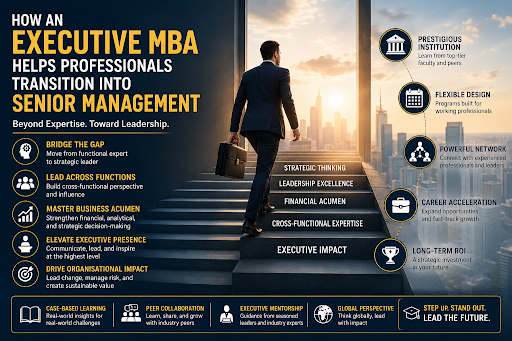
There is a moment, and I remember it clearly, when you realise that technical brilliance and functional expertise will only take you so far. I had spent the better part of a decade being very good at my job. I understood my domain. I delivered results. I managed my team well. And yet, when I began to look at the roles one level above mine, something became apparent: the people in those rooms were operating from a fundamentally different set of frameworks. They were not just better at what I did. They were doing something categorically different. They were making decisions that shaped entire organisations, not just departments.
That realisation was both clarifying and, honestly, a little uncomfortable. Because it meant that the path forward was not simply about working harder or accumulating more years of experience. It required a deliberate investment in a different kind of capability, strategic, cross-functional, and organisationally broad. For me, and for the many professionals I have since mentored, that investment came in the form of an advanced management education. What I did not fully appreciate until I was inside the program was how comprehensively it would reconfigure the way I thought, communicated, and led.
I share this not as a biography but as context. Because the most common question I am asked by mid-career professionals who are sitting at that same inflexion point is whether going back to school, at this stage of their career, is genuinely worth it. My answer, after over a decade in senior leadership, is an unqualified yes. But the reasons matter as much as the answer.
Table of Contents
- Understanding the Real Barrier to Senior Management
- What the Credential Actually Does Beyond the Degree
- The Working Professional's Calculus
- Designed for Where You Are, Not Where You Were
- The Weight of Institutional Pedigree
- The Return on a Strategic Investment
- A Word to Those Standing at the Threshold
- FAQs
Understanding the Real Barrier to Senior Management
Most professionals who are stuck at the threshold of senior management are not stuck because they lack ambition or even competence. They are stuck because there is a structural gap between what functional expertise develops and what senior leadership actually demands. I have seen this pattern repeat itself in hiring decisions, in promotion cycles, and in the quiet frustrations of talented people who cannot understand why they keep getting passed over.
The table below captures this gap with some precision, and I use a version of it when coaching professionals who are trying to understand what exactly needs to change:
| What Senior Management Roles Demand | What Most Mid-Career Professionals Typically Have |
|---|---|
| Enterprise-wide strategic thinking | Functional or departmental expertise |
| Cross-functional leadership and influence | Team or vertical management skills |
| Financial acumen and P&L ownership | Project budgeting or cost-centre awareness |
| Stakeholder communication at the board level | Internal reporting and upward communication |
| Organisational change management | Process improvement within a defined scope |
| Risk governance and regulatory fluency | Operational compliance in one's own domain |
| Executive presence and decision gravitas | Subject-matter credibility |
The right side of that table is not a criticism. It reflects the perfectly rational outcome of years of functional development. The left side, however, is what organisations are paying senior management salaries for. And the fastest, most structured way I have seen professionals close that gap is through a rigorous, cohort-based postgraduate management program.
What the Credential Actually Does Beyond the Degree
When professionals ask me about the Executive Master of Business Administration , I always begin by distinguishing between what the credential signals and what the education delivers. Both matter, but they matter differently. The credential opens doors it communicates to boards, search committees, and executive teams that a candidate has been rigorously assessed against a recognised standard of management knowledge. But the education, the actual process of engaging with case studies, frameworks, finance, strategy, and leadership theory alongside experienced peers, does something far more durable. It builds a vocabulary and a mental model for organisational complexity that professionals without it simply do not have access to in the same structured way.
I have sat across the table from candidates who were phenomenally impressive on paper but who struggled when the conversation moved into enterprise strategy, board-level risk, or organisational change. And I have sat across from candidates who, within minutes of the discussion, demonstrated the kind of integrated thinking that signals genuine readiness for senior leadership. The difference, more often than not, traces back to whether they had invested in the kind of education that forces you to hold an entire organisation in your head, not just your function.
The Working Professional's Calculus
One of the most persistent objections I hear from mid-career professionals considering a return to education is the practical one: I cannot stop working. I have a team, deliverables, and a life. And this is where the design of a good Master of Business Administration Program structured specifically for experienced professionals becomes critical. The best programs are built around the reality that their students are already operating professionals, not full-time students. They use blended formats, weekend intensives, executive cohort structures, and asynchronous components that allow learning to be integrated into a professional schedule rather than set against it.
What I found, and what I consistently hear from the professionals I have mentored through this process, is that the working-while-studying dynamic actually enhances the learning. When you are studying financial modelling in the morning and managing a P&L in the afternoon, the concepts do not remain theoretical. They land. They connect to real problems you are already solving. The classroom becomes a place where the friction of actual leadership gets examined rather than hypothesised.
Designed for Where You Are, Not Where You Were
There is an important distinction between a general MBA taken in one's mid-twenties and an Executive MBA for Working ProfessionalsExecutive MBA for Working Professionals pursued a decade or more into a career. The latter is not a remedial version of the former. It is a fundamentally different product for a fundamentally different learner. Where a general MBA builds foundational business literacy, an executive program presupposes that literacy and builds upon it. The case discussions are richer because every participant brings a decade of organisational experience to the table. The leadership modules cut deeper because the participants have already led and carry real questions about what they might have done differently.
In my own experience, some of the most valuable learning came not from the faculty, though the faculty were exceptional, but from my cohort. I was sitting alongside a manufacturing director from a multinational, a finance head from a public-sector bank, and a technology leader from a mid-sized startup. The diversity of context, combined with the rigour of the curriculum, produced conversations that I genuinely believe would not have been possible in any other setting. That peer learning is not incidental. In well-designed executive programs, it is a deliberately engineered feature of the pedagogy.
The Weight of Institutional Pedigree
I want to address something that professionals in India, in particular, ask me about frequently: the significance of institutional brand. It matters, and it would be disingenuous to pretend otherwise. An Executive MBA from IIM carries a weight in the Indian business landscape that goes beyond the quality of the curriculum, though the curriculum at these institutions is undeniably world-class. It reflects access to a network that has been built over decades, a faculty body with deep ties to industry and policy, and a cohort of peers who are, by selection, among the most accomplished professionals in their respective fields. For someone targeting board-level roles or leadership positions in large organisations, that network and that institutional signal are not trivial.
I have been on hiring committees where two equally capable candidates were being evaluated, and institutional affiliation became the differentiating factor, not because we were being superficial, but because the network, the calibre of peer interaction, and the rigour of the selection process all carry real information about a candidate. This is a reality of how senior leadership hiring works, and professionals planning their transitions would do well to factor it in.
The Return on a Strategic Investment
I am frequently asked about the financial return on the Executive MBA Degree. It is a fair question; the programs are not inexpensive, and for someone already established in their career, the opportunity cost is real. My answer is that the return is not best measured in the salary increment of the first post-program role, though that increment is typically significant. It is better measured in the trajectory it creates. The professionals I know who completed rigorous executive programs did not simply move one rung up the ladder. They fundamentally altered the gradient of their career curve. They moved into roles that previously would have been beyond their visible horizon, with genuine enterprise impact, with board exposure, with the kind of scope that gives a career its long-term meaning.
There is also a dimension of return that is harder to quantify but that I consider the most important: the return on self-awareness. The best executive programs include leadership assessment, coaching, and reflection components that force participants to understand not just organisations but themselves, their decision-making patterns, their leadership blind spots, and their default responses under pressure. I emerged from my program with a clearer sense of the kind of leader I wanted to be than I had going in. That clarity, compounded over a career, is worth more than any salary band.
A Word to Those Standing at the Threshold
I have written this not as an endorsement of any particular institution, but as an honest account of why I believe executive management education is one of the most consequential investments a mid-career professional can make. I have seen careers transformed by it. I have seen professionals, talented, experienced, capable, who had stalled, find new momentum, new language for their ambitions, and new access to the rooms where the most interesting decisions get made.
The transition into senior management is rarely a matter of waiting long enough or performing consistently enough. It is a matter of developing a specific and demonstrable range of capabilities that organisations only trust to certain people. That range can be built. It is not a fixed trait. But it requires intentionality, the right curriculum, and the right community of peers, all of which a well-chosen executive program provides in concentrated form.
If you are sitting at that inflexion point, wondering whether the investment is warranted, whether the timing is right, whether you are too senior or not senior enough, I would offer you the same counsel I wish someone had offered me earlier: the best time to make this investment is before you need the credential to open a door. Make it while you are already moving, so that the education accelerates a trajectory rather than rescues one. The doors it opens are worth it. So, more importantly, is the leader you become in the process.