
In finance, technical competence is the price of entry. The professionals who progress into mid and senior finance roles have typically demonstrated that they can close books accurately, produce auditable financial statements, manage working capital, oversee tax compliance, and communicate financial performance to internal stakeholders. These are genuine skills, developed over years of practice and often validated through professional qualifications. But they are not, in themselves, sufficient preparation for the role of Chief Financial Officer.
The CFO role has undergone a fundamental shift in scope over the past two decades. What was once primarily a custodial function ensuring the accuracy and integrity of financial records and the organisation's compliance with reporting obligations has evolved into a strategic leadership role that operates at the centre of organisational decision-making. Today's CFO is expected to co-own the strategic agenda alongside the CEO, to serve as the primary financial voice to the board, to lead the organisation's capital allocation decisions, to build and manage relationships with investors, lenders, and regulators, and to architect the financial technology and data infrastructure that modern organisations depend on for their competitive intelligence.
The gap between where most capable finance professionals are and where the CFO role begins is therefore not merely a matter of seniority or experience. It is a structural capability gap, one that involves the development of new frameworks for thinking about organisations, new communication skills for executive and board-level audiences, and new literacy in areas such as corporate governance, enterprise risk, capital markets, and strategic finance that many finance careers do not systematically develop. Bridging that gap is the specific purpose of CFO-focused educational programmes, and understanding what those programmes offer and why they work is essential for any finance professional who is serious about reaching the top of their discipline.
Table of Contents
- Why Experience Alone Does Not Close the Gap
- What CFO Programmes Are Actually Designed to Develop
- The Transition in Detail: What Changes at the CFO Level
- The Value of a Recognised Credential in a Senior Finance Career
- The Strategic Finance Imperative: Why Boards Are Raising the Bar
- Peer Learning and the CFO Network: An Underestimated Asset
- Technology Fluency: The New Non-Negotiable
- Choosing the Right Programme: What Distinguishes Quality
- FAQs
Why Experience Alone Does Not Close the Gap
A common assumption among finance professionals is that the CFO role will come to those who perform consistently at a high level over a long enough period. There is a partial truth in this: sustained high performance is necessary. But it is not sufficient, and the distinction matters enormously for professionals who are actively managing their career trajectories. The capabilities that the CFO role demands, board-level communication, strategic capital allocation, enterprise risk governance, investor relations, and the leadership of large and diverse teams, are not developed automatically through functional excellence in accounting, financial planning, or even finance business partnering.
Experience in functional finance roles develops deep and valuable expertise in the specific domains that those roles address. It does not, by itself, expose professionals to the breadth of the CFO's mandate. A finance director who has spent a career in manufacturing finance may be exceptionally capable in cost accounting, operational efficiency analysis, and capital expenditure evaluation, but may have limited exposure to treasury management, capital markets, mergers and acquisitions, board governance, or the communication dynamics of investor relations. A financial controller from a listed company may have deep knowledge of public reporting requirements but limited experience with the strategic finance work scenario planning, portfolio optimisation, and value creation analysis that occupies a significant portion of the CFO's attention. Structured education in CFO-specific competencies accelerates the development of this breadth in a way that functional experience alone cannot replicate.
What CFO Programmes Are Actually Designed to Develop
A well-constructed CFO course is built around a precise understanding of what the role actually demands, derived from systematic analysis of CFO responsibilities across different organisational types, sizes, and sectors. It is not a general finance refresher, and it is not a leadership programme that happens to include some financial content. It is a focused curriculum that addresses the specific competencies strategic, technical, relational, and communicative that separate effective CFOs from strong finance professionals who have not yet made the full transition to executive leadership.
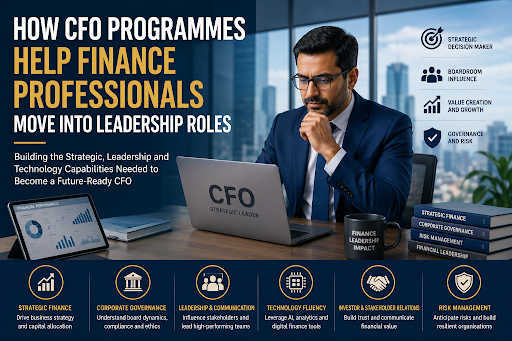
The strategic dimension of such a programme typically includes corporate strategy and business model analysis, capital structure decisions, mergers and acquisitions from the CFO's perspective, and the integration of financial planning with enterprise strategy. The governance dimension covers board structures and dynamics, audit and risk committee responsibilities, regulatory frameworks, and the CFO's specific obligations in listed and unlisted company contexts. The leadership dimension addresses executive communication, particularly the translation of financial complexity into strategic narrative for non-finance audiences, as well as team leadership, organisational design within the finance function, and the development of direct reports into future finance leaders. The technology dimension, increasingly important, addresses financial technology strategy, data governance, and the application of artificial intelligence and automation to finance operations and decision-making.
The Transition in Detail: What Changes at the CFO Level
Understanding what a structured programme develops requires clarity on what the transition to the CFO role actually involves. The table below maps key dimensions of the difference between a senior finance professional operating at the function-head level and a CFO-ready leader, illustrating both the scope of the transformation required and the specific areas that focused education must address:
| Dimension | Senior Finance Professional | CFO-Ready Leader |
|---|---|---|
| Primary focus | Accuracy, compliance, and reporting within the defined scope | Enterprise value creation, risk governance, and capital strategy |
| Decision-making role | Informs decisions through financial data and analysis | Owns financial decisions and co-owns strategic decisions at the board level |
| Stakeholder landscape | Internal teams, auditors, and functional peers | Board, investors, regulators, banks, and C-suite peers across functions |
| Technology posture | User of financial systems and reporting tools | Architect of finance technology strategy; AI and automation advocate |
| Risk orientation | Identifies and escalates financial risk within the function | Designs enterprise risk frameworks; integrates financial and non-financial risk |
| Leadership scope | Manages the finance team's performance and professional development | Shapes finance culture, builds leadership pipeline, and influences organisational direction |
| Communication register | Technical financial language for internal audiences | Translates financial complexity into a strategic narrative for diverse stakeholders |
The transitions mapped in the table are not cosmetic. They represent a genuine reorientation of professional identity from a specialist who provides financial intelligence to an organisation, to a leader who is accountable for the organisation's financial health, strategic direction, and long-term value creation. Each of these transitions requires not just knowledge but practised capability, which is why the best CFO programmes combine content delivery with applied projects, peer discussion, and case analysis that allows participants to develop and test their thinking in conditions that approximate the actual demands of the role.
The Value of a Recognised Credential in a Senior Finance Career
For finance professionals at the stage of their career where the CFO role is a realistic near-term objective, the credential question deserves careful consideration. A rigorous CFO Certification Programme from an institution with a serious track record in executive finance education provides a form of validation that internal performance records, however impressive, cannot fully replicate. It communicates to boards, to search committees, to private equity sponsors, and to the investors who assess management team quality that the holder has been evaluated against a defined and externally validated standard of CFO competence, not just that they have been successful in previous roles, but that they have specifically prepared for the scope of this one.
The credential also serves a function within organisations. Finance professionals who hold recognised CFO-level qualifications are better positioned to make the case, internally, for the responsibilities and decision-making authority that the CFO role requires. In organisations where the CFO role is being redefined, where a previous incumbent operated primarily as a controller, and the business needs a genuinely strategic CFO, the credential helps establish the legitimacy of a different kind of engagement with strategy, governance, and the board. It provides a shared reference point for what the role should involve, and for what level of capability the holder can be expected to bring to it.
The Strategic Finance Imperative: Why Boards Are Raising the Bar
Boards of directors, across sectors and geographies, are holding the Chief Finance Officer role to a higher standard than was typical a generation ago. The reasons are structural. The increasing complexity of capital markets, the growth of ESG reporting obligations, the acceleration of digital transformation as a finance function priority, the heightened regulatory environment following successive waves of corporate governance failure, and the growing expectation that CFOs will serve as co-strategists alongside their CEOs all of these factors have raised the cognitive and communicative demands of the role substantially. Boards that previously appointed technically excellent financial controllers to the CFO position are now explicitly seeking candidates with demonstrated strategic capability, investor relations experience, and the ability to operate credibly at the board table as a thought partner rather than a reporter of numbers.
This shift in board expectations has a direct consequence for the finance professionals who aspire to these roles: the preparation required is more extensive, more structured, and more explicitly strategic than it was previously. Finance professionals who are building their candidacy for CFO positions need to be able to demonstrate not only that they have managed finance functions effectively but that they understand and can articulate the organisation's strategic context, its capital markets position, its governance framework, and its value creation agenda. These are not capabilities that develop incidentally. They require deliberate investment in learning, in experience, and in the development of the relationships and credibility that board-level roles depend on.
Peer Learning and the CFO Network: An Underestimated Asset
Among the benefits of structured CFO programmes that are most consistently reported by participants, and most consistently underestimated before enrolment, is the value of the peer cohort. CFO programmes that attract a cohort of experienced finance professionals, including finance directors, group controllers, VP Finance leaders, and CFOs of smaller organisations seeking to scale their capability for larger roles, create a learning environment in which the formal curriculum is enriched by the depth of professional experience that every participant brings to the room. Case discussions are not theoretical exercises. They are live negotiations between professionals who have navigated real versions of the situations being analysed, and who bring genuine judgements, hard-won through experience, to the comparison of different approaches.
The relationships formed in these cohorts are also, over time, among the most professionally valuable that finance leaders develop. The peer network of a strong CFO programme is not a contact list; it is a community of practitioners who understand the specific challenges, pressures, and judgment calls of senior finance leadership in a way that few outside the function fully appreciate. CFOs who can turn to a trusted peer at a comparable organisation for a sounding board on a capital structure decision, a board communication challenge, or a difficult talent situation are operating with a form of support that significantly improves the quality of their decisions. That network is built most effectively in the context of shared, intensive learning, which is precisely what well-designed executive programmes provide.
Technology Fluency: The New Non-Negotiable
One of the most significant shifts in what CFO programmes must address is the growing centrality of technology fluency to finance leadership. This does not mean that CFOs need to be software engineers or data scientists. It means that they need to be sufficiently fluent in the technologies that are reshaping the finance function enterprise resource planning systems, financial planning and analysis platforms, robotic process automation, advanced analytics, and artificial intelligence applications in forecasting, audit, and financial control to make sound investment decisions about them, to evaluate vendor claims critically, to lead the finance function's technology adoption in alignment with the organisation's broader digital strategy, and to manage the talent implications of a finance function that increasingly operates through automated and AI-augmented processes.
Programmes that do not address this dimension are preparing finance leaders for a version of the CFO role that is already receding. The CFOs who will be most effective over the next decade are those who combine the classical competencies of strategic finance and governance with a genuine and current understanding of how technology is changing what finance does, how it does it, and what skills its people need to contribute at their highest level. That combination is what rigorous, contemporary CFO programmes are designed to develop, and it is what the most discerning boards and nomination committees are increasingly looking for in the candidates they appoint.
Choosing the Right Programme: What Distinguishes Quality
For finance professionals who have decided that structured preparation for the CFO role is the right investment, the question of programme selection is consequential. The quality of CFO-focused programmes varies substantially, and the differences are not always apparent from prospectus materials. Several dimensions deserve careful evaluation. The first is curriculum design specifically, whether the programme addresses the full scope of the modern CFO role or focuses narrowly on technical finance content. A programme that does not include governance, strategic communication, technology leadership, and people leadership alongside corporate finance and accounting standards is not preparing candidates for the CFO role as it currently exists.
The second is faculty quality whether the teaching team combines academic rigour with genuine practitioner experience at the CFO or board level. CFO programmes taught exclusively by academics, without the grounding that comes from faculty who have actually held senior finance and governance roles, tend to produce learning that is theoretically sound but practically thin. The third is cohort composition, whether the programme attracts participants of sufficient seniority and professional breadth to make peer learning substantive. And the fourth is institutional credibility, whether the programme is offered by an institution whose name carries weight with the boards, search firms, and investors that appoint and assess CFO candidates. These criteria together provide a reliable framework for distinguishing the programmes that will genuinely accelerate a CFO transition from those that will merely add a line to a resume.