
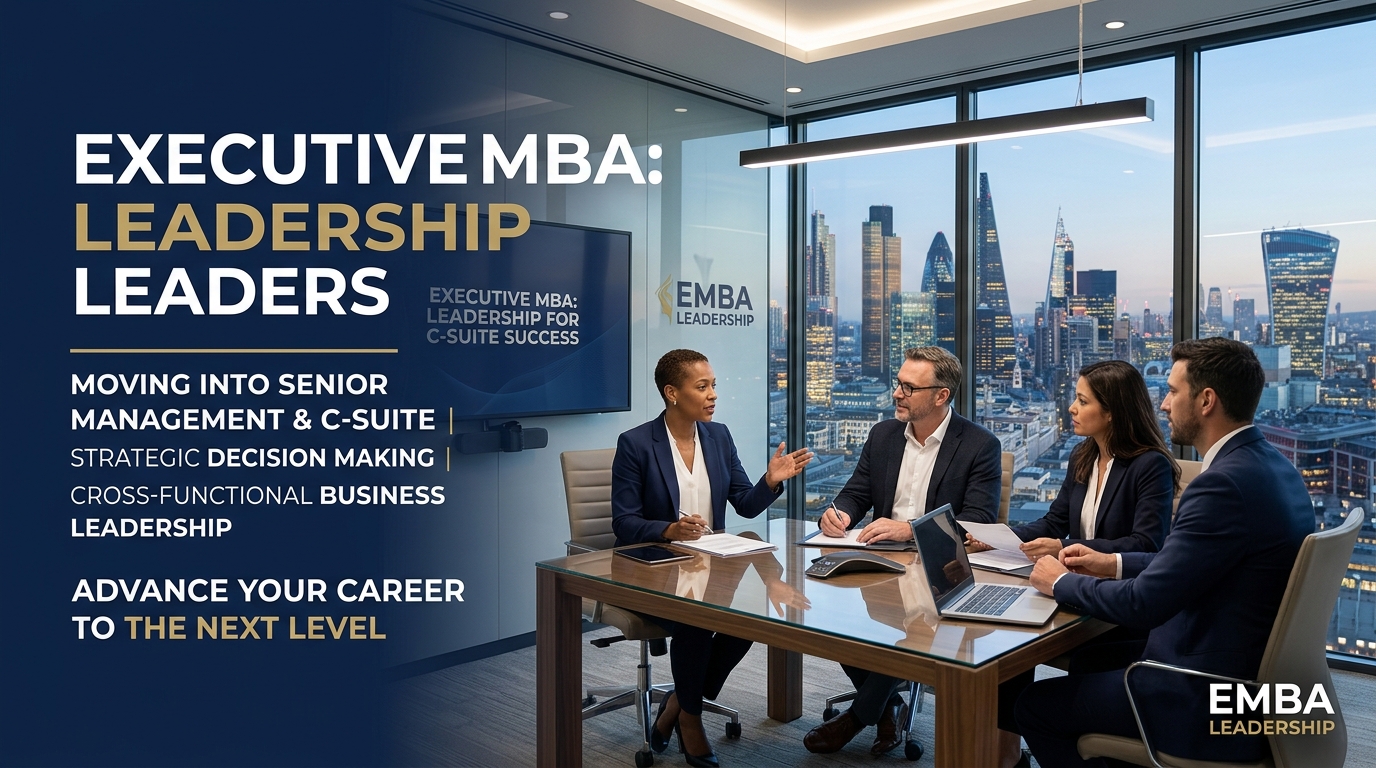
Moving into senior management is not simply a promotion in scale. It is a change in the nature of responsibility.
At functional levels, professionals are usually valued for depth: technical expertise, domain knowledge, operational control and the ability to deliver within a defined area. Senior management requires something broader. Decisions increasingly involve trade-offs across functions, capital, people, technology, customers, risk and long-term strategy.
This transition is becoming more demanding in 2026. The World Economic Forum has argued that leadership is moving beyond functional authority towards enterprise-wide judgement, with future-ready leaders expected to operate across organisational boundaries rather than optimise individual silos.
An Executive MBA course can support this transition when it helps experienced professionals move from specialist decision-making towards a wider understanding of how organisations create value, allocate resources, manage uncertainty and coordinate competing priorities.
Table of Contents
- The Promotion Gap Is Often Broader Than Experience
- Senior Management Decisions Are Increasingly Cross-Functional
- The First Transition: From Functional Excellence to Enterprise Economics
- The Second Transition: From Solving Problems to Choosing Which Problems Matter
- The Third Transition: From Individual Output to Organisational Leverage
- The Senior Management Readiness Grid
- The Rise of AI Makes Management Judgement More Important, Not Less
- Why Cross-Functional Learning Matters
- The Role of Peer Learning in Executive Development
- Senior Management Is a Portfolio of Capabilities
- What Should Professionals Examine Before Choosing a Programme?
- The Transition Is From Expertise to Enterprise Judgement
- Frequently Asked Questions
The Promotion Gap Is Often Broader Than Experience
A professional may have ten or fifteen years of experience and still encounter difficulty when moving into a significantly broader role. The reason is not necessarily a lack of competence. Experience can become deep without becoming wide.
A technology leader may understand architecture and delivery exceptionally well but have limited exposure to corporate finance. A finance professional may understand capital allocation but have less experience with marketing, operations or organisational design.
A sales leader may understand customers and revenue but have limited familiarity with enterprise risk, governance or supply-chain economics. Senior management requires these perspectives to interact.
A leader deciding whether to enter a new market, for example, may need to consider:
- Revenue potential;
- Capital requirements;
- Operating capacity;
- Customer acquisition economics;
- Technology readiness;
- Regulatory exposure;
- Talent availability;
- Competitive reaction; and
- Execution risk.
No single functional lens is sufficient.
The transition into senior leadership therefore depends partly on developing enterprise range.
Senior Management Decisions Are Increasingly Cross-Functional
The traditional organisation could often tolerate relatively strong functional boundaries.
Operations managed efficiency.
Finance managed capital.
Marketing managed demand.
Technology managed systems.
Human resources managed workforce priorities.
That separation is becoming harder to sustain.
AI investments affect workforce design.
Pricing decisions affect working capital.
Supply-chain decisions affect customer experience.
Cybersecurity affects enterprise risk.
Sustainability commitments affect procurement, operations, finance and reputation simultaneously.
The World Economic Forum's 2026 assessment of the changing C-suite describes this shift clearly: discussions at senior levels increasingly need to revolve around enterprise decisions, shared priorities, capital allocation and risk exposure rather than sequential functional updates.
This changes what leadership readiness means. The strongest functional performer is not automatically the strongest enterprise leader.
The First Transition: From Functional Excellence to Enterprise Economics
One of the most significant gaps experienced professionals encounter is understanding how different parts of the organisation contribute to enterprise value. Senior managers need to interpret the business beyond their own function.
That includes understanding:
- how revenue is generated;
- where margins are created or lost;
- what drives return on capital;
- how working capital affects growth;
- how customer acquisition translates into lifetime value;
- where operating leverage exists;
- how investment decisions are evaluated; and
- which risks could materially change expected returns.
This does not require every leader to become a finance specialist.
It requires sufficient financial and strategic literacy to understand the economic consequences of decisions.
That distinction matters because leadership decisions frequently involve choosing between several individually reasonable priorities.
Should capital be directed towards market expansion or process automation?
Should the organisation prioritise margin protection or market share?
Should a capability be built internally, acquired or outsourced?
Should growth be accelerated despite higher short-term risk?
These are enterprise questions.
The Second Transition: From Solving Problems to Choosing Which Problems Matter
Functional roles frequently reward problem-solving. Senior roles increasingly reward problem selection. An organisation may have hundreds of issues requiring attention, but leadership capacity and capital remain finite.
Senior management must therefore determine:
- which issues are strategically important;
- which can be delegated;
- which require immediate intervention;
- which are symptoms rather than causes; and
- which apparent opportunities are not worth pursuing.
The distinction becomes more important in an environment characterised by rapid technological change and information abundance. Executives rarely suffer from insufficient data. The challenge is determining which signals deserve attention.
The World Economic Forum's 2026 leadership work emphasises that the defining capability increasingly lies in how leaders make decisions under uncertainty, pressure and incomplete information rather than simply how much expertise they possess.
Management development therefore needs to strengthen judgement, not merely knowledge accumulation.
The Third Transition: From Individual Output to Organisational Leverage
A senior manager's effectiveness cannot be measured primarily through personal execution.
The role increasingly involves creating conditions through which other people and functions perform.
This includes:
- setting priorities;
- allocating resources;
- defining decision rights;
- resolving cross-functional conflict;
- developing managers;
- establishing accountability;
- communicating direction; and
- removing organisational constraints.
A functional expert may succeed by personally solving difficult problems.
A senior leader who continues operating that way can become a bottleneck.
The leadership transition therefore requires a different question:
How can the organisation make better decisions without depending on one individual to make all of them?
That is an organisational-design problem.
The Senior Management Readiness Grid
A useful way to evaluate readiness for broader responsibility is through the Senior Management Readiness Grid.
It separates leadership readiness into six dimensions.
| Dimension | Functional-level emphasis | Senior-management requirement |
|---|---|---|
| Business Scope | Optimise a function | Understand the enterprise |
| Decision Horizon | Deliver current objectives | Balance current and future priorities |
| Resource Responsibility | Manage assigned resources | Allocate resources across competing priorities |
| Stakeholder Range | Influence immediate teams | Align multiple functions and stakeholders |
| Risk Perspective | Manage functional risk | Evaluate enterprise trade-offs |
| Performance Lens | Track functional KPIs | Understand value creation across the organisation |
The framework highlights an important point. Seniority is not defined only by managing more people.
It is defined by managing greater complexity, wider consequences and more interconnected decisions.
The Rise of AI Makes Management Judgement More Important, Not Less
AI can increasingly support analysis, forecasting, communication and workflow execution.
This changes managerial work.
Information can be generated more quickly.
Alternatives can be modelled faster.
Performance signals can be surfaced automatically.
Routine coordination can be reduced.
But faster analysis does not remove the need for judgement.
It can increase it.
The World Economic Forum noted in September 2026 that skills in highly AI-exposed occupations are changing more than twice as rapidly as those in less exposed occupations, while leadership increasingly needs to focus on embedding AI across organisations rather than treating it as an isolated technology initiative.
Senior managers therefore need to understand when to trust technology, when to challenge it and which decisions should remain subject to explicit human accountability.
Why Cross-Functional Learning Matters
One of the most important benefits of advanced management education is exposure to problems outside an individual's established expertise. A finance leader examining a supply-chain case may recognise how inventory decisions affect capital. A technology leader examining consumer strategy may better understand the economics of product adoption.
An operations professional analysing organisational behaviour may recognise why technically correct transformations fail during implementation.
This kind of cross-functional learning helps reduce what can be described as functional overconfidence: the tendency to interpret enterprise problems through the discipline in which a professional is already strongest.
Senior management requires the opposite capability. Leaders need to know when their own functional interpretation is incomplete.
The Role of Peer Learning in Executive Development
Experienced cohorts introduce another dimension that conventional individual learning cannot easily reproduce. Professionals from different sectors and functions bring different assumptions into the same business problem. A banker may approach risk differently from a manufacturing leader.
A technology professional may evaluate scalability differently from a sales executive. An entrepreneur may interpret uncertainty differently from someone operating within a large corporation.
Peer learning creates value when these perspectives are tested rather than merely exchanged. A business case discussed among experienced professionals can reveal that the same decision may appear rational from one functional viewpoint and deeply problematic from another.
That is highly relevant to senior management, where leadership frequently consists of reconciling competing but legitimate perspectives.
Senior Management Is a Portfolio of Capabilities
No single capability creates leadership readiness. A useful portfolio can be divided into five areas:
Enterprise Understanding
The ability to understand how strategy, customers, operations, finance, people and technology interact.
Analytical Judgement
The ability to evaluate evidence, question assumptions and make decisions under uncertainty.
Resource Allocation
The ability to determine where capital, talent and management attention should be concentrated.
Organisational Leadership
The ability to align teams, design accountability and influence stakeholders beyond direct authority.
Transformation Capability
The ability to lead through technological, competitive and organisational change without losing operating discipline.
Weakness in one dimension can constrain leadership effectiveness even when the others are strong.
A commercially strong leader with poor financial judgement may allocate resources badly.
A strategically sophisticated leader with weak execution discipline may fail to translate decisions into results.
A technically strong leader with limited stakeholder capability may struggle to mobilise the organisation.
The transition therefore requires balance.
What Should Professionals Examine Before Choosing a Programme?
The value of management education depends heavily on alignment with the professional objective.
Before evaluating Executive MBA course details, experienced professionals should examine whether the curriculum and learning design address the specific gaps between their current responsibility and the level of responsibility they intend to assume.
A useful evaluation should include:
- Breadth: Does the curriculum extend beyond the professional's existing function?
- Integration: Are finance, strategy, operations, marketing, leadership and technology connected through business decisions?
- Application: Does learning involve cases, simulations, projects or situations requiring managerial judgement?
- Cohort: Does the peer group provide exposure to different functions and industries?
- Faculty: Is teaching grounded in rigorous management thinking and contemporary business developments?
- Format: Can the learning model support serious engagement alongside professional responsibilities?
- Leadership relevance: Does the experience develop enterprise judgement rather than simply provide additional technical knowledge?
The strongest fit is not necessarily the programme containing the largest number of subjects. It is the one that addresses the most consequential capability gaps.
The Transition Is From Expertise to Enterprise Judgement
The most important career transition into senior management is therefore not from manager to senior manager as a matter of title. It is from solving problems within a function to making decisions for the enterprise.
The professional must become capable of seeing beyond functional boundaries, evaluating trade-offs, allocating resources, interpreting uncertainty and influencing outcomes through other leaders. Experience provides context for that transition. Structured management education can provide the broader frameworks through which that experience is interpreted.
The combination becomes valuable when professionals begin to see the organisation not as a collection of departments, but as an interconnected system in which every significant decision has financial, operational, technological and human consequences. That is the threshold senior management ultimately requires.