
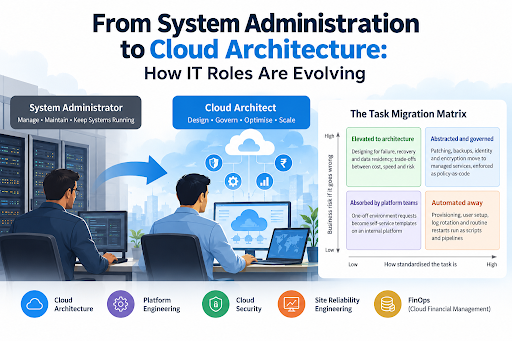
What is changing? Infrastructure work is moving from operating individual servers to designing, governing and paying for distributed services. The unit of work is no longer the machine; it is the platform and the policy that runs it.
Is system administration disappearing? Not abruptly, but it is contracting. The US Bureau of Labour Statistics projects a 4% decline in network and computer systems administrator jobs between 2025 and 2035, citing automation, DevOps practices and outsourced network services.
Where is the demand moving? Towards cloud architecture, platform engineering, site reliability, cloud security and cloud financial management. In India, Gartner forecasts public cloud spending to reach $17.5 billion in 2026, while TeamLease Digital places the cloud talent gap at 55–60%, the widest of any digital skill family it tracks.
What should professionals do? Treat the move as a change of discipline, not a change of tools: from keeping systems running to deciding how systems should be built, secured and funded.
Table of Contents
- Why the Server Room Stopped Being the Centre of IT
- The Task Migration Matrix
- Five Roles Replacing the Generalist Administrator
- What Organisations Get Wrong in the Transition
- A Transition Plan for Mid-Career Infrastructure Professionals
- When Formal Postgraduate Study Makes Sense
- Frequently Asked Questions
Why the Server Room Stopped Being the Centre of IT
For two decades, the system administrator was the custodian of the enterprise: installing operating systems, patching servers, managing storage and restoring backups. That role was defined by proximity to hardware. Three forces have steadily removed that proximity.
1. Consumption replaced ownership. Gartner expects end-user public cloud spending in India to rise 28.1% in 2026, from $13.7 billion to $17.5 billion. Infrastructure as a service is the fastest-growing segment at 40%, while platform services become the largest category at about $6.4 billion. Gartner Senior Principal Analyst Ashish Banerjee observed that "strong enterprise demand for AI-ready cloud infrastructure is redefining cloud investment priorities in India."
2. AI workloads raised the stakes. Worldwide, Gartner projects data centre systems spending to grow 31.7% in 2026, to $653.4 billion, largely because hyperscale providers are buying servers built for AI. Gartner also expects that by 2030, more than 60% of enterprises will run AI models in one cloud while their data sits in another. That kind of design decision did not exist in the server-room era.
3. Sovereignty became an infrastructure requirement. Gartner estimates sovereign cloud infrastructure spending will reach $80 billion worldwide in 2026, up 35.6%, driven by regulation and national-security concerns. In India, the phased roll-out of the Digital Personal Data Protection Rules, 2025 adds a similar layer: where data lives, and who can reach it, is now a design question rather than an operational detail.
The cost of getting it wrong
Moving to the cloud did not remove infrastructure problems; it changed their shape. Flexera's 2026 State of the Cloud Report, based on more than 750 cloud decision-makers, found:
| Indicator | Finding |
|---|---|
| Share of cloud spend estimated as wasted | 29%, rising for the first time in five years |
| Organisations citing cloud spend management as a challenge | 85% |
| Organisations running hybrid environments | 73% |
| Organisations with a dedicated FinOps team | 63% |
| Organisations with a Cloud Centre of Excellence | 71% |
The pattern is clear. The technical capacity to run workloads in the cloud is now widespread. The capacity to run them efficiently, securely and in line with regulation is not.
Key Terms
| Term | Meaning |
|---|---|
| System administrator | A professional responsible for installing, configuring and maintaining servers, operating systems and core infrastructure |
| Cloud architect | A professional who designs how applications, data and infrastructure are distributed across cloud services to meet performance, cost, security and compliance goals |
| Platform engineering | Building internal self-service platforms so that development teams can provision infrastructure without raising tickets |
| Site reliability engineering (SRE) | Applying software engineering to operations, with reliability managed through measurable service-level objectives |
| FinOps | The practice of managing cloud spending as a shared responsibility between engineering, finance and business teams |
| Infrastructure as code | Defining infrastructure in version-controlled configuration files rather than through manual set-up |
| Sovereign cloud | Cloud services operated so that data, operations and legal control remain within a specific jurisdiction |
The Task Migration Matrix
The Task Migration Matrix is a framework for predicting what happens to each traditional administration task as organisations move to the cloud. It sorts tasks along two dimensions: how standardised the task is, and how much business risk follows if it goes wrong. Each quadrant has a different destiny.
1. Automated Tasks: Routine provisioning, user creation, log rotation and restarts are handled by scripts and pipelines, requiring scripting and infrastructure-as-code skills.
2. Cloud Governance: Patching, backups, identity and encryption are managed through cloud services and policies, requiring expertise in policy-as-code, cloud security and compliance.
3. Platform Engineering: Environment requests and custom server builds are replaced by self-service internal platforms, requiring platform design and developer experience skills.
4. Architecture and Strategy: Disaster recovery, data residency and capacity planning require architectural expertise in distributed systems, cost modelling and risk assessment.
How to read the matrix
The bottom-right quadrant is where traditional roles shrink fastest. The BLS attributes the projected decline in administrator jobs to exactly these forces: automation of routine work, DevOps teams absorbing tasks and outsourced network services.
The top-left quadrant is where value concentrates. These decisions are rarely repeatable, carry high consequences and cannot be delegated to a managed service.
Professionals can map their current weekly tasks onto the matrix. The share of time spent in the top-left quadrant is a practical indicator of career resilience.
Observation: The most transferable asset a system administrator carries is not a technology skill but a failure instinct, a working knowledge of how systems break under real load. The gap is usually in expressing that instinct as design: architecture diagrams, cost models and written trade-offs that others can review.
Five Roles Replacing the Generalist Administrator
The generalist who "ran the servers" is giving way to specialised roles. Each answers a different question for the business.
| Role | Core question it answers | Key capabilities | What carries over from administration |
|---|---|---|---|
| Cloud architect | How should this system be built across cloud services? | Distributed systems design, networking, security architecture, cost modelling | Understanding of operating systems, networks and failure modes |
| Platform engineer | How can teams provision infrastructure safely without waiting? | Infrastructure as code, containers, Kubernetes, internal developer platforms | Automation scripts, configuration management |
| Site reliability engineer | How reliable must this service be, and how is that measured? | Service-level objectives, observability, incident response, coding | On-call experience, troubleshooting discipline |
| Cloud security engineer | Who and what can access this, and how is it proven? | Identity and access management, policy-as-code, compliance automation | Access control, patch management |
| FinOps practitioner | What does this workload cost, and is it worth it? | Cost allocation, usage optimisation, forecasting, commercial negotiation | Capacity planning, licence management |
TeamLease Digital's Digital Skills and Salary Primer FY2026–27 classifies cloud engineering as an AI-adjacent premium skill. The report's central message is that employers now reward the ability to build, operate and govern systems in production, not familiarity with tools alone.
What Organisations Get Wrong in the Transition
Many organisations treat cloud adoption as a migration project. The evidence suggests it is an operating-model change, and the common failures follow from that misreading.
- Lifting and shifting without redesign. Moving virtual machines to the cloud unchanged reproduces data-centre costs at cloud prices, which helps explain the 29% waste figure in the Flexera survey.
- Retraining on tools, not on judgement. Certification in one provider's services does not teach how to choose between providers, regions or architectures.
- Leaving cost to finance. When engineering teams cannot see what their design choices cost, spending drifts until a budget review forces an abrupt correction.
- Treating compliance as an audit event. With sovereignty and data-protection rules tightening, compliance has to be designed into infrastructure from the start.
- Losing institutional knowledge. Experienced administrators understand legacy dependencies that no documentation captures. Organisations that sideline them during migration often rediscover those dependencies through outages.
Leadership implication: Infrastructure leaders should measure team capability by the quality of design decisions, not by ticket throughput. Promotion paths, training budgets and performance metrics all need to reflect that shift.
A Transition Plan for Mid-Career Infrastructure Professionals
The move from administration to architecture is cumulative. Each stage builds on the operational knowledge already held.
Stage 1: Automate what is already known
- Script every routine task currently performed manually
- Move one environment to infrastructure as code
- Learn version control as a daily working habit
Stage 2: Rebuild on managed services
- Gain hands-on depth in at least one major cloud platform
- Learn containers and orchestration
- Study identity and access management in depth
Stage 3: Think in systems
- Study distributed systems principles: consistency, latency and failure isolation
- Practise writing architecture decision records that explain trade-offs
- Build cost models for designs before deploying them
Stage 4: Own outcomes
- Lead a reliability or cost-optimisation initiative end to end
- Map designs against regulatory requirements such as data-residency rules
- Mentor others through earlier stages
Stages 1 and 2 are well served by vendor courses and certifications. Stages 3 and 4 depend on theory, design practice and peer review, which is where self-directed learning tends to stall.
When Formal Postgraduate Study Makes Sense
Not every transition requires a degree. The right learning route depends on the target role and the gap between current and required capability.
Structured Cloud Computing for working professionals fills a specific gap in this landscape. It is designed for people who already understand infrastructure in practice, but who need the theoretical foundations, such as algorithms, distributed systems and optimisation, that architecture roles demand. Online delivery with optional campus sessions allows study alongside full-time work.
| Learning route | Strength | Limitation | Best fit |
|---|---|---|---|
| Vendor certification | Fast, practical, recognised by recruiters | Tied to one provider; limited depth in design theory | Moving into cloud engineering or operations roles |
| Short professional course | Focused on one skill, such as Kubernetes or FinOps | Rarely builds systems-level thinking | Filling a specific, known gap |
| Executive postgraduate degree | Depth in algorithms, distributed systems and architecture; formal credential; peer cohort | Multi-year commitment; higher cost | Moving into architecture, design authority or technical leadership |
| On-the-job learning only | Directly relevant and paid | Narrow to the current employer's stack; slow | Professionals already in a cloud-first organisation |
A two-year M.Tech Cloud Computing programme from a premier engineering institute typically combines a core in algorithms, computer systems, probability and linear algebra with electives such as cloud architecture, cloud security, distributed systems, cloud-based DevOps and machine learning for cloud workloads. Two project semesters give working professionals space to apply this depth to problems drawn from their own organisations.
Prospective applicants tracking IIT Patna M.Tech admission 2026 should note the eligibility pattern common to executive engineering programmes: a relevant degree such as BE, B.Tech, MCA or MSc in computing, a minimum academic score, and at least one year of work experience. Executive formats generally rely on academic record and experience for selection, and applications are handled through an online portal.
When assessing M.Tech Cloud Computing fees, the useful comparison is not against short courses but against the role the degree is meant to unlock. Executive programmes of this kind are generally billed per semester and can total around ₹3 lakh over two years, with optional campus immersion charged separately. Since published fee totals can differ between sources, applicants should confirm the current figure directly with the admissions office.