
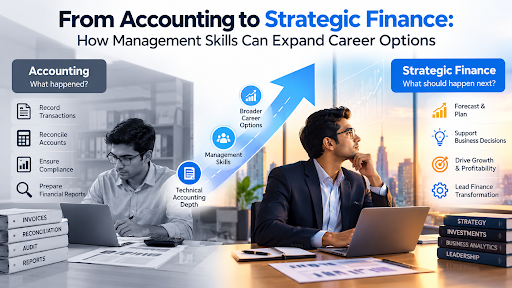
Accounting expertise remains the foundation of every finance career, but it no longer defines the ceiling. As automation absorbs transactional work, the finance roles that are growing in value are those that connect numbers to decisions: financial planning and analysis, business partnering, capital allocation and finance transformation.
Three developments explain the shift:
- AI is taking over the routine core of accounting. Gartner reports that 59% of finance functions used AI in 2025, up from 37% in 2023, with accounts payable automation and anomaly detection among the leading use cases.
- Finance leaders now prize different capabilities. In a 2026 Gartner survey, CFOs named acquiring and developing AI and digital talent as their top near-term challenge.
- India's finance job market is moving up the value chain. ACCA research shows finance roles in global capability centres shifting from transaction processing towards planning, analysis and business partnering.
The professionals who benefit most are those who combine technical accounting depth with management breadth: strategy, markets, operations and leadership.
Table of Contents
- What the Numbers Say About the Finance Function
- Accounting and Strategic Finance: Where One Ends and the Other Begins
- The Depth–Breadth Finance Career Grid
- Capabilities That Separate Finance Partners from Finance Processors
- Comparing the Main Routes
- Where a Management Degree Fits
- Decision Guide by Career Goal
- Common Missteps
- Frequently Asked Questions
What the Numbers Say About the Finance Function
Automation is concentrated where accountants spend most of their time
Gartner's 2025 finance AI survey, covering 183 finance leaders, found that adoption has stabilised at 59% after a sharp rise. The most common applications show where the pressure lands:
| AI use case in finance | Share of AI-using finance functions |
|---|---|
| Knowledge management | 49% |
| Accounts payable automation | 37% |
| Error and anomaly detection | 34% |
Each of these overlaps directly with work that traditionally filled an accountant's week: retrieving policies, processing invoices and checking for errors. Gartner also found that 91% of finance leaders report only low or moderate impact so far, which suggests the larger changes still lie ahead.
Finance leaders are redefining the talent they need
A Gartner survey of 100 CFOs, conducted in early 2026, placed AI and digital talent at the top of their near-term challenges. Gartner describes four workforce shifts the finance function must make: from guardians to catalysts, from partners to tool builders, from manual to machine-driven work, and from linear to iterative processes. Because external hiring for these skills is costly, Gartner recommends upskilling existing finance teams first.
India is becoming a home for higher-value finance work
ACCA's 2025 report on India's global capability centres projects that these centres could generate 2.8 million jobs and host about 20,000 global leadership roles by 2030. Within finance, opportunities are expanding in business partnering, reporting, procurement, and planning and analysis, while mid-level roles increasingly focus on process improvement and transformation. Pooja Chaudhary, ACCA's policy and insights lead for India, noted that "strong leadership, cross-cultural talent, and collaboration between global and local teams are key."
Observation: The tasks automated first are the ones that consumed the month-end close. That frees capacity in finance teams, but the freed time only becomes career value if the professional can redirect it towards analysis, forecasting and advising the business. Without those skills, automation shrinks the role rather than elevating it.
Accounting and Strategic Finance: Where One Ends and the Other Begins
Accounting records, classifies and reports financial transactions accurately and in line with standards and regulations. Its central question is: what happened?
Strategic finance uses financial information to shape business decisions, including where to invest, how to price, when to raise capital and which risks to accept. Its central question is: what should happen next?
| Dimension | Accounting | Strategic finance |
|---|---|---|
| Time orientation | Historical: closing, reconciling, reporting | Forward-looking: forecasting, scenario planning, valuation |
| Primary output | Accurate, compliant financial statements | Decisions, recommendations and investment cases |
| Measure of success | Accuracy, timeliness, clean audits | Business outcomes: growth, margin, return on capital |
| Key stakeholders | Auditors, regulators, tax authorities | CEO, board, business unit heads, investors |
| Core skills | Standards, controls, tax, reconciliation | Modelling, strategy, negotiation, communication |
| Typical roles | Accountant, auditor, tax specialist, controller | FP&A lead, finance business partner, corporate development, CFO |
The two are not opposites. Strategic finance depends on the integrity that accounting provides. The shift is one of extension: building on accounting rigour to take part in decisions rather than only reporting their results.
The Depth–Breadth Finance Career Grid
The Depth–Breadth Finance Career Grid is a framework for locating a finance professional's current position and identifying the most efficient route to strategic roles. It measures two dimensions: technical finance depth, meaning mastery of accounting, valuation, risk and markets; and business breadth, meaning understanding of strategy, operations, markets and leadership.
Most qualified accountants begin in the technical specialist quadrant. Their gap is not technical knowledge but breadth, which explains why management education is a common route upward.
Professionals from general business backgrounds sit in the generalist quadrant. Their gap is technical depth, which explains the appeal of specialist charters such as the CFA for investment-focused roles.
The transaction processor quadrant carries the highest automation risk. Professionals there need to move out deliberately, not wait for the role to change around them.
Capabilities That Separate Finance Partners from Finance Processors
1. Financial Planning and Analysis: Builds forecasting and modelling skills to connect accounting with business strategy through on-the-job FP&A experience and modelling practice.
2. Corporate Valuation and Strategic Thinking: Supports investment, acquisition and funding decisions while enabling finance professionals to evaluate business choices through corporate finance coursework, management education and cross-functional projects.
3. Data and Analytics Fluency: Helps professionals assess AI-generated insights and make informed decisions through analytics training and practical use of finance AI tools.
4. Communication, Leadership and Influence: Enables finance professionals to present recommendations clearly, lead teams and shape business decisions through presentation practice, stakeholder-facing roles and structured management development.
The first two capabilities extend an accountant's existing strengths. The remaining four rarely develop inside a pure accounting role, and they are where most career plateaus occur.
Comparing the Main Routes
Professionals planning a move into strategic finance usually weigh several finance qualifications, each built for a different destination. Chartered accountancy and ACCA establish accounting and audit depth; the CMA focuses on management accounting and cost control; the CFA charter centres on investment analysis and portfolio management; and a management degree with a finance specialisation adds strategy, leadership and cross-functional business knowledge.
The comparison that arises most often is MBA Finance vs CFA, and the two answer different career questions. The table below sets them side by side.
| Dimension | Management degree with finance specialisation | CFA charter |
|---|---|---|
| Primary focus | Business strategy, corporate finance, leadership | Investment analysis, portfolio management, ethics |
| Grid movement | Adds business breadth | Adds technical depth in markets and valuation |
| Format | Full-time, part-time or executive programmes of one to two years | Three self-study exam levels |
| Practical requirement | Projects, internships or live case work | 4,000 hours of relevant experience over at least 36 months to earn the charter |
| Exam difficulty | Competitive entrance tests | Level I pass rate of 45% in February 2026, against a 10-year average of 40% |
| Network | Cohort, faculty and alumni network | Global charterholder community |
| Strongest career fit | FP&A, business partnering, corporate finance, CFO track | Equity research, asset management, portfolio roles |
The CFA figures come from CFA Institute's February 2026 Level I results, in which 24,006 candidates sat the exam worldwide.
The routes are complementary rather than competing. A chartered accountant targeting a CFO path typically benefits more from management breadth, while one moving towards investment management benefits more from the CFA's market depth. Some professionals pursue both at different career stages.
Where a Management Degree Fits
A well-designed MBA Finance course addresses the specific gap that holds most accountants in specialist roles. It combines advanced corporate finance, valuation and financial strategy with subjects that accounting training rarely covers: competitive strategy, marketing, operations, organisational behaviour and negotiation. Case-based teaching places finance decisions inside full business problems, which is the context in which strategic finance roles operate.
For working professionals, the value also lies in peer learning. A cohort that includes engineers, marketers and operations managers reproduces the cross-functional conversations that finance business partners handle every day.
MBA Finance eligibility in India generally requires a bachelor's degree of at least three years with a minimum aggregate score, commonly 50% for general candidates and 45% for reserved categories, along with a valid entrance test score. CAT 2026 is scheduled for 29 November 2026, and final-year undergraduates can usually apply provisionally. Work experience is not mandatory for most two-year programmes, although executive formats typically require several years of it.
Decision Guide by Career Goal
1. CFO or Finance Director: Develop strategy, leadership and board-level communication through a management degree with a finance specialisation and leadership experience.
2. FP&A or Business Partnering: Strengthen forecasting, modelling and stakeholder management through management education or targeted FP&A training, supported by on-the-job experience.
3. Investment and Market-Focused Roles: Build expertise in valuation, market analysis, portfolio theory and deal structuring through the CFA charter or a finance-specialised management degree, depending on the career goal.
4. Specialist and Transformation Roles: Advance in tax or audit through specialist certifications and continuing professional education, or move into finance transformation through management education, analytics and change management projects.
Common Missteps
- Collecting credentials without a destination. A qualification has value only relative to the role it unlocks. Starting with the target role prevents years spent on the wrong route.
- Assuming technical excellence leads automatically to promotion. Strategic finance roles are awarded for influence on decisions, not for error-free reconciliations.
- Ignoring AI tools. Finance professionals who cannot work with AI-assisted forecasting and analysis will find their judgement harder to defend.
- Underestimating communication. The most common reason finance recommendations fail is not weak analysis but explanations that business leaders cannot act on.
- Waiting too long to move. Roles in the transaction quadrant are contracting first. Development is easier to plan before a role changes than after.