
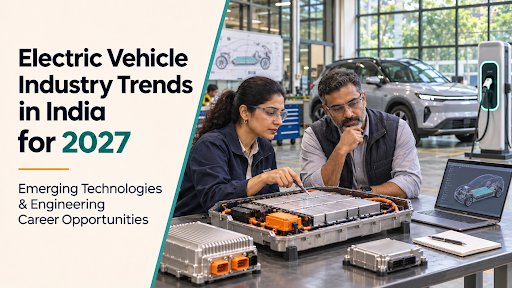
India's electric vehicle industry is entering an important phase of technological development. While the initial years of electric mobility focused largely on encouraging vehicle adoption, the next stage involves improving battery performance, developing efficient powertrains, strengthening domestic manufacturing and introducing intelligent vehicle technologies.
The transition is already visible in India's automotive market. According to the India Brand Equity Foundation (IBEF), electric vehicle sales reached approximately 26.6 lakh units in FY 2025–26, recording nearly 30% growth over the previous financial year. EVs accounted for approximately 8.62% of total vehicle sales during the period.
However, increasing vehicle adoption also brings new engineering challenges. Manufacturers must develop batteries that last longer, charging systems that operate efficiently and vehicle technologies that meet safety, performance and cost expectations.
These developments are creating a stronger connection between advanced engineering education and the future of India's automotive industry. For professionals considering an M.Tech in EV technology, understanding the developments expected in 2027 can help identify relevant technical specialisations and career pathways.
Table of Contents
- India's Electric Vehicle Industry in 2026: Understanding the Transition
- 1. Next-Generation Batteries and Advanced Battery Management Systems
- 2. Power Electronics and Electric Powertrain Innovation
- 3. Ultra-Fast Charging, Smart Charging and Vehicle-to-Grid Technology
- 4. Software-Defined Vehicles and Intelligent Mobility Systems
- 5. Indigenous EV Manufacturing and Component Localisation
- 6. Electric Commercial Vehicles and Heavy-Duty Mobility
- 7. Battery Recycling, Second-Life Applications and Circular EV Technologies
- Which EV Technology Trends Should Engineering Professionals Prioritise in 2027?
- How Can Advanced Engineering Education Support Careers in Electric Mobility?
- Conclusion
- Frequently Asked Questions (FAQs)
India's Electric Vehicle Industry in 2026: Understanding the Transition
The developments recorded in 2026 show how India's electric mobility ecosystem is gradually moving beyond vehicle sales towards a broader focus on infrastructure, manufacturing and engineering capabilities.
Several indicators explain this transition.
| Industry indicator | Reported development | Significance |
|---|---|---|
| Electric vehicle sales | Approximately 26.6 lakh units in FY 2025–26 | Growing adoption across vehicle categories |
| EV market penetration | Approximately 8.62% in FY 2025–26 | Increasing presence of EVs in India's automotive market |
| Public charging stations | 52,718 stations reported in July 2026 | Expansion of electric mobility infrastructure |
| PM E-DRIVE scheme | ₹11,900 crore revised financial outlay | Support for electric mobility and infrastructure development |
| Scheme implementation | Extended to March 2028 for applicable segments | Continued policy support for the EV ecosystem |
Sources: IBEF, Ministry of Heavy Industries and Press Information Bureau (2026).
These developments reflect growing attention towards electric mobility across personal transportation, public transport and commercial operations.
Electric two-wheelers and three-wheelers continue to represent a substantial share of EV sales in India. At the same time, electric passenger cars, buses and commercial vehicles are attracting investment and policy attention.
The expansion of the industry also increases the importance of reliable charging infrastructure, battery safety, domestic component manufacturing and specialised engineering knowledge.
Major developments that influenced the industry in 2026
- Battery manufacturing and localisation: India continued working towards stronger domestic manufacturing capabilities for battery systems and associated materials. Reducing dependence on imported components remains an important consideration.
- Charging infrastructure development: The expansion of public charging facilities brought greater attention to charging speed, interoperability, electrical safety and grid integration.
- Domestic component manufacturing: Manufacturers increased their focus on electric motors, power electronics, control units and related vehicle technologies.
- Commercial vehicle electrification: Electric buses, logistics fleets and last-mile delivery vehicles gained importance as organisations explored alternatives to conventional fuel-powered transportation.
- Battery lifecycle management: Battery health assessment, recycling, material recovery and end-of-life management became increasingly relevant to the sustainability of electric mobility.
Together, these developments provide an understanding of the technological priorities likely to influence India's EV industry in 2027.
1. Next-Generation Batteries and Advanced Battery Management Systems
Battery engineering is expected to remain one of the most important areas of electric vehicle innovation in 2027.
The performance of an electric vehicle depends significantly on its battery's energy capacity, charging characteristics, operating temperature and ability to retain performance over repeated charging cycles.
While lithium-ion batteries remain widely used, research into solid-state batteries, sodium-ion technologies and improved battery chemistries is exploring alternatives that could enhance safety, affordability and energy storage performance.
However, emerging battery technologies are at different stages of commercial readiness. Their large-scale adoption will depend on manufacturing feasibility, cost, reliability and practical performance.
Why are Battery Management Systems becoming important?
A Battery Management System (BMS) monitors and helps control the operating conditions of an EV battery.
It tracks parameters such as voltage, current, temperature and state of charge to support efficient and safe battery operation.
As battery systems become more advanced, engineering professionals need to understand how these monitoring and control functions interact with vehicle performance.
Important technical areas include:
- Battery Management Systems and control algorithms
- Battery health monitoring and diagnostics
- Thermal management and cooling technologies
- Battery safety and protection systems
- Battery lifecycle and performance optimisation
Advanced battery knowledge is particularly relevant to professionals working in automotive electronics, electrical engineering, energy storage and vehicle design.
2. Power Electronics and Electric Powertrain Innovation
The performance of an electric vehicle depends on how efficiently electrical energy is converted into mechanical movement.
An EV powertrain integrates components such as the electric motor, inverter, converter and control systems to regulate energy flow and vehicle operation.
Unlike conventional internal combustion vehicles, electric powertrains use electrical control technologies to manage motor speed, torque and energy consumption.
As manufacturers work towards improving driving efficiency and reducing energy losses, power electronics and electric motor technologies will remain important areas of engineering development.
Emerging technologies in electric powertrains
Wide-bandgap semiconductor technologies, including silicon carbide (SiC) and gallium nitride (GaN), are receiving attention for their potential applications in efficient power conversion.
Silicon carbide devices are particularly relevant to high-voltage EV power electronics, while gallium nitride is being explored for suitable power conversion applications.
These technologies can support improvements in power density and electrical efficiency, although their suitability depends on design requirements and cost considerations.
Relevant engineering capabilities include:
- Electric motor design and control
- Power converters and inverters
- Motor drive systems
- Power electronics and semiconductor applications
- Powertrain performance analysis
For professionals exploring an EV systems course, the study of powertrain architecture and energy conversion can provide important technical foundations for understanding electric vehicle operation.
3. Ultra-Fast Charging, Smart Charging and Vehicle-to-Grid Technology
Charging infrastructure is becoming an important part of India's electric mobility development.
Although public charging stations are expanding, the industry must also address charging speed, accessibility, compatibility and the impact of charging demand on electricity networks.
Three technological developments are particularly relevant for 2027.
Ultra-fast charging
Ultra-fast charging technologies aim to reduce charging time by delivering higher electrical power to compatible vehicles.
However, charging performance depends on several factors, including battery chemistry, charging equipment, thermal conditions and vehicle design.
Engineers must therefore balance charging speed with battery safety and long-term performance.
Smart charging
Smart charging uses digital communication and control systems to regulate charging schedules, electricity consumption and charging demand.
For example, fleet operators may use smart charging systems to manage multiple vehicles according to their operating schedules and available electrical capacity.
Vehicle-to-Grid technology
Vehicle-to-Grid (V2G) technology enables compatible electric vehicles to potentially return stored electricity to the grid through bidirectional charging systems.
Although V2G is still emerging in India, its development could create opportunities for integrating electric mobility with broader energy management systems.
Engineering knowledge relevant to these technologies includes charging system design, bidirectional power conversion, grid integration, charging communication protocols and electrical safety.
4. Software-Defined Vehicles and Intelligent Mobility Systems
Electric vehicles are becoming increasingly dependent on software and electronic control technologies.
Modern EVs use sensors, embedded systems, electronic control units and communication networks to manage vehicle functions.
These systems influence battery management, motor performance, energy consumption, diagnostics and several safety-related operations.
The growing concept of Software-Defined Vehicles (SDVs) reflects this transition.
A software-defined vehicle uses centralised or distributed computing systems and software-based functions to manage and, where supported, update vehicle capabilities.
How is software changing electric vehicle engineering?
Traditional automotive engineering has relied heavily on mechanical systems. Electric mobility requires greater integration between mechanical, electrical, electronic and software technologies.
As a result, EV development increasingly involves professionals with knowledge of:
- Embedded systems and microcontrollers
- Electronic Control Units (ECUs)
- Vehicle communication networks
- Automotive software architecture
- Sensor integration and diagnostics
- Intelligent vehicle control systems
Understanding these technologies can support engineering roles involving vehicle electronics, control systems, testing and software integration.
The trend also highlights the importance of interdisciplinary technical knowledge in future automotive development.
5. Indigenous EV Manufacturing and Component Localisation
India's electric vehicle ambitions depend not only on increasing domestic sales but also on developing stronger manufacturing capabilities.
A major challenge is reducing dependence on imported specialised components while improving the country's ability to design and manufacture critical EV technologies.
According to a June 2026 report by the Institute for Energy Economics and Financial Analysis (IEEFA) and JMK Research, several non-battery EV component categories could achieve 90–100% localisation by 2030, provided announced manufacturing projects are successfully implemented.
However, the report also identified continued dependence on imported semiconductors, rare-earth magnets and advanced materials.
Why does localisation matter for EV engineering?
Domestic assembly does not necessarily mean that all the important components or technologies are manufactured locally.
Developing a stronger manufacturing ecosystem requires capabilities in component design, testing, electronics, materials engineering and production processes.
Priority areas include:
- Electric motor manufacturing
- Power electronics and control units
- Automotive semiconductor applications
- Charging equipment manufacturing
- Thermal management systems
- Component testing and quality assurance
The move towards indigenous manufacturing could increase the relevance of specialised engineering expertise across automotive research, product development and manufacturing operations.
6. Electric Commercial Vehicles and Heavy-Duty Mobility
Electric mobility is expanding beyond privately owned passenger vehicles.
Electric buses, delivery vehicles, commercial fleets and other heavy-duty applications are becoming important areas of development as organisations evaluate transportation efficiency, operating costs and emissions.
The requirements of commercial vehicles can differ significantly from those of personal electric vehicles.
For example, an electric delivery fleet may operate for extended periods, carry varying loads and require charging schedules that minimise operational interruptions.
Similarly, electric buses need battery and powertrain systems capable of supporting demanding daily operations.
Engineering challenges in commercial EV development
The electrification of commercial transportation involves several specialised technical requirements.
These include:
- High-capacity battery systems
- Heavy-duty electric powertrains
- Battery and motor thermal management
- Energy consumption analysis
- Charging infrastructure planning
- Vehicle performance and reliability testing
Such applications also require careful consideration of vehicle payload, operating conditions, route characteristics and maintenance requirements.
For engineering professionals, commercial mobility represents an area where advanced vehicle systems knowledge can support the development of practical transportation solutions.
7. Battery Recycling, Second-Life Applications and Circular EV Technologies
As the number of electric vehicles increases, managing batteries throughout their lifecycle is becoming an important industry responsibility.
EV batteries experience gradual changes in performance due to charging cycles, temperature exposure, operating conditions and ageing.
Eventually, some batteries may no longer meet the requirements of automotive applications.
However, depending on their remaining condition and safety, certain batteries may be suitable for alternative uses.
What are second-life batteries?
Second-life batteries are previously used battery systems that are assessed and potentially repurposed for applications such as stationary energy storage.
For example, a battery that no longer satisfies the performance requirements of an electric vehicle may still have usable capacity for an appropriate energy storage application.
Such reuse requires technical evaluation, safety testing and suitable system integration.
Battery recycling, meanwhile, focuses on recovering materials that may be reused in manufacturing.
Important engineering applications
- Battery State of Health (SOH) estimation
- Battery diagnostics and testing
- Battery dismantling and recycling technologies
- Material recovery processes
- Second-life energy storage systems
- Battery safety and lifecycle management
The development of these technologies could contribute to more responsible resource utilisation and improved sustainability across the electric mobility industry.
Which EV Technology Trends Should Engineering Professionals Prioritise in 2027?
While all seven developments are relevant, some areas are more directly connected with advanced vehicle engineering, component development and infrastructure expansion.
| Priority | Industry trend | Technical specialisation | Potential career direction |
|---|---|---|---|
| 1 | Advanced battery systems | Battery technology, BMS and thermal engineering | Battery Systems Engineer |
| 2 | Electric powertrains | Motor control, power electronics and converters | EV Powertrain Engineer |
| 3 | Smart and fast charging | Charging systems and grid integration | EV Charging Systems Engineer |
| 4 | Indigenous manufacturing | Component design, testing and manufacturing | EV Design and Development Engineer |
| 5 | Software-defined vehicles | Embedded systems and vehicle electronics | Automotive Embedded Systems Engineer |
| 6 | Commercial electric mobility | Vehicle performance and energy management | Electric Vehicle Systems Engineer |
| 7 | Battery lifecycle technologies | Battery diagnostics, recycling and reuse | Battery Testing and Validation Engineer |
These career pathways are indicative. Actual opportunities and role requirements depend on the employer, candidate's experience and technical specialisation.
Battery engineering, powertrain development, charging technologies and embedded vehicle systems are particularly important areas for professionals seeking advanced technical responsibilities.
How Can Advanced Engineering Education Support Careers in Electric Mobility?
India's electric mobility transition is creating a need for engineering professionals who understand how different vehicle systems work together.
Designing an electric vehicle requires more than knowledge of individual components. Engineers must also understand the relationship between battery systems, motors, power electronics, charging technology, embedded controls and thermal management.
Advanced postgraduate education can provide opportunities to study these interconnected systems in greater depth.
An Executive M.Tech in EV may be a relevant academic option for eligible working professionals who want to develop specialised technical knowledge while continuing their careers, depending on the programme's delivery structure and academic requirements.
When evaluating a postgraduate programme in electric vehicle systems, prospective learners should consider how the curriculum addresses important engineering areas such as battery management, powertrain technologies, simulation, vehicle control and system integration.
The relevance of a programme also depends on the learner's academic background, current responsibilities and intended career direction.
For example, an electrical engineer may focus on motor drives and power electronics, while a mechanical engineer may be more interested in thermal management and vehicle design. Professionals from electronics backgrounds may find embedded systems and vehicle controls particularly relevant.
Choosing a suitable specialisation can help connect existing technical knowledge with the emerging requirements of the electric mobility industry.
Conclusion
India's electric vehicle industry is gradually progressing from an adoption-focused market towards a more complex engineering and manufacturing ecosystem.
The developments recorded in 2026 demonstrate growing investment in electric mobility, charging infrastructure and domestic component manufacturing. Looking towards 2027, advanced battery technologies, efficient powertrains, intelligent charging systems, software-defined vehicles and battery lifecycle management are likely to remain important areas of development.
These changes also highlight the growing importance of interdisciplinary engineering knowledge. Electric vehicle development increasingly requires the integration of electrical, mechanical, electronic and software-based systems.
For engineering graduates and working professionals, understanding these technologies can help identify relevant areas for technical upskilling and postgraduate specialisation.
As India's EV ecosystem matures, professionals with strong technical foundations, practical engineering capabilities and an understanding of complete vehicle systems may be better positioned to contribute to the country's next phase of electric mobility development.
Frequently Asked Questions (FAQs)
Advanced battery technologies, Battery Management Systems, power electronics, smart charging, software-defined vehicles, domestic component manufacturing and battery recycling are among the major developments expected to influence India's EV industry in 2027.
Advanced engineering education can help professionals develop deeper knowledge of battery systems, electric powertrains, embedded electronics, vehicle controls and charging technologies. These capabilities are relevant to the increasing technical complexity of electric vehicle development.
Graduates from electrical, electronics, mechanical, automotive and related engineering disciplines may be suitable for advanced studies in electric vehicle systems. However, admission eligibility varies by institution and programme.
Professionals with relevant technical knowledge can explore opportunities in battery engineering, EV powertrain design, power electronics, charging infrastructure, automotive embedded systems, vehicle testing and component manufacturing. Specific roles depend on experience and employer requirements.
The expansion of domestic EV manufacturing may create opportunities for engineers specialising in component design, power electronics, battery systems, motor technologies, testing and production processes. The development of indigenous technologies can also increase the importance of research, product development and specialised manufacturing expertise.