
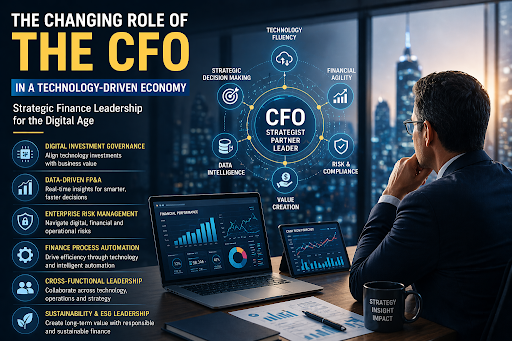
There was a time when the most consequential decision a finance leader made was whether the numbers added up. Accuracy, compliance, and cost control were the measures of excellence. The CFO sat at the end of the value chain, validating what the business had already decided, ensuring the ledgers balanced, and presenting results to the board.
That version of the role no longer exists at the leadership level. The finance function in a modern enterprise is not the last stop in the decision process; it is the nerve centre. Technology has restructured how organisations generate, interpret, and act on financial information, and with it, the expectations placed on the executive leading that function have been comprehensively rewritten.
Today's finance leader is expected to be an architect of strategic direction, someone who reads market signals through data analytics, who governs enterprise-wide digital investments with financial rigour, who speaks fluently across the organisation in the language of technology risk, and who brings a systemic perspective to decisions that were once the exclusive domain of operations or technology leadership.
Insight
"The CFO who only understands finance is not equipped for a world where finance and technology are inseparable. The role demands a new kind of leader, one who can see both the numbers and the systems generating them."
This transformation is not a future state. It is happening now, across industries and geographies, and the finance professionals who will lead through it are those who have made a deliberate investment in understanding the technology-driven landscape they are operating in. For those professionals, the question is not whether to develop that capability; it is where to do it and how to do it without stepping away from a career already in motion.
Table of Contents
- From Scorekeeper to Strategist: The Evolution of Finance Leadership
- The Six Dimensions of the Modern Finance Leadership Mandate
- The Credential That Closes the Capability Gap
- What a World-Class Finance Leadership Curriculum Looks Like Today
- The Finance Leader India's Next Decade Will Demand
- The Finance Leadership Role Has Changed. Your Education Should Too.
- Frequently Asked Questions
From Scorekeeper to Strategist: The Evolution of Finance Leadership
The transition of the senior finance role from custodian to strategist did not happen in a single moment. It was driven by a series of intersecting technological and economic forces that, over roughly two decades, progressively expanded what the function was required to do.
The first wave was ERP adoption. When enterprise resource planning systems consolidated financial data across business units into a single system of record, the mechanics of reporting changed fundamentally. Month-end close timelines compressed. Reconciliation became automated. The manual labour that had historically consumed the finance team's capacity was progressively replaced by system logic, and the professionals who previously performed that work found their capacity liberated for higher-order analysis.
The second wave was the emergence of real-time analytics and business intelligence platforms. Suddenly, the finance function was not simply reporting on what had happened; it was providing the analytical infrastructure through which the rest of the organisation understood its performance. Dashboards, scenario models, variance analyses, and rolling forecasts replaced static quarterly reports as the primary output of the finance function. The business expected finance to be always-on and always-analytical.
The third wave, the one we are living through now, is the integration of artificial intelligence, cloud infrastructure, advanced automation, and real-time financial risk management into the operational fabric of every enterprise. This wave does not simply change what finance does. It changes what finance must understand in order to govern the organisation effectively. A finance leader who cannot evaluate the financial and strategic implications of a cloud migration, an AI investment, or a digital platform acquisition is operating with a blind spot that has become organisationally dangerous.
Insight
"The finance leader who navigated the ERP era with spreadsheet expertise and the analytics era with BI tools now needs a command of digital economics, technology risk, and data governance that the traditional finance curriculum was never designed to provide."
This is the context in which structured, senior-level finance education has become not a professional amenity but a strategic necessity. Understanding what that education should contain and what it should enable begins with understanding the specific demands that technology-driven economies are placing on the finance function today.
The Six Dimensions of the Modern Finance Leadership Mandate
1. Digital Investment Governance
Technology spending now constitutes one of the largest and most strategically consequential budget lines in most enterprise organisations. Cloud infrastructure contracts, SaaS platform commitments, AI development programmes, and digital transformation initiatives carry multi-year financial implications that require rigorous evaluation frameworks, not just approval processes. The modern finance leader is expected to chair or meaningfully contribute to technology investment decisions, applying financial modelling, scenario analysis, and value realisation frameworks to decisions that were once delegated entirely to the CTO or CIO.
2. Data-Driven Financial Planning and Analysis
Advanced Financial Planning and Analysis has moved from a specialised capability to a core expectation of the finance function. Real-time P&L visibility, driver-based forecasting models, machine learning-assisted scenario planning, and automated variance analysis are now standard in organisations with mature finance functions. Finance leaders who cannot design, govern, or credibly interrogate these systems are at a structural disadvantage in organisations where the board and CEO expect analytical sophistication as a baseline.
3. Technology Risk and Cybersecurity Financial Governance
As enterprise operations become increasingly dependent on digital infrastructure, the financial consequences of technology failure, cyberattack, or data breach have grown from significant to potentially existential. Finance leaders are now expected to understand, quantify, and govern technology risk at the enterprise level, including cyber risk quantification, business continuity financial modelling, insurance programme design, and the integration of technology risk into the enterprise risk management framework. This is territory that sits squarely at the intersection of finance leadership and technical understanding.
4. ESG Reporting and Sustainable Finance
Environmental, Social, and Governance (ESG) reporting has moved from voluntary disclosure to regulatory mandate across major global markets, and India is following the same trajectory. Finance leaders are now responsible for the integrity and credibility of non-financial reporting alongside traditional financial statements. This requires understanding the data infrastructure that underpins ESG measurement, the accounting frameworks that govern sustainability reporting, and the financial product knowledge required to manage sustainable finance instruments, including green bonds and ESG-linked credit facilities.
5. Regulatory Technology and Compliance Automation
The regulatory environment for finance functions has become significantly more complex over the last decade, driven by global regulatory harmonisation, the expansion of tax reporting obligations, evolving accounting standards, and the emergence of regulations specific to digital financial services. RegTech platforms that automate compliance monitoring, regulatory reporting, and audit preparation are now standard infrastructure in organisations of significant scale. Finance leaders who understand how these platforms work, what their limitations are, and how to govern them effectively are better positioned to manage regulatory risk at the enterprise level.
6. Treasury Innovation and Digital Asset Strategy
Treasury management has been transformed by the same digital forces reshaping the rest of the finance function. Real-time cash visibility, automated liquidity management, algorithmic FX risk management, and the emerging questions around digital asset treasury strategy are now live considerations for finance leaders in globally operating organisations. Understanding the technology architecture that makes modern treasury management possible and the strategic risks and opportunities that emerge from it is a competency requirement that did not exist in the finance function a decade ago.
The Credential That Closes the Capability Gap
Finance professionals who understand the depth of transformation described above face a clear professional question: how do they develop the technology-integrated leadership capabilities that the evolved role demands, within the constraints of a career that is already operating at full intensity?
The answer, for senior finance professionals, is not a short-form course or a series of workshops. The depth of capability required for financial technology strategy, digital risk governance, advanced analytics leadership, ESG reporting architecture, and regulatory technology management requires a structured, rigorous, senior-level education framework. One that respects the experience participants bring while substantially deepening their strategic and technical horizon.
Insight
"Senior finance professionals do not need more technical training delivered at a junior level. They need education that meets them at the executive level that engages with the strategic complexity of the role they are already leading or preparing to lead."
This is the gap that a structured CFO Certification Programme delivered through a premier institution is designed to close. Not by replacing the financial expertise that participants already carry, but by systematically integrating the technology leadership, strategic governance, and digital economics knowledge that the modern finance leadership role demands within a framework that working professionals can complete without interrupting the careers they are building.
The professionals who invest in this level of education are not simply improving their qualifications. They are repositioning themselves for a tier of finance leadership that is categorically different from what traditional finance credentials prepare for. Boards and CEOs are not looking for finance leaders who can manage the function; they are looking for finance leaders who can transform it.
What a World-Class Finance Leadership Curriculum Looks Like Today
The design of a serious senior finance education programme in the current environment requires a curriculum that is simultaneously anchored in financial rigour and genuinely current on the technology and regulatory landscape that finance leaders are navigating. This is a more demanding curriculum design challenge than it might appear.
Financial accounting, corporate finance, treasury management, and financial reporting remain foundational, but they must be taught in the context of the digital infrastructure through which they are now practised. Technology investment appraisal, digital transformation, financial governance, AI risk and opportunity assessment, and advanced FP&A must sit alongside them as core modules rather than optional electives. ESG finance, regulatory technology, and digital asset strategy must be treated with the same rigour as capital structure or valuation.
Programmes that achieve this standard are developed in consultation with the organisations that employ senior finance leaders, ensuring that what participants learn is directly applicable to the environments they return to. A well-designed CFO course at the executive level draws on faculty who combine deep academic expertise with active engagement in the finance leadership community, bringing to the learning environment not just theory, but the practitioner judgment that distinguishes education that transforms professional capability from education that merely certifies existing knowledge.
For working finance professionals, the peer environment is as valuable as the curriculum. Senior-level programmes that convene cohorts of experienced finance leaders create a learning context in which case discussions, shared experiences, and professional networks compound the formal curriculum, generating insights and relationships that persist well beyond the programme itself.
The Finance Leader India's Next Decade Will Demand
India's economic trajectory over the next decade will be defined by a set of forces that place the finance function at the centre of strategic value creation. The continued digitalisation of Indian enterprise. The expansion of financial services infrastructure into underserved markets. The maturation of India's startup and deep-tech ecosystem. The integration of Indian organisations into global capital markets and regulatory frameworks. The accelerating adoption of AI across every sector of the economy.
Each of these forces creates demand for finance leadership that is simultaneously technically sophisticated, strategically credible, and institutionally authoritative. The CFO who can govern a digital transformation programme, who can design the financial architecture for an AI-powered business model, who can present a credible ESG narrative to international investors, and who can manage the regulatory complexity of operating across multiple jurisdictions, is the finance leader that India's most consequential organisations will compete for.
The professionals who will fill those roles are not waiting for the perfect moment to invest in their development. They are investing now through structured, senior-level programmes that deliver the depth and breadth of capability that the evolved role demands. A Chief Financial Officer Programme from a premier institution is not a credential to display; it is a capability investment that changes how finance leaders see their function, how they engage with the organisation, and how the organisation sees them.
Insight
"India does not need finance leaders who can manage the present. It needs finance leaders who can architect the future, and the difference between the two begins with the investment in education that the role now demands."
The Chief Finance Officer of tomorrow is being developed today in programmes that refuse to separate financial expertise from technological fluency, that treat strategic leadership as a teachable discipline, and that prepare participants not just for the next role, but for the full scope of impact that the finance function is now positioned to deliver.
The Finance Leadership Role Has Changed. Your Education Should Too.
Senior finance professionals who are ready to lead through the technology-driven transformation of their function have a clear pathway forward. The programmes are structured, the curriculum is rigorous, and the institutional credibility is established.
Apply Now: CFO Certification Programme Applications Currently Open
Premier institutions are building the finance leaders that India's technology-driven economy will depend on. The decision to be one of them begins here.