
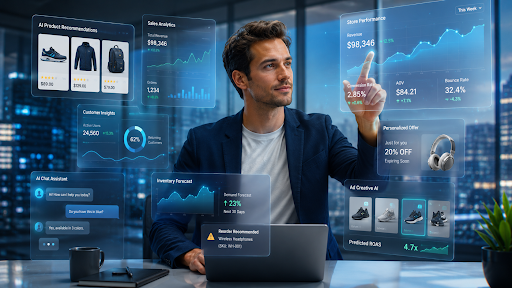
A few years ago, the dominant questions in e-commerce circles revolved around which marketplace to prioritise or how to structure a performance marketing budget. Today, the conversation has shifted almost entirely toward one theme: how does a professional stay relevant as AI rewrites the rules of online retail?
E-commerce has moved through several waves of change over the past decade, from the rise of marketplaces to the dominance of performance marketing and customer experience strategy. None of those shifts compares to the scale of disruption that generative AI is now bringing to the table.
This is not a theoretical overview. It is a practical look at what is changing on the ground, how generative AI actually works in an e-commerce context, and what working professionals need to do differently to build, or rebuild, a meaningful career in this space.
Table of Contents
- Why E-commerce Careers Are Being Redefined
- How Generative AI Actually Works in E-commerce
- What Separates Teams That Adapted Well
- Practical Steps for Working Professionals
- Where Structured Learning Fits In
- Lessons From the Transition
- Closing Thoughts
Why E-commerce Careers Are Being Redefined
For much of the last decade, e-commerce roles were built around managing channels: optimising a marketplace listing, running an ad campaign, troubleshooting a checkout flow. These tasks required judgement, but they were largely manual and repeatable. Generative AI has changed that equation. Product descriptions, ad creatives, customer support responses, and even demand forecasting can now be generated, tested, and refined by AI systems in a fraction of the time it once took a team to do the same work.
What this means in practice is that professionals who simply execute these tasks are seeing their roles compressed, while those who can direct, evaluate, and improve AI-driven outcomes are becoming significantly more valuable. This pattern plays out consistently across real teams: a marketer who only writes ad copy is replaceable; a marketer who knows how to brief an AI system, evaluate its output against brand and conversion goals, and iterate quickly is not.
How Generative AI Actually Works in E-commerce
It helps to demystify what is happening under the hood because professionals who understand the mechanics make far better decisions than those who treat AI as a black box. Generative AI models are trained on enormous datasets of text, images, and patterns of behaviour. Rather than retrieving pre-written answers, they predict the most statistically appropriate output based on the input, or “prompt,” they are given. In an e-commerce setting, this translates into a few core capabilities that working professionals are increasingly expected to understand and apply.
- Content generation: product descriptions, category pages, email copy, and ad variants created at scale, then refined by a human for tone and accuracy.
- Personalisation: AI models analysing browsing and purchase behaviour to recommend products, adjust pricing, or tailor on-site messaging to individual shoppers in real time.
- Conversational commerce: chatbots and virtual assistants that handle queries, returns, and product discovery, freeing human teams for complex escalations.
- Demand and inventory forecasting: predictive models that flag stock-outs or overstock risks before they happen, using patterns far too complex for manual spreadsheets.
- Visual and creative generation: AI-generated product imagery, lifestyle shots, and ad creatives that reduce dependency on large-scale photoshoots.
None of this removes the need for human strategy. AI is exceptionally good at generating options and identifying patterns; it is not yet reliable at understanding brand nuance, market context, or long-term customer trust. That gap is exactly where working professionals need to position themselves.
What Separates Teams That Adapted Well
Professionals and teams who have transitioned smoothly into this AI-first environment share a common pattern. They did not wait for their roles to be threatened before they acted. They treated AI fluency as a core professional skill, the same way digital marketing or analytics became non-negotiable skills a decade ago. The comparison below outlines what tends to separate professionals who are thriving from those who are struggling to keep pace.
| Area | Professionals falling behind | Professionals adapting well |
|---|---|---|
| Tool usage | Avoid AI tools or use them only when mandated | Experiment proactively, even informally |
| Content creation | Manually write every asset from scratch | Draft with AI, then refine for brand and accuracy |
| Decision-making | Treat AI output as final | Treat AI output as a starting point requiring judgement |
| Skill focus | Focus only on tool mechanics | Build category expertise alongside tool fluency |
| Data habits | Ignore data quality issues | Audit inputs before trusting AI-driven outputs |
| Learning approach | Rely on scattered tutorials | Pursue structured, outcome-linked learning |
The difference is rarely about technical skill alone. It is about mindset. Professionals who see AI as a collaborator rather than a threat tend to ask better questions, experiment faster, and recover from failed experiments without losing momentum.
Practical Steps for Working Professionals
For professionals currently working in e-commerce, whether in marketing, operations, product, or customer experience, the following sequence has consistently worked for those navigating this transition.
- Start using AI tools in the current role immediately, even informally. Drafting a product description, summarising customer feedback, or building a basic forecast with an AI tool, then comparing it against the usual process, reveals where the gains are real.
- Build a habit of prompt iteration. The first output from an AI system is rarely the best one. Professionals who get strong results are the ones who refine instructions methodically rather than accepting the first draft.
- Develop a working understanding of data quality. AI output is only as good as the data feeding it. Professionals who can spot flawed data inputs catch problems before they reach the customer.
- Strengthen the judgement layer. Deliberate time spent on brand strategy, customer psychology, and category expertise builds the layer AI cannot replicate, and the layer that will define professional value going forward.
- Invest in structured learning rather than relying only on trial and error. A well-designed e-commerce certification course online can compress years of scattered learning into a focused, practical curriculum.
Where Structured Learning Fits In
Self-directed learning has its place, but a consistent gap shows up among professionals who rely solely on tutorials and trial-and-error experimentation: they tend to pick up tools quickly but struggle to connect those tools to business outcomes such as margin, retention, or lifetime value. A more structured path, such as an Executive Program in AI for E-Commerce, tends to close that gap because it forces professionals to apply AI concepts to real business problems under guidance, rather than learning features in isolation.
What stands out most in this kind of structured exposure is the peer learning. Working alongside other professionals who are solving similar problems in different categories, from fashion to FMCG to electronics, often surfaces practical insights that no course material alone can offer.
Lessons From the Transition
Industry Insight
“The biggest career risk in this transition is not using the wrong AI tool. It is waiting too long to start using any AI tool at all.”
Capable professionals have lost ground simply by assuming mastery would come naturally once their organisation rolled out an AI tool officially. In reality, the professionals who got ahead were the ones experimenting on their own time, often with free or low-cost tools, well before their company mandated anything. Curiosity, in this transition, has mattered more than access.
The opposite extreme carries its own risk: outsourcing judgement entirely to AI. Professionals who publish AI-generated content without reviewing it for brand fit or factual accuracy tend to create more cleanup work than the time they saved. The goal is augmentation, not abdication.
Closing Thoughts
E-commerce has always rewarded professionals who adapt quickly, and generative AI is simply the latest, and perhaps the most significant, test of that adaptability. The entrepreneurs and professionals who will lead this industry over the next decade are not necessarily the ones with the most technical knowledge of AI, but the ones who pair AI capability with sound business judgement.
One piece of advice stands above the rest for working professionals: do not wait for certainty before adapting. Beginning to experiment now, building judgement alongside AI fluency, and considering a recognised Certificate in E-commerce or equivalent structured programme can make that learning deliberate rather than incidental. The professionals who treat this moment as a career inflexion point, rather than a passing trend, are the ones who will define what AI-first e-commerce looks like in the years ahead.