
Students finishing Class 12 today are choosing among career categories that simply did not exist in a recognisable form when their parents were making the same decision. Counselling conversations that once revolved around engineering, medicine or commerce now routinely include specialisations that sit at the intersection of computing, data and applied intelligence and the breadth of choice, while exciting, has made the decision noticeably harder to navigate without a clear map.
Table of Contents
- Twelve Career Paths That Did Not Exist for Their Parents
- Career Options Worth Serious Consideration
- What This Actually Opens
- Timing the Decision
- Frequently Asked Questions
Twelve Career Paths That Did Not Exist for Their Parents
The shift is structural, not a passing trend. Industries from healthcare to agriculture to logistics are hiring for roles that require working knowledge of applied intelligence systems, which means the career surface area touched by this field has expanded well beyond software companies alone. A student choosing a path today is effectively choosing how close to the technical core of that shift they want to sit, not whether to be near it at all.
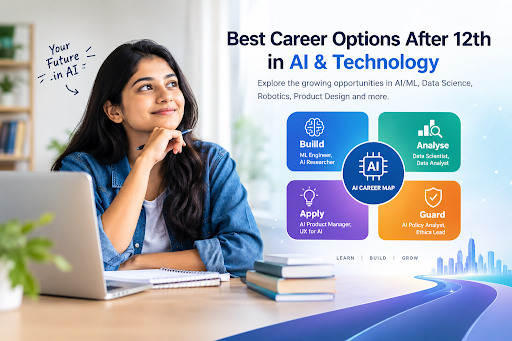
Before narrowing to a specific degree, it helps to see the field's full shape. The AI Career Map, introduced here, groups the available paths into four broad categories, each drawing on a different core strength.
Build
Designing and training the underlying models and systems.
e.g. ML engineer, AI researcher
Analyse
Working with data to find patterns and inform decisions.
e.g. data scientist, data analyst
Apply
Turning AI capability into products people actually use.
e.g. AI product manager, UX for AI
Guard
Ensuring AI systems are safe, fair and compliant.
e.g. AI policy analyst, ethics lead
Career Options Worth Serious Consideration
Within that map, several specific undergraduate routes consistently come up in counselling conversations for students with a genuine interest in this field. None is objectively superior; the right fit depends on which quadrant of the map above feels most natural.
Dedicated AI/ML Degree
A focused undergraduate route built specifically around machine learning, data systems and applied AI from the first semester.
Computer Science, Broad
Wider software foundation with AI as a strong elective track rather than the sole focus.
Data Science
Leans heavier into statistics and analytics, useful for the Analyse quadrant specifically.
Robotics & Mechatronics
Combines AI with hardware and control systems, a strong fit for the Build quadrant with a physical-systems bent.
Design for AI Products
Suits students drawn to the Apply quadrant who want to shape how people actually interact with intelligent systems.
Policy, Ethics & Law
A non-technical entry point into the Guard quadrant for students more drawn to governance than engineering.
Among these options, the focused undergraduate route has grown fastest in application volume over the past few admission cycles, largely because it removes a step students previously had to take on their own: assembling AI depth through electives bolted onto a general computer-science degree. Recruiters building an early-career machine learning career pipeline increasingly favour candidates who built that depth from the first year rather than picking it up late through optional coursework.
What This Actually Opens
Committing to this route early does not lock a student into a single narrow outcome. The breadth of AI career opportunities available to graduates spans research-adjacent roles, product-facing roles and applied engineering roles across almost every industry that touches data, which is, in practice, nearly every industry now hiring at scale.
Understanding the underlying B.Sc AI ML eligibility requirements up front saves families from researching a path that turns out to be closed off on a technicality discovered too late in the admissions cycle.
Completion of Class 12 or its recognised equivalent, including a State Board, CBSE, ICSE or NIOS certification, or an international qualification such as IB or A-Levels evaluated as equivalent by the relevant academic body.
The qualifying examination must be the final 10+2 assessment conducted by a Central or State Board recognised by the Association of Indian Universities (AIU).
Entry into this specific route works through two distinct channels, and students often assume incorrectly that only one applies to them. The full B.Sc AI ML admission process allows candidates with a valid national entrance score to apply directly on that basis, while candidates without one are simply required to sit a dedicated online entrance test instead; neither route is treated as inferior to the other in the review process.
Timing the Decision
Families researching this path are increasingly starting the conversation earlier in Class 12 itself rather than waiting for board results, largely because application windows for competitive specialised programmes tend to close faster than for general degree options. Interest in AI career 2026 planning specifically has been visible earlier in the academic year than in previous cycles, which is worth factoring into how early a student and family should start shortlisting programmes.
Questions Worth Discussing at Home
- Which quadrant of the AI Career Map genuinely excites the student: Build, Analyse, Apply or Guard rather than which sounds most impressive to relatives?
- Is the interest based on real exposure (a project, a course, a competition) or mainly on how often the topic appears in the news?
- Does the family's preferred entrance route (national score vs dedicated test) match what this specific programme actually requires?
- Is there a fallback general degree in mind if the specialised route does not work out in a given cycle?
- Has the student spoken to anyone actually working in one of the four quadrants, rather than relying on marketing material alone?