
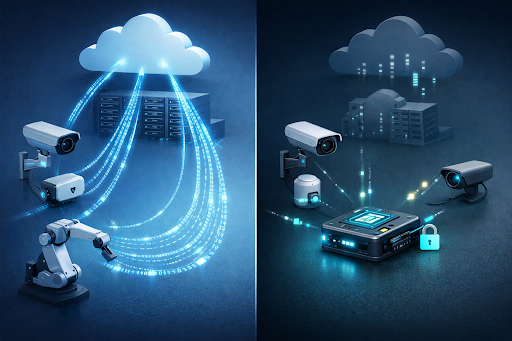
Not all IoT systems are created equal — and in 2026, that difference has never mattered more.
For over a decade, traditional IoT gave us connected devices: sensors that collected data, networks that transmitted it, and cloud servers that made sense of it all — eventually. That model worked when 'eventually' was acceptable. Today, in a world of autonomous vehicles, real-time industrial safety systems, and intelligent healthcare monitors, 'eventually' can be a liability.
Enter AIoT — Artificial Intelligence of Things. It's not just IoT with a new coat of paint. It's a fundamental reimagining of where intelligence lives in a connected system. And if you're building, managing, or upskilling for tomorrow's tech landscape, understanding this shift is non-negotiable.
Table of Contents
- What Is Traditional IoT — and Where Does It Fall Short?
- What Is AIoT — and What Makes It Different?
- AIoT vs Traditional IoT: A Side-by-Side Comparison
- Where AIoT Is Already Changing Industries
- The Engineering Skills Gap — and How to Bridge It
- Common Mistakes Engineers Make When Moving to AIoT
- Key Takeaways: Why This Shift Matters Now
- Conclusion: Building the Future of Connected Intelligence
- FAQs
What Is Traditional IoT — and Where Does It Fall Short?
Traditional IoT is built on a straightforward pipeline: devices collect data, send it to the cloud or a central server, and wait for instructions or analysis to come back. Think of smart thermostats sending temperature readings every minute, or industrial sensors streaming vibration data to a remote dashboard.
This architecture works — until it doesn't. The core limitations of traditional IoT become painfully visible at scale:
- Latency: A cloud round-trip can take hundreds of milliseconds to several seconds. For systems requiring instant response — like a robot arm that must stop the moment a human enters its path — this is unacceptable.
- Bandwidth costs: Continuously streaming raw sensor data from thousands of devices is expensive and often impractical, especially in remote or low-connectivity environments.
- Single point of failure: If the cloud connection drops, the device often loses its ability to make decisions entirely.
- Privacy exposure: Sending raw data — including audio, video, or biometrics — to centralized servers creates significant security and compliance risks.
These aren't edge cases. They're the everyday reality of deploying IoT at industrial scale.
What Is AIoT — and What Makes It Different?
AIoT embeds machine learning models and AI-driven decision logic directly into the device or nearby edge hardware — rather than routing everything through the cloud. The intelligence moves closer to where data is generated.
In practical terms, this means a quality-control camera on a manufacturing line doesn't stream video to a server for analysis. It runs a trained computer vision model on-device, flags defects in real time, and only sends a compact alert — not gigabytes of footage.
The key enabler? TinyML — the discipline of running optimized machine learning models on microcontrollers and embedded processors with limited compute and power resources. Combined with advances in edge processors (NVIDIA Jetson, Raspberry Pi, STM32, ESP32), AIoT has moved from research lab to factory floor.
AIoT vs Traditional IoT: A Side-by-Side Comparison
| Feature | Traditional IoT | AI-Enabled IoT (AIoT) |
|---|---|---|
| Data Processing | Cloud/server-side | Edge + cloud hybrid |
| Latency | High (100ms–5s) | Ultra-low (<10ms) |
| Bandwidth Use | High (raw data upload) | Low (only insights sent) |
| Decision Making | Rule-based | Adaptive & predictive |
| Offline Capability | Limited | Full local inference |
| Security Surface | Centralized risk | Distributed, reduced exposure |
| Power Consumption | High | Optimized with TinyML |
| Cost at Scale | Increases with data volume | Decreases with edge offload |
The table above isn't just theoretical. These differences directly determine product reliability, operational costs, and competitive advantage — especially in industries where real-time decisions are the product itself.
Where AIoT Is Already Changing Industries
1. Manufacturing & Predictive Maintenance
Traditional IoT tells you a machine's temperature has exceeded threshold — after it
already has. AIoT-powered embedded systems use vibration patterns, acoustic signatures,
and thermal data to predict failure hours or days in advance, before production halts.
" A mid-sized automotive plant using AIoT-driven predictive maintenance reported a 35% reduction in unplanned downtime — translating directly to millions in recovered production value."
2. Healthcare Wearables
Wearables running on-device AI can detect atrial fibrillation, monitor blood oxygen
trends, or flag anomalous sleep patterns — all without sending raw biometric data to
the
cloud. This matters for both privacy compliance (HIPAA, GDPR) and clinical reliability.
3. Smart Agriculture
In remote farmlands with poor connectivity, waiting for a cloud response to decide when
to irrigate or adjust nutrient levels is impractical. Edge AI models on low-power
embedded nodes process soil sensor data locally and act autonomously — even offline.
4. Autonomous Systems & Robotics
Whether it's a warehouse robot navigating around a human or a drone adjusting its flight
path mid-air, real-time embedded AI is what makes autonomous decision-making possible.
Cloud latency simply cannot serve these use cases.
The Engineering Skills Gap — and How to Bridge It
AIoT sounds compelling. But actually building these systems requires a skill set that sits at the intersection of multiple disciplines: embedded systems design, machine learning model optimization, IoT protocols, real-time operating systems (RTOS), and hardware-software co-design.
Most working engineers were trained in either embedded systems or software — rarely both, and almost never with AI added to the mix. This gap is widening as demand for AIoT engineers accelerates across sectors.
This is precisely why structured programs like a PG Certificate in AI Enabled IoT and Embedded Systems are gaining traction. They're not hobbyist courses. They're purpose-built to take someone with an engineering foundation and build the cross-domain depth that AIoT roles actually demand — covering everything from TinyML model deployment to RTOS programming and IoT security architecture.
If you're evaluating an IoT certification course or embedded systems course, look for programs that move beyond theory — hands-on labs with real hardware, model training and deployment pipelines, and capstone projects that mirror industry use cases.
Common Mistakes Engineers Make When Moving to AIoT
- Treating AIoT as 'IoT + a model': The model is only one piece. Optimizing for edge deployment — quantization, pruning, RTOS integration — is where most complexity lives.
- Ignoring power budgets: A model that runs beautifully on a dev board may drain a battery-powered sensor in hours. Power-aware design is non-negotiable.
- Skipping security design: Edge devices are a new attack surface. Secure boot, encrypted storage, and firmware update integrity must be part of the architecture from day one.
- Over-engineering the cloud connection: Some teams add AIoT edge processing but still send all data to the cloud 'just in case.' This eliminates most of the benefit. Design what you actually need to transmit.
Key Takeaways: Why This Shift Matters Now
- AIoT is not an upgrade to traditional IoT — it's a fundamentally different architecture that places intelligence at the source of data.
- The advantages — lower latency, better privacy, offline capability, reduced costs — are measurable and significant in real deployments.
- The skills required to build AIoT systems are specialized and increasingly rare, creating strong career opportunities for engineers who invest in this knowledge.
- The right IoT and embedded systems training bridges hardware, firmware, and AI — not just one of the three.
Conclusion: Building the Future of Connected Intelligence
" The question is no longer whether your industry will adopt AIoT. It's whether you'll be the one building it — or the one trying to catch up."