
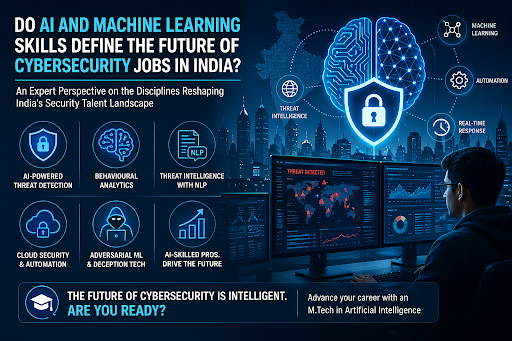
India's cybersecurity challenge has moved well beyond firewalls and antivirus protocols. The attacks targeting Indian enterprises, government systems, and critical infrastructure today are not brute-force intrusions; they are intelligent, adaptive, and in many cases, algorithmically orchestrated. Adversarial actors are deploying machine learning to probe vulnerabilities, automate phishing campaigns, evade detection systems, and pivot laterally across networks faster than human security teams can respond.
This shift fundamentally changes what it means to be a cybersecurity professional. The skills that defined the discipline a decade ago, network forensics, intrusion detection, and penetration testing, remain relevant, but they are no longer sufficient. The security professionals who will lead India's cyber defence in the next decade are those who understand not just how attacks happen, but how intelligent systems can be built to anticipate, detect, and neutralise them before they cause damage.
Insight
"The most dangerous adversary in cybersecurity today is not a human hacker. It is an algorithm, and the only effective response is a better one."
This is the context in which AI and machine learning skills have become the defining differentiator in cybersecurity careers. Not as a niche specialisation, but as a core competency, one that separates professionals who can operate at the pace and scale of modern threats from those who cannot.
Table of Contents
- From Signature-Based Defence to Intelligent Security Systems
- Where AI and ML Are Rewriting Cybersecurity Practice
- The Career Case: Why AI Expertise Redefines Security Professional Value
- Building the AI-Security Curriculum India's Industry Actually Needs
- India's AI-Security Decade: The Professionals Who Will Lead It
- The Future of Cybersecurity Is Intelligent. Are You?
- Frequently Asked Questions
From Signature-Based Defence to Intelligent Security Systems
Traditional cybersecurity architecture was built on a reactive model. Security systems maintained databases of known threat signature patterns associated with previously identified malware, attack vectors, and intrusion methods. When an incoming event matched a known signature, the system flagged or blocked it. The limitation of this model is as fundamental as it is widely understood: it cannot defend against what it has not already seen.
The volume, velocity, and variety of modern cyber threats have exposed the limits of this architecture decisively. Threat actors now routinely generate polymorphic malware code that mutates to evade signature-based detection. They deploy zero-day exploits that have no existing signature by definition. They use encrypted traffic, legitimate cloud services, and social engineering at machine speed to compromise systems in ways that rule-based security tools are architecturally incapable of detecting.
AI and machine learning change the defence model from reactive to anticipatory. Rather than matching events against a fixed database of known threats, ML-powered security systems learn the behavioural norms of a network, its users, its traffic patterns, its application interactions and flag deviations from those norms in real time. They detect anomalies that no human analyst would notice in a sea of millions of daily events. They correlate signals across multiple layers of the technology stack to identify attack chains that appear innocuous in isolation but devastating in combination.
Industry Insight
"Intelligent security is not about knowing every threat. It is about understanding normal behaviour so precisely that abnormal behaviour becomes immediately visible, regardless of its form."
For professionals who understand both the security domain and the AI/ML systems that are transforming it, this shift is a career-defining opportunity. The organisations building and deploying these intelligent security systems across BFSI, healthcare, defence, critical infrastructure, and enterprise technology need professionals who can design, train, evaluate, and govern the models at the heart of their security architecture. That is a capability that cannot be acquired through short-form training. It requires the kind of systematic, postgraduate-level education that develops both the theoretical foundations and the applied engineering judgment that professional-grade AI security work demands.
Where AI and ML Are Rewriting Cybersecurity Practice
Threat Detection and Behavioural Analytics
The most immediate application of machine learning in cybersecurity is in threat detection. Supervised learning models trained on labelled datasets of malicious and benign activity can classify network events, file behaviours, and user actions with a precision that manual analysis cannot match at scale. Unsupervised models identify clusters of anomalous behaviour that fall outside expected patterns, surfacing previously unknown threat categories without requiring labelled training data. For security operations centres managing thousands of events per second, these capabilities are not enhancements; they are operational necessities.
Natural Language Processing in Threat Intelligence
Cyber threat intelligence is increasingly text-heavy, including security advisories, dark web forums, malware analysis reports, and vulnerability disclosures, generating enormous volumes of unstructured information that human analysts cannot process manually. Natural language processing models extract structured intelligence from this data at scale, identifying newly disclosed vulnerabilities, mapping threat actor tactics, and correlating intelligence signals across disparate sources faster than any human team. For organisations that rely on current threat intelligence to inform their defensive posture, NLP is becoming a critical operational capability.
Adversarial Machine Learning and Model Security
As AI becomes embedded in security systems, it also becomes a target. Adversarial machine learning, the discipline of designing inputs that cause AI models to misclassify or malfunction, is an active area of both offensive security research and defensive engineering. Security professionals who understand how AI models can be attacked, evaded, or manipulated are increasingly valuable in organisations that have committed to AI-powered security infrastructure. This is a domain where deep AI expertise and deep security expertise converge and where the talent gap is most acute.
Automated Incident Response and Security Orchestration
AI-driven Security Orchestration, Automation, and Response (SOAR) platforms are transforming how security operations teams manage incident response. Machine learning models triage alerts, prioritise incidents by severity and business impact, execute predefined response playbooks automatically, and escalate to human analysts only when genuine judgment is required. For organisations managing large, distributed technology estates, the ability to automate routine security operations is not a cost-saving measure it is the only way to maintain adequate coverage at scale.
The Career Case: Why AI Expertise Redefines Security Professional Value
The career implications of the AI-security convergence are already visible in India's technology labour market. Organisations across the BFSI sector, healthcare, defence contracting, cloud service providers, and enterprise software companies are actively seeking professionals who can bridge the two disciplines, and they are paying significantly for that bridging capability.
The roles that have emerged at this intersection carry titles that reflect the depth of integration the industry now expects: AI Security Engineer, Machine Learning Security Architect, Threat Intelligence Data Scientist, Adversarial ML Research Engineer, and AI-Driven SOC Analyst. These are not entry-level roles. They require professionals who have both the cybersecurity domain knowledge to understand what needs to be protected and the AI/ML technical depth to build systems capable of protecting it.
Career Insight
"The security professional of the next decade will not simply know how to respond to threats. They will know how to build systems that learn from every threat they encounter and become more effective as a result."
For professionals seeking to position themselves for these roles, the path of investment is clear. A postgraduate qualification in AI and machine learning, specifically one designed for working professionals who already carry security domain expertise, provides the academic validation and technical depth that these roles require. The M.Tech in AI and ML for working professionals represents precisely this pathway: a formal, rigorous qualification that recognises the realities of professional life while delivering the depth of education that career-defining specialisation demands.
Building the AI-Security Curriculum India's Industry Actually Needs
The credibility of any postgraduate AI programme is inseparable from the relevance of its curriculum to the problems that practitioners actually face. In the AI-security domain, this means a curriculum that goes beyond machine learning fundamentals to engage with the real architectural challenges of deploying AI in adversarial environments: model robustness under distribution shift, the trade-offs between model interpretability and performance in regulated security contexts, the governance of AI-powered security decisions in high-stakes enterprise environments, and the security of the AI models themselves against adversarial manipulation.
Programmes that achieve this standard are designed in direct dialogue with the security industry, with curriculum modules informed by the practitioners, researchers, and technology leaders who are actively building the systems that students will eventually be asked to lead. The Online M.Tech in Artificial Intelligence delivered through premier institutions provides this standard of curriculum depth in a format accessible to professionals without requiring them to step away from their careers. The online delivery model does not represent a compromise in rigour; it represents an acknowledgement that the professionals most qualified to benefit from this education are already working at the frontier.
Faculty who hold both research credentials and industry engagement bring the perspective that working security professionals find most valuable, not just theoretical foundations, but the judgment to navigate the messy, constraint-laden reality of deploying AI in production security environments. For executive students who carry years of professional context into the classroom, that combination is the difference between education that transforms their professional capability and education that simply certifies knowledge they already hold.
India's AI-Security Decade: The Professionals Who Will Lead It
India's cybersecurity market is projected to grow substantially over the next five years, driven by the expansion of digital public infrastructure, the accelerating adoption of cloud services across enterprise and government, the deepening integration of IoT and operational technology in critical industries, and the increasing sophistication of threat actors targeting Indian systems. Every dimension of this growth increases demand for security professionals, and the premium placed on AI-capable security professionals will intensify as the industry scales.
The government's investment in national cybersecurity frameworks, the Reserve Bank of India's expanding technology risk governance mandates for the financial sector, and the data protection obligations introduced by India's emerging privacy legislation are creating compliance and risk management imperatives that require AI-capable security professionals at scale. These are not temporary requirements; they are structural features of the regulatory landscape that will define security talent demand for decades.
For professionals who are ready to lead this landscape rather than simply operate within it, the investment case for a postgraduate AI qualification is compelling and time-sensitive. The Executive M.Tech in Artificial Intelligence offered by premier Indian institutions provides the credentials, the technical depth, and the institutional recognition that position graduates for leadership-level roles in India's AI-security ecosystem, whether within enterprises, security technology companies, government digital initiatives, or the growing base of AI-focused cybersecurity startups.
Industry Signal
India does not need more cybersecurity professionals who can follow playbooks written by others. It needs professionals who can write the playbooks that the rest of the world will follow.
The window for building that leadership position is open, but it will not remain open indefinitely. As AI becomes standard practice in security operations, the distinction between professionals with and without postgraduate AI credentials will become the primary lens through which hiring decisions at senior levels are made. The professionals who make that investment now are not simply improving their qualifications. They are securing their position at the front of a field that India is increasingly positioned to lead globally.
The Future of Cybersecurity Is Intelligent. Are You?
India's AI-security talent gap is real, it is significant, and it represents an extraordinary opportunity for professionals who choose to close it through serious, postgraduate-level investment in AI and machine learning expertise.
Apply Now: Executive M.Tech in Artificial Intelligence Applications Open
Premier institutions are building the professionals that India's AI-security future depends on. The decision to be one of them begins with a single application.