
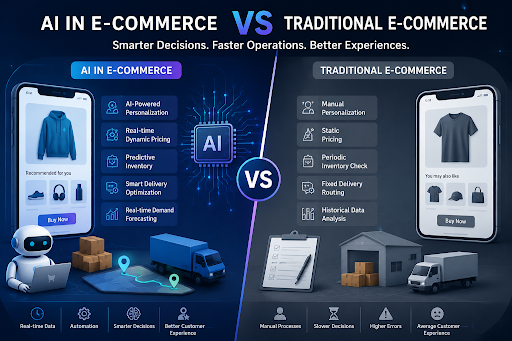
Why the Speed of Decisions, Not Just the Channel, Is the Real Divide
The difference between traditional e-commerce and its AI-enabled successor is not the presence of a website or app; both have that. The difference is decision speed: traditional e-commerce runs on periodic human decisions about pricing, stock, and routing, while AI-enabled e-commerce compresses those same decisions into a continuous, often automated cycle. Retailers who understand this as a speed problem, rather than a technology upgrade, tend to make better choices about where to invest and which roles need to change first.
Table of Contents
- Setting the Two Models Side by Side
- Why the Shift Shows Up First in the Fastest-Moving Segment
- An Original Model: The Retail Decision Velocity Model (RDVM)
- What This Means for Roles and Skills
- What the Evidence From the Field Shows
- A Decision Matrix for Retail Professionals
- Mistakes Retailers and Professionals Keep Making
- An Executive Checklist Before the Next Investment Cycle
- Preparing the Workforce for the Faster Cycle
- Frequently Asked Questions
Setting the Two Models Side by Side
Before examining why the shift is happening, it is worth being precise about what is actually different at a functional level. The table below compares the two models across the core operating functions of an online retail business.
| Function | Traditional E-Commerce | AI-Enabled E-Commerce |
|---|---|---|
| Demand forecasting | Historical sales averages, manual seasonal adjustment | Real-time demand sensing across location, weather, and event signals |
| Inventory placement | Fixed warehouse allocation is reviewed periodically | Dynamic micro-fulfilment placement is updated continuously |
| Pricing | Scheduled price changes, manual competitor checks | Continuous, algorithm-driven price and promotion adjustment |
| Delivery routing | Fixed routes and time slots | Dynamic routing optimised in real time against traffic and order density |
| Customer experience | Static recommendations, generic promotions | Personalised recommendations and offers are updated per session |
Why the Shift Shows Up First in the Fastest-Moving Segment
Nowhere is this compression of decision speed more visible than in ultra-fast delivery formats, where the entire value proposition depends on decisions that traditional e-commerce would make in days being made in minutes. Quick commerce operations hyperlocal inventory placement, delivery-slot promising, and real-time demand sensing within a few kilometres of a customer cannot function on periodic manual review at all; the format only exists because AI-driven decisioning replaced the traditional cycle outright, rather than merely accelerating it.
An Original Model: The Retail Decision Velocity Model (RDVM)
A more precise way to describe the shift than "traditional versus AI-enabled" is to place a retail operation along a four-stage decision-velocity scale. Most traditional e-commerce businesses sit in the first two stages; the businesses reshaping the category, quick commerce prominent among them, are operating in the third and fourth.
| Cycle | Decision Speed | Typical Retail Behaviour |
|---|---|---|
| Manual Cycle | Days to weeks | Periodic manual review of pricing, stock, and promotions |
| Assisted Cycle | Hours to a day | Dashboards and reports inform decisions still made by people |
| Predictive Cycle | Minutes | Models forecast demand and flag actions for human approval |
| Real-Time Autonomous Cycle | Seconds | Systems adjust pricing, stock allocation, and routing without waiting for approval |
Where a specific retailer or professional sits on this scale is a more useful diagnostic than asking whether the business "uses AI," since almost every major retailer now uses AI somewhere. The relevant question is which cycle governs its core pricing, stock, and delivery decisions.
What This Means for Roles and Skills
As decision cycles compress, the professionals who add the most value are no longer the ones executing decisions manually but the ones configuring, monitoring, and correcting the systems that now make them. AI in Quick Commerce has already reshaped roles such as category management and delivery operations into functions that spend more time auditing model outputs and setting override rules than making case-by-case calls, and this pattern is extending steadily into mainstream e-commerce as well.
What the Evidence From the Field Shows
Retailers that have moved core functions into the predictive or autonomous cycle consistently report similar gains: tighter inventory accuracy, faster fulfilment, and higher conversion from real-time personalisation.The Benefits of AI in Quick Commerce Operations are particularly well documented because the format's thin margins and short delivery windows leave little room for inefficiency, making the operational gains from AI-driven decisioning immediately visible in fulfilment cost and delivery-promise accuracy in a way that is harder to isolate in slower-moving retail formats.
A Decision Matrix for Retail Professionals
| Professional Role | Current Exposure | Recommended Action |
|---|---|---|
| Marketplace/category manager | Assisted Cycle | Build fluency in reading and acting on algorithmic pricing and demand signals |
| Operations/fulfilment lead | Assisted to Predictive Cycle | Develop capability to configure and audit dynamic routing and micro-fulfilment systems |
| Performance marketer | Predictive Cycle | Shift from campaign scheduling to real-time personalisation model oversight |
| Senior retail/e-commerce executive | Moving toward Autonomous Cycle | Set governance and escalation thresholds for autonomous pricing and inventory decisions |
Mistakes Retailers and Professionals Keep Making
- Equating "having an AI feature" with operating in the predictive or autonomous decision cycle, when most such features still sit inside an assisted, human-reviewed workflow.
- Automating pricing or routing decisions without setting clear governance thresholds for when a human should intervene.
- Training category and operations teams on generic AI concepts rather than on how to audit and override the specific models running their function.
- Benchmarking performance against traditional e-commerce competitors rather than against quick commerce operators already running at a faster decision cycle.
- Underestimating how much organisational redesign, not just technology procurement, is required to move from an assisted to an autonomous cycle.
An Executive Checklist Before the Next Investment Cycle
- Has each core function pricing, inventory, routing, personalisation been mapped to its current position on the decision-velocity scale?
- Are override and escalation rules defined for functions moving into the autonomous cycle?
- Do category, operations, and marketing teams have the skills to audit model output, not just consume dashboards?
- Is competitive benchmarking including faster-moving formats rather than only direct traditional competitors?
- Is there a named owner for the organisational redesign that accompanies each stage of the shift, separate from the technology rollout itself?
Preparing the Workforce for the Faster Cycle
Closing this skills gap is rarely achieved through informal exposure alone, given how quickly the decision cycle is compressing across the sector. Structured, applied training designed specifically for AI for quick commerce professionals gives category managers, operations leads, and marketers a faster route to auditing and configuring these systems confidently, rather than learning by trial and error while a live delivery-promise commitment is at stake.
Once a professional or organisation has located itself on the decision-velocity scale and identified the functions still running on manual or assisted cycles, the reasonable next step is structured learning aimed squarely at that gap, rather than broad, unfocused AI exposure.